MagazineMarine vs. bovine collagen: What manufacturers do not tell you about absorption
Marine vs. bovine collagen: What manufacturers do not tell you about absorption
There is one big confusion in the collagen market. Manufacturers promise miracles, but few will explain why one product works and another does not. Bovine or marine? 2,000 mg or 10,000 mg? The answer comes down to a single number that most labels deliberately hide: molecular weight.

What is hydrolysed collagen and why molecule size matters
The collagen in the bottle is not the same as what you have in your skin or tendons. It goes through hydrolysis, breaking down into shorter chain fragments called peptides. The size of these peptides (measured in Daltons, Da) determines how easily they cross the intestinal lining into the bloodstream.
Marine collagen, obtained from fish, most often from the skin of cod or tilapia, has a molecular weight after hydrolysis of typically 300 to 500 Da. Bovine collagen ranges from 500 to 5,000 Da, depending on the producer and the degree of hydrolysis.
For comparison: the human gut can effectively absorb peptides up to around 5,000 Da. Technically it can handle both types. But the smaller the particle, the faster and more complete the absorption, regardless of whether you have a strong or weakened gut microbiome.
Type of collagen: not every collagen is the same
Our body contains at least 28 types of collagen. For work on skin, hair and nails the most important is Type I, which makes up roughly 80 % of the collagen in the skin and plays a key role in its elasticity and hydration.
Marine collagen is 70 to 100 % Type I. Bovine collagen, especially that from bones and cartilage, contains a mix of Type I and Type III. Type III binds more to tissues and connective structures (liver, lungs, blood-vessel walls). For joints, that is welcome. For skin? Less relevant.
That is why studies focused above all on the skin, hydration, fine lines and elasticity, mostly use marine Type I and achieve consistent results.
What research says about absorption
A study published in the Journal of Agricultural and Food Chemistry (Ohara et al., 2007) compared hydrolysates from fish scale, fish skin and porcine skin: after the fish scale hydrolysate, the blood contained significantly more hydroxyproline-containing peptides, hydroxyproline being the key amino acid of collagen, than after the porcine one. Fibroblast studies showed that hydroxyproline acts as a signal for dermis cells: it stimulates them to produce their own collagen.
In other words: the collagen from a capsule or sachet does not exactly „settle“ at its original site in the body as a building block, but the peptides deliver, via the bloodstream, a signal that triggers the production of new collagen exactly where the skin needs it.
This mechanism works with both types, but marine collagen, thanks to its smaller molecule, delivers the signal faster and in greater volume.
Ethics, safety and sustainability: what is not on the label
Here begin the differences that bovine-collagen makers would rather not talk about.
BSE and prion risk
Bovine collagen carries a specific risk that does not exist with marine collagen: BSE (bovine spongiform encephalopathy), commonly known as mad cow disease. The prions that cause BSE concentrate in the central nervous system of cattle, but EU regulators and research institutions confirm that contamination of collagen products is not ruled out, especially with less-controlled producers outside the EU.
Industrial production of bovine collagen therefore involves heat treatment and chemical processes (acid or alkaline hydrolysis) that reduce prion infectivity. The problem is that the same intense heat treatment at temperatures above 60 to 65 °C also denatures the collagen structure, reducing peptide solubility and their biological availability. Producers do not mention this trade-off on the label.
Marine collagen does not have this problem from the outset: fish do not carry prions, no analogous regulatory measures apply to them, and production can take place by gentler processes without a safety compromise.
Deforestation and carbon footprint
Bovine collagen has one more dimension that does not fit into comparison tables: its environmental cost. Global demand for beef cattle, and so also for by-products such as collagen, directly drives deforestation, especially in South America. The Brazilian Amazon and Cerrado have lost tens of millions of hectares of forest in recent decades precisely because of the spread of cattle pasture. The cattle sector is among the largest global producers of methane and carbon dioxide.
Marine collagen, by contrast, typically comes from waste parts of the fishing industry, from fish skins and scales that would otherwise end up as biological waste. From this angle it is a meaningful use of a by-product, not a source of primary environmental pressure.
Origin matters, of course: fish from certified sustainable fisheries and intensive aquaculture are two different things. But even when comparing worst-case scenarios, marine collagen comes out significantly better in terms of carbon footprint than industrial bovine.
Who should choose what
- Skin, hair, nails: marine Type I collagen is the clear choice. Smaller molecule, cleaner type, no BSE issue.
- Joints and sports recovery: bovine or a combined product with Type II and III can make sense, provided it comes from a verified producer with transparent origin certification.
- Vegans: here neither marine nor bovine collagen works. Plant-based alternatives exist (amino acids like proline and glycine), but without clinically proven comparable efficacy.
- Fish allergy sufferers: bovine or chicken, with an emphasis on choosing a certified producer from a low-BSE region.
- Consumers focused on ecology: marine collagen from sustainable fisheries significantly reduces the environmental footprint compared with bovine.
Summary
Marine collagen does not win on marketing. It wins on physics, safety and ethics. A smaller molecule, cleaner Type I, faster absorption, plus no prion risk and none of the carbon footprint tied to industrial cattle farming. Results are not visible overnight, but after 6 to 8 weeks of a consistent course your skin will let you know on its own.
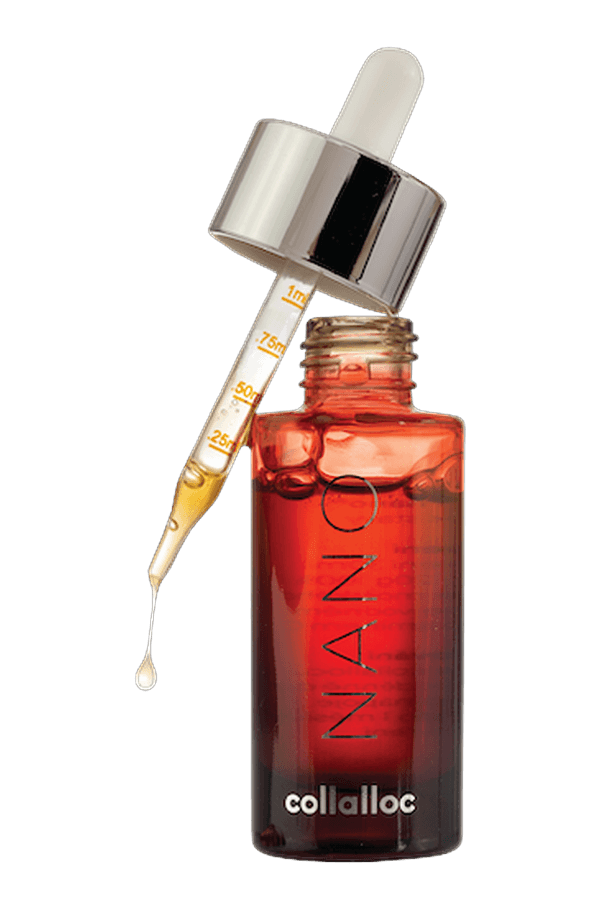
collalloc kolagen contains hydrolysed marine collagen with a molecular weight of 500 Da and 95 % absorption, with no needless fillers. See the composition: collalloc.com
Frequently asked questions
Jaký kolagen vybrat pro pleť, vlasy a nehty?
Mořský Typ I kolagen. Má menší molekulu (300 až 500 Da), čistější typové složení (70 až 100 % Typ I) a tedy rychlejší vstřebání než hovězí.
Jaký kolagen vybrat pro klouby a sportovní regeneraci?
Hovězí nebo kombinovaný produkt s Typem II a III, pokud pochází od prověřeného výrobce s transparentní certifikací původu.
Existuje veganská alternativa kolagenu?
Ani mořský, ani hovězí kolagen není veganský. Existují rostlinné alternativy postavené na aminokyselinách (prolin, glycin), ale bez klinicky prokázané srovnatelné účinnosti.
Je mořský kolagen bezpečnější než hovězí?
Z hlediska prionového rizika ano. Ryby BSE nepřenášejí. Hovězí kolagen prochází tepelnými a chemickými procesy, které riziko snižují, ale zároveň denaturují strukturu peptidů.
Sources
- Comparison of quantity and structures of hydroxyproline-containing peptides in human blood after oral ingestion of gelatin hydrolysates from different sources Ohara H, Matsumoto H et al., Journal of Agricultural and Food Chemistry, 2007