MagazineIs the collagen I drink absorbed? What happens to it in the body
Is the collagen I drink absorbed? What happens to it in the body
The large collagen molecule is not absorbed whole. That does not mean drinkable collagen ends up like any other protein, though. Here is what a human study, one that measured what actually reaches the blood after drinking it, shows about its absorption.

Short answer
Yes, hydrolyzed collagen is absorbed. A 2005 human study measured that after drinking a collagen hydrolysate, collagen-specific peptides appear in the blood, mainly Pro-Hyp, peaking at 1 to 2 hours. Hydrolysis breaks the large collagen molecule down into small peptides that survive digestion and pass through the intestinal wall into circulation. The big difference is that part of it is absorbed not only as building-block amino acids, but as whole short peptides that also act as a signal in the body.
Why this is even a question
The native collagen molecule is huge. It is a triple helix weighing around 300,000 Da. A molecule like that is not absorbed whole through the intestinal wall; it is orders of magnitude too large for that. So the logical objection goes: the body will break collagen down into amino acids just like any other protein, so what is the point of drinking collagen specifically?
The answer rests on exactly what is produced from collagen after digestion and how much of that reaches the blood. And here collagen differs from an ordinary protein, because it carries the unusual amino acid hydroxyproline and characteristic pairs that can survive digestion.
What happens after drinking it, step by step
Hydrolyzed collagen is collagen that the manufacturer has pre-cleaved with enzymes into short peptides, on the order of 1 to 5 kDa. In the digestive tract the peptides are broken down further into dipeptides, tripeptides and free amino acids.
Hydroxyproline is the key. The bond between proline and hydroxyproline is unusually resistant to digestive enzymes, so the proline-hydroxyproline pair (Pro-Hyp) often survives cleavage intact. The intestinal wall can then carry such a small peptide into the blood whole, not just broken down into individual amino acids.
Pro-Hyp: the peptide that survives
The study by Iwai and colleagues (Journal of Agricultural and Food Chemistry, 2005) measured the peptides in volunteers' blood after they drank a collagen hydrolysate. Pro-Hyp made up around 95 % of the peptide-bound hydroxyproline in the blood, and its concentration rose to 20 to 60 nmol/mL of plasma, peaking at 1 to 2 hours.
What is more, Pro-Hyp lasts in the blood. In a test with human serum, more than 75 % of Pro-Hyp remained uncleaved after 24 hours. That is exactly why it is measurable in circulation for hours, not minutes. Note: the hydrolysate sample in this study was porcine and chicken, but the absorption principle is shared across collagen sources.
Does it reach the tissue
Absorption into the blood is the first step. The second is whether the peptides reach the place where they are meant to do something. An experiment in mice with radioactively labeled collagen hydrolysate (Oesser et al., Journal of Nutrition, 1999) showed that after ingestion the label preferentially accumulated in cartilage, where radioactivity was more than double that of the control.
The resulting peptides are also not just fuel. Pro-Hyp acts as a chemotactic signal for fibroblasts, the cells that produce collagen. That is the difference between "supply amino acids" and "give the cells an instruction". So far this part is documented mainly in animals and cells, not in large human studies.
What this means in practice
- Hydrolyzed, not ordinary collagen. Peptides from the hydrolysate appear in the blood; the large unhydrolyzed molecule does not pass through.
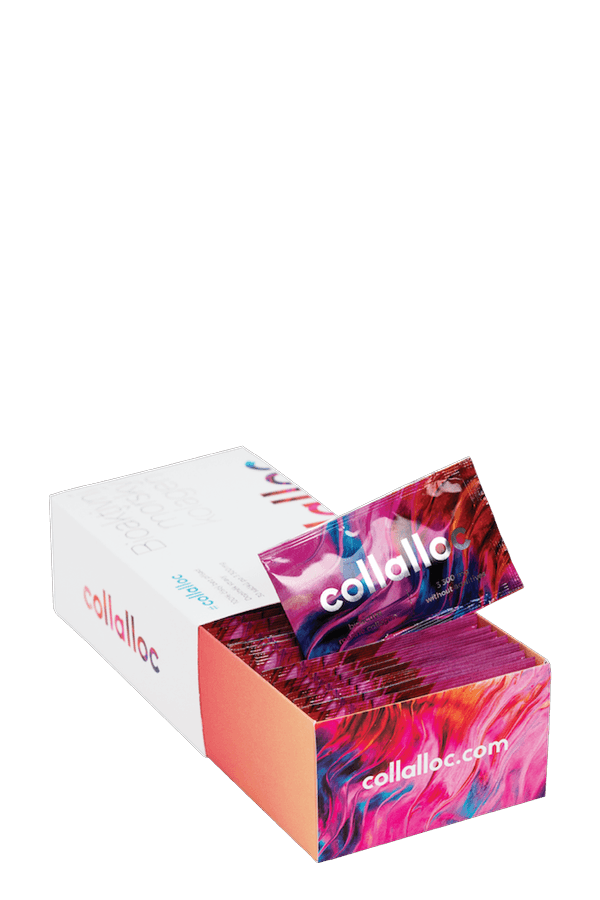
- Size matters. Smaller peptides are absorbed more easily. collalloc collagen has a fraction below 500 Da.
- Peak in hours, not minutes. Hence regularity: one dose a day, over the long term, makes more sense than an occasional one.
- Cold preparation. Marine collagen is sensitive to heat; it belongs in a drink only up to 60 °C, never in boiling water.
The collagen you drink is not absorbed whole. The peptides from it are absorbed, and those are exactly what carry the signal.
Sources
- Iwai K. et al. Identification of food-derived collagen peptides in human blood after oral ingestion of gelatin hydrolysates. Journal of Agricultural and Food Chemistry, 2005. doi.org/10.1021/jf050206p
- Oesser S. et al. Oral administration of 14C labeled gelatin hydrolysate leads to an accumulation of radioactivity in cartilage of mice. Journal of Nutrition, 1999. doi.org/10.1093/jn/129.10.1891
Frequently asked questions
Is the collagen I drink absorbed?
Yes, in hydrolyzed form. A 2005 human study measured collagen peptides in the blood, mainly Pro-Hyp, peaking at 1 to 2 hours after drinking it (Iwai et al., 2005).
Why hydrolyzed and not ordinary collagen?
Native collagen is a molecule of around 300,000 Da and is not absorbed whole. Hydrolysis cleaves it into peptides on the order of 1 to 5 kDa, which pass through the intestinal wall into the blood.
What is Pro-Hyp?
Pro-Hyp (prolyl-hydroxyproline) is the main collagen peptide that appears in the blood after ingesting collagen. It resists breakdown, which is why it lasts in circulation for hours (Iwai et al., 2005).
Does the collagen I drink reach the tissue?
An experiment in mice with labeled collagen showed preferential accumulation in cartilage (Oesser et al., 1999). In humans this is so far mainly evidence of absorption into the blood.
How fast does collagen act?
The peptides are in the blood within 1 to 2 hours, but that is only absorption. Measurable effects on tissues come gradually, which is why regularity matters more than a single dose.