MagazineLiquid collagen or powder? Forms of collagen: sachet, capsules, gummies
Liquid collagen or powder? Forms of collagen: sachet, capsules, gummies
Liquid collagen, powder, capsules or gummies? An honest comparison: how much collagen is in a serving, what else is inside and what studies say about absorption.
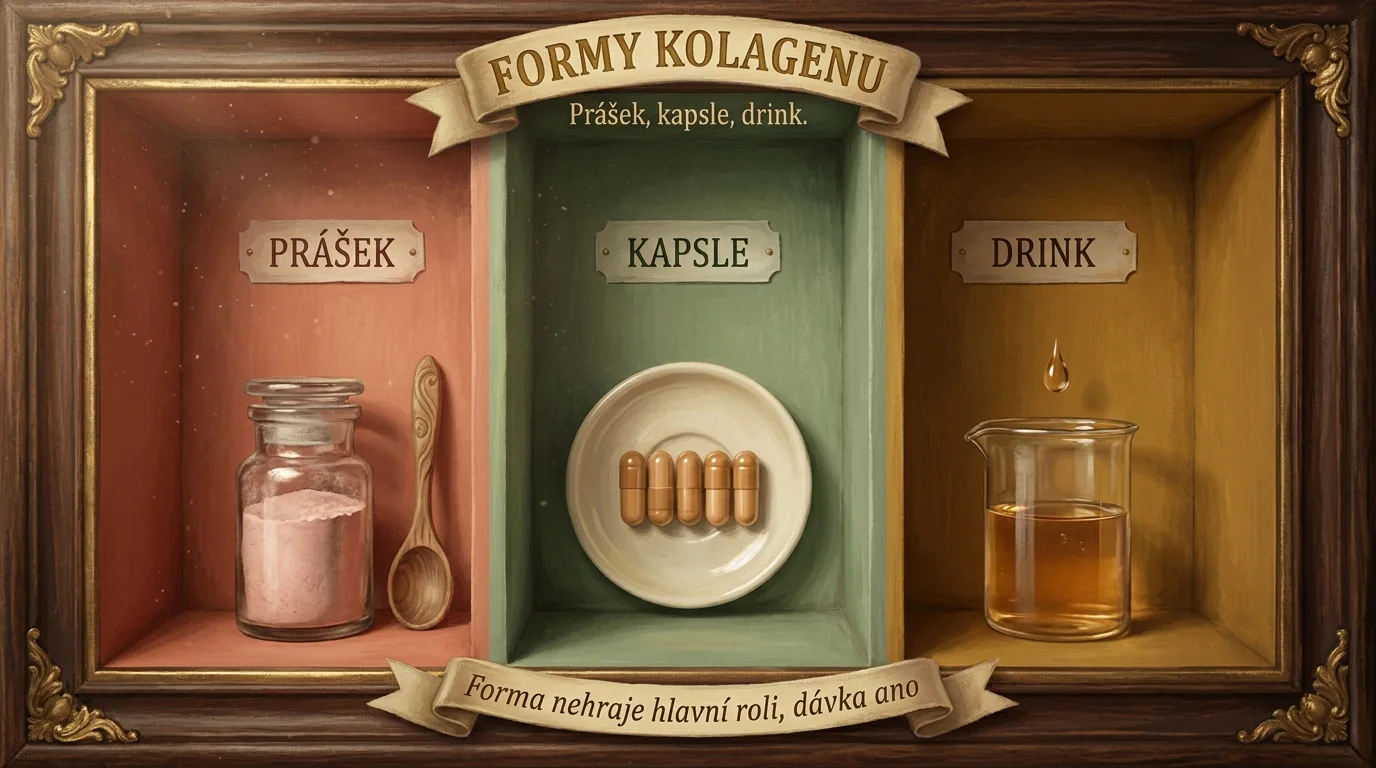
Short answer: there is no strong evidence that liquid collagen is absorbed better than powder. We have not found a study comparing the same collagen in liquid and powder form. And powder stirred into a drink is, by the time you drink it, liquid collagen too. What matters more than the form is the dose, whether the collagen is hydrolysed, and taking it regularly. Skin studies typically used 2.5 to 10 g a day (Choi et al., 2019). Powder makes that dose easiest to reach; with liquid products it depends on the amount per serving, and with capsules or gummies it is usually harder.
Collagen forms at a glance
| Form | Collagen per serving | What else is usually inside | Preparation | Who it suits |
|---|---|---|---|---|
| Powder in a sachet or tub | Easily matches the doses used in studies (2.5 to 10 g) | Pure powder nothing; flavoured versions sweeteners and flavourings | Stir into a cold or lukewarm drink, at most 60 °C | For a daily routine and a full dose |
| Liquid collagen (shot, ampoule, dropper) | Depends on the product; look for the mg per serving | Water and, depending on the product, flavourings, sweeteners or a preservative | No mixing, drink it straight away | For travel and for anyone who does not want to mix |
| Capsules and tablets | A capsule holds little powder, so a study dose takes several | The capsule shell; binders and fillers in tablets | Swallow with water | For those who do not mind several a day |
| Gummies | Much of the weight is sugar or sweeteners and a gelling agent | Sugar or sweeteners, flavourings, sometimes colourings | Chew | For the taste, not for a high dose |
Always work out the price per gram of collagen itself, not per pack or per piece.
Is liquid collagen absorbed better than powder?
After you drink hydrolysed collagen, short collagen peptides, mainly Pro-Hyp, appear in the blood and peak after 1 to 2 hours (Iwai et al., 2005). So the body really does absorb collagen from a drink. What counts is exactly what reaches your gut, not whether it came from a bottle or a sachet.
The studies that compared forms are small, but they point the same way. In a study with ten men, the same 15 g dose taken as gelatin, hydrolysed collagen or a gummy raised blood amino acids similarly, measured in four of them (Lis and Baar, 2019). In the study by Virgilio et al. (2024), hydrolysates from fish, pigs and cattle with different molecular weights all led to measurable levels of hydroxyproline and collagen peptides in the blood. Its authors worked for a collagen manufacturer.
The liquid form was tested, for example, in a study of drinkable ampoules with 2.5 g of collagen peptides, in which skin hydration and elasticity improved in 72 women after 12 weeks compared with placebo (Bolke et al., 2019). The ampoule also contained vitamins, zinc and biotin, though, and the study did not compare it with powder.
What matters more than the form
- Dose. Eight studies in the review by Choi et al. (2019) used 2.5 to 10 g of hydrolysed collagen a day for 8 to 24 weeks. In a study with 69 women, skin elasticity improved after 8 weeks compared with placebo at both 2.5 g and 5 g a day (Proksch et al., 2014). So check the label for the mg of collagen in one serving, not in the whole pack.
- Hydrolysis and peptide size. In a small study with ten men, further enzymatic breakdown of collagen sped up the absorption of glycine, proline and hydroxyproline (Skov et al., 2019). A good manufacturer therefore states that the collagen is hydrolysed and gives its molecular weight.
- Regularity. Studies assessed results after weeks to months of daily use. The form you will take every day beats the one that stays in the cupboard.
- What else is in the serving. Sugar, sweeteners, flavourings and fillers add no collagen.
We explain how to recognise a good product in How to spot a quality collagen supplement.
Capsules: how many do you actually need?
Capsules are practical and tasteless, but they are small. Check the label for how many mg of collagen one capsule contains and how many capsules make up the daily serving. For example, at 500 mg per capsule you need five capsules a day for 2.5 g and twenty for 10 g. If the manufacturer recommends two capsules a day, your dose may be well below what the studies used.
Gummies: what to watch out for
Gummies taste good and are easy to remember. Much of their weight, however, is sugar or syrup, or sweeteners, plus a gelling agent. Check the ingredients for how much sugar you eat with the daily serving and how much collagen it contains. Keep them out of reach of children.
Collagen powder in coffee? Only up to 60 °C
Collagen belongs in a cold or lukewarm drink, at most 60 °C. Freshly made coffee or tea is hotter, so let it cool first. The simplest option is to stir collagen into water, juice, milk or a smoothie. Why we keep the limit at exactly 60 °C is explained in Collagen and hot coffee.
How we do it at collalloc
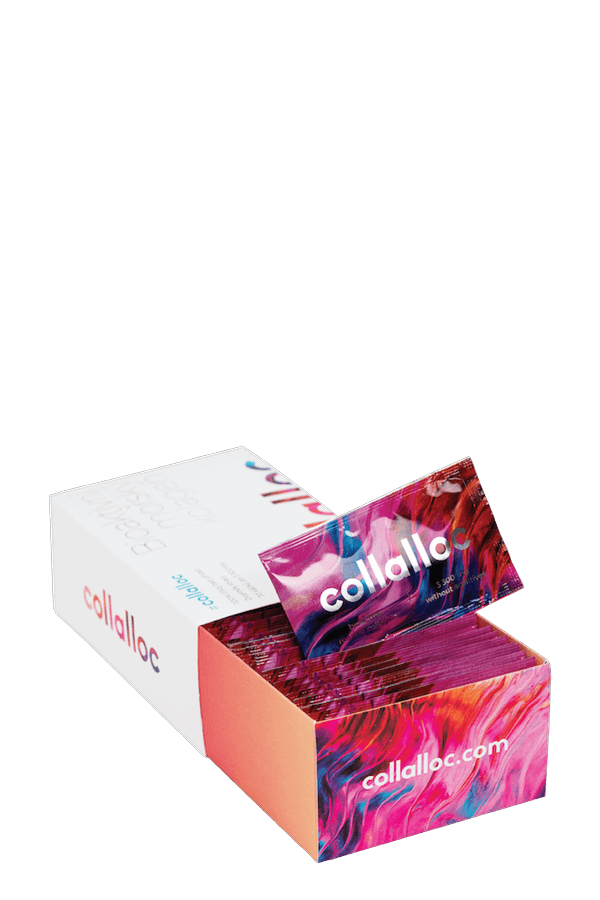
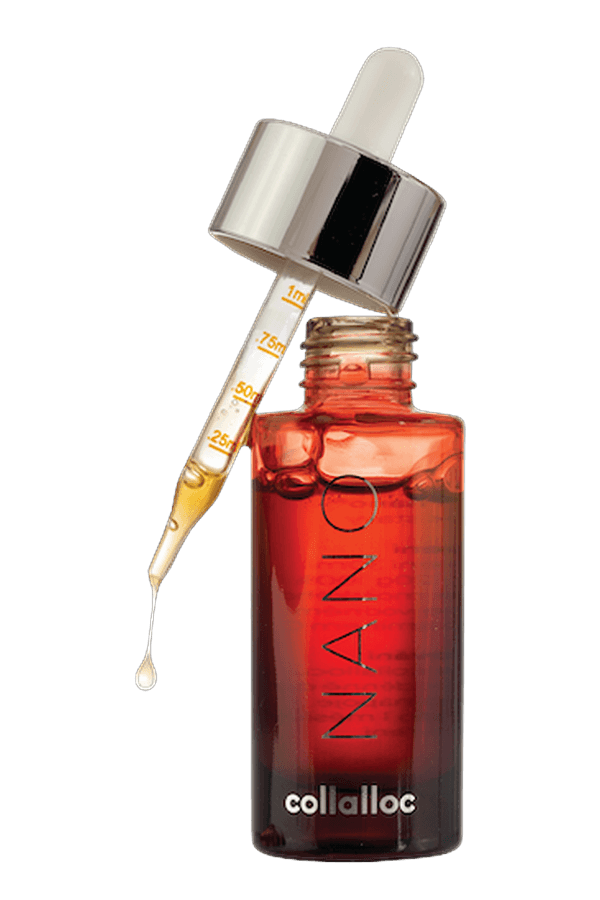
collalloc collagen is a powder in a sachet: 3,300 mg of hydrolysed marine collagen with a molecular weight of around 500 Da and 95% absorbability, with no sweeteners, colourings or flavourings. You stir the sachet into a cold or lukewarm drink up to 60 °C. If you would rather not mix anything, you can reach for the liquid NANO 2.0 with vitamin C, which contributes to normal collagen formation for the normal function of skin. Its serving contains less collagen than a sachet, so you can combine the two.
We test microbiology for every production batch and heavy metals every month in an external laboratory. You will find the results on the product page and on our Laboratory page. What happens to collagen in the body after you drink it is covered in Is the collagen I drink absorbed?, and the link with skin on our Collagen for skin page.
Frequently asked questions
Is liquid collagen better than powder?
There is no strong evidence that liquid collagen is absorbed better. Powder stirred into a drink is liquid when you drink it too. Dose, a hydrolysed raw material and regularity matter; the liquid form is mainly more convenient.
Are collagen capsules as good as powder?
They contain the same hydrolysed collagen, but a capsule holds very little of it. To reach the doses used in studies, typically 2.5 to 10 g a day (Choi et al., 2019), you would need several capsules a day. Check how many mg are in one capsule.
Are collagen gummies or powder better for skin?
Skin studies worked with doses of 2.5 to 10 g a day (Choi et al., 2019), which are easier to reach with powder. Gummies contain sugar or sweeteners. In a small study, however, the same dose in a gummy raised blood amino acids similarly to gelatin or hydrolysed collagen (Lis and Baar, 2019).
How much collagen a day?
Studies typically used 2.5 to 10 g of hydrolysed collagen a day for 8 to 24 weeks (Choi et al., 2019). Stick to the serving on the pack; for collalloc that is one sachet with 3,300 mg.
Can I put collagen powder in coffee?
Not in hot coffee. Collagen belongs in a drink of at most 60 °C, so let coffee or tea cool first. Cold or lukewarm water, juice, milk or a smoothie are the easiest options.
What is the best collagen powder?
There is no single best one. Look for hydrolysed collagen, a clear amount in mg per serving, a short ingredient list without unnecessary additives, the molecular weight and published test results for heavy metals and microbiology.
Sources
- Oral Collagen Supplementation: A Systematic Review of Dermatological Applications Choi F. D., Sung C. T., Juhasz M. L., Mesinkovska N. A., Journal of Drugs in Dermatology, 2019
- Oral supplementation of specific collagen peptides has beneficial effects on human skin physiology: a double-blind, placebo-controlled study Proksch E., Segger D., Degwert J., Schunck M., Zague V., Oesser S., Skin Pharmacology and Physiology, 2014
- Identification of food-derived collagen peptides in human blood after oral ingestion of gelatin hydrolysates Iwai K., Hasegawa T., Taguchi Y. et al., Journal of Agricultural and Food Chemistry, 2005
- Absorption of bioactive peptides following collagen hydrolysate intake: a randomized, double-blind crossover study in healthy individuals Virgilio N., Schön C., Mödinger Y. et al., Frontiers in Nutrition, 2024
- Enzymatic Hydrolysis of a Collagen Hydrolysate Enhances Postprandial Absorption Rate: A Randomized Controlled Trial Skov K., Oxfeldt M., Thøgersen R., Hansen M., Bertram H. C., Nutrients, 2019
- Effects of Different Vitamin C-Enriched Collagen Derivatives on Collagen Synthesis Lis D. M., Baar K., International Journal of Sport Nutrition and Exercise Metabolism, 2019
- A Collagen Supplement Improves Skin Hydration, Elasticity, Roughness, and Density: Results of a Randomized, Placebo-Controlled, Blind Study Bolke L., Schlippe G., Gerß J., Voss W., Nutrients, 2019
- Commission Regulation (EU) No 432/2012 establishing a list of permitted health claims made on foods European Commission, Official Journal of the European Union, 2012