MagazineFunctional mushrooms vs. nootropics: what is the difference?
Functional mushrooms vs. nootropics: what is the difference?
Both terms circulate in the biohacking community. But they are different categories with different mechanisms, risks and time horizons.
What a nootropic is
The term “nootropic” (from the Greek: nous = mind, trepein = to bend) refers to a substance that improves cognitive function, memory, focus and processing speed. The category is broad: it includes synthetic molecules such as racetams (piracetam, aniracetam), natural adaptogens (ashwagandha, rhodiola) and functional mushrooms.
In the r/nootropics community, “nootropics” are usually understood more narrowly, as synthetic or semi-synthetic substances with a fast, measurable effect on neurotransmitters. Functional mushrooms do not fit into that box, they work differently.
The key difference: repairing the infrastructure vs. manipulating neurotransmitters
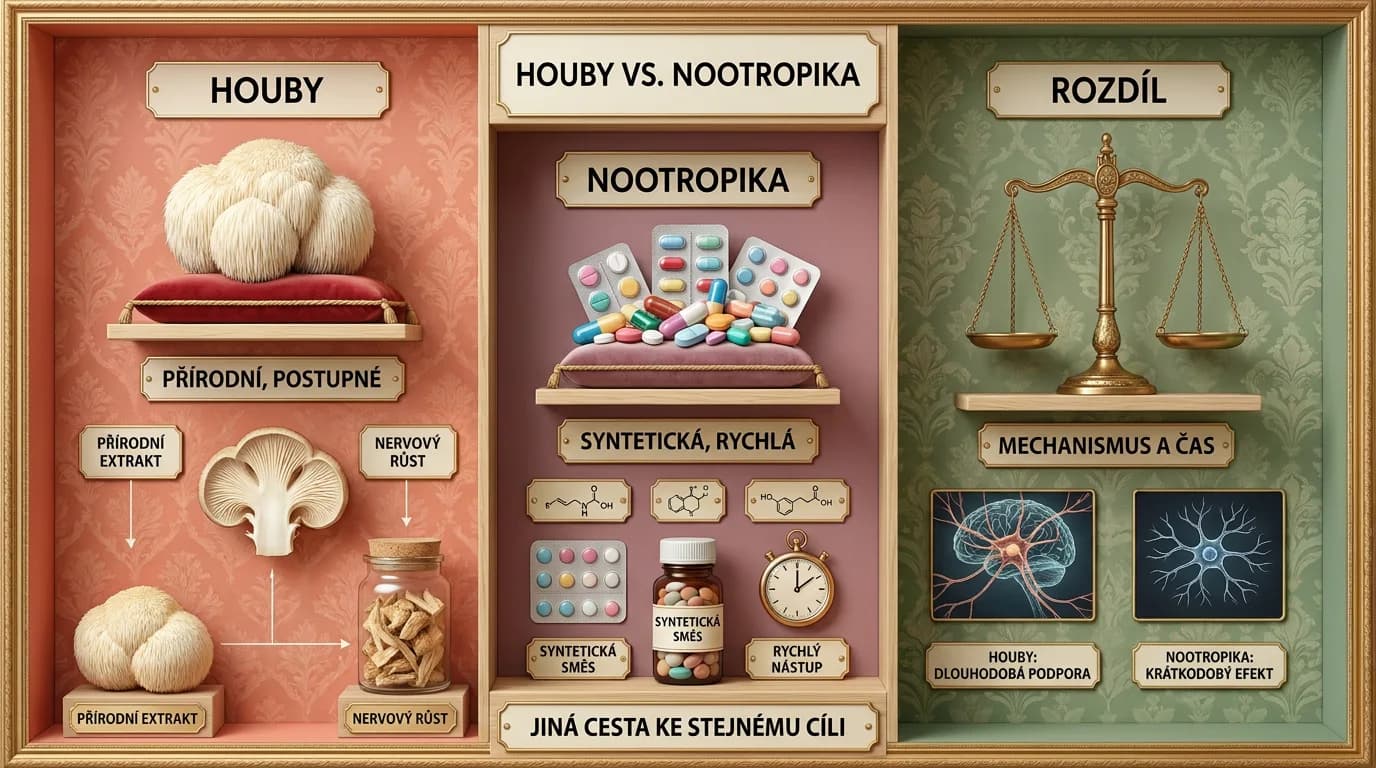
Synthetic nootropics (racetams, modafinil) modulate neurotransmitter receptors for a fast, pronounced cognitive effect. The result is felt within hours. The risk: tolerance, dependence, an unclear long-term safety profile. Many of them require a prescription.
Lion’s Mane stimulates the production of NGF (nerve growth factor) and BDNF (brain-derived neurotrophic factor). It does not override neurotransmitters, it supports the growth and repair of neurons. The effect comes on slowly, but it changes the biological infrastructure of the brain.
“Synthetic nootropics are like a debt, you borrow from your future neurotransmitters. Lion’s Mane is like an investment: it builds the infrastructure that makes every other nootropic more effective.”
Where mushrooms and nootropics overlap
Functional mushrooms, especially Lion’s Mane, are legitimately part of the “natural nootropics” category. Hericenones and erinacines (the bioactive compounds of Lion’s Mane) cross the blood-brain barrier and act directly in the brain. They are the best scientifically supported natural nootropic, with human studies, not just animal data.
Cordyceps adds an energy component: it increases ATP production and the oxidative capacity of cells. The combination of Lion’s Mane and Cordyceps is therefore a popular stack among professionals who want both focus and energy, without stimulants.
How to read labels
- Fruiting body, not mycelium on grain: Clinical studies work with extracts from fruiting bodies. Mycelium grown on grain has a lower content of bioactive compounds and a higher proportion of starch.
- Beta-glucan standardization: A quality product states its beta-glucan content. Without that number you do not know what you are buying.
- Dual extraction: hot water and alcohol extraction ensures the product contains both polysaccharides and triterpenoids, both bioactive groups.