MagazineHow long does it take for functional mushrooms to start working?
How long does it take for functional mushrooms to start working?
How long does it take for mushroom supplements to work? How many weeks studies of Lion’s Mane, Cordyceps and maitake lasted and what they showed.

Short answer: human studies with functional mushrooms mostly lasted 4 to 18 weeks, and their results were not clear-cut. With Lion’s Mane, a difference from placebo appeared in week 8 of a 16-week study and disappeared 4 weeks after stopping (Mori et al., 2009); in healthy young people, the results after 28 days mostly did not differ from placebo (Docherty et al., 2023). With Cordyceps, maximal oxygen uptake rose in a small study after 3 weeks, not after the first week (Hirsch et al., 2017), but in trained cyclists even 5 weeks of use changed nothing (Parcell et al., 2004). It therefore makes sense to evaluate no earlier than after several weeks of regular use, and to allow for the possibility that you will notice no change at all.
Overview: how long the human studies lasted
| Mushroom and study | Who and for how long | Result |
|---|---|---|
| Lion’s Mane (Mori et al., 2009) | 30 people aged 50 to 80, 16 weeks | Difference from week 8, gone after stopping |
| Lion’s Mane (Saitsu et al., 2019) | Adults, 12 weeks | Better in 1 of 3 tests |
| Lion’s Mane (Docherty et al., 2023) | 41 healthy people, 28 days | No significant difference after 28 days |
| Blend with Cordyceps militaris (Hirsch et al., 2017) | 28 young people, 1 and 3 weeks | VO2 max unchanged after 1 week, higher after 3 weeks |
| Cordyceps sinensis (Chen et al., 2010) | 20 people aged 50 to 75, 12 weeks | Better exercise thresholds, VO2 max unchanged |
| Cordyceps sinensis (Parcell et al., 2004) | 22 trained cyclists, 5 weeks | No difference |
| Maitake in bread (Jogi et al., 2026) | 47 people over 60, 18 weeks | Difference for 1 of 2 strains |
| Chaga | Controlled human studies are lacking | Szychowski et al., 2021 |
Why mushrooms do not work like coffee
Caffeine is a stimulant, and you feel its effect quickly. Functional mushrooms do not contain caffeine, so human studies did not test an immediate feeling like after coffee, but changes after weeks of regular use. We found only one exception: in the study by Docherty et al. (2023), people were faster in one attention test (the Stroop test) an hour after their first dose of Lion’s Mane. After 28 days of use, however, the results did not differ significantly from placebo, and some of the tests came out unchanged or worse. So if you feel nothing after the first few days, that matches what the studies saw.
Lion’s Mane: studies lasted 4 to 16 weeks
The most cited is the Japanese double-blind study by Mori et al. (2009). 30 people aged 50 to 80 with mild cognitive impairment took tablets with roughly 3 g of dried Lion’s Mane a day, or a placebo, for 16 weeks. The mushroom group had higher scores on a cognitive function test in weeks 8, 12 and 16, and the score rose with the length of use. Four weeks after stopping, however, it dropped markedly again. The study’s first author works in the mushroom laboratory of the Japanese company Hokuto.
In the study by Saitsu et al. (2019), adults took a supplement with Lion’s Mane fruiting body, or a placebo, for 12 weeks. Of three tests, only one improved, a short cognitive function test (MMSE). The shortest was a 28-day study with 41 healthy young people and a dose of 1.8 g a day, whose results we describe above (Docherty et al., 2023). We write about Lion’s Mane in detail in the article Lion’s Mane: what kind of mushroom it is.
Cordyceps: studies lasted 1 to 16 weeks
The most direct answer to the question of how long Cordyceps takes to start working comes from the study by Hirsch et al. (2017). 28 young people took 4 g a day of a mushroom blend with Cordyceps militaris, or a placebo. After the first week, maximal oxygen uptake (VO2 max) and other main measures did not differ from placebo, but a supplementary analysis showed 28 seconds longer endurance to exhaustion. Ten people from both groups continued for another 2 weeks. After 3 weeks, VO2 max rose by 4.8 ml/kg/min in the mushroom blend group and by 0.9 in the placebo group. However, it was a blend of mushrooms, so the result cannot be attributed to Cordyceps alone.
With the species Cordyceps sinensis, which is also in collalloc MIND, two small studies were done with the preparation Cs-4. In 20 healthy people aged 50 to 75, after 12 weeks of taking roughly 1 g a day, the metabolic threshold rose by 10.5% and the ventilatory threshold by 8.5%, while maximal oxygen uptake did not change (Chen et al., 2010). In 22 trained cyclists, 5 weeks of taking 3 g a day changed neither oxygen uptake nor the time trial result (Parcell et al., 2004). A review of five studies with Cordyceps militaris from 2017 to 2024, with 321 participants aged 16 to 35, reports durations of use of 1 to 16 weeks and doses of 1 to 12 g a day. According to the authors, the results are not consistent, and the certainty of the evidence is reduced by small numbers of participants and by blends of several substances (Jędrejko et al., 2026).
Maitake and chaga: the fewest human studies
For maitake, we found one newer controlled study. 47 healthy Japanese people over 60 ate bread with 50 g of maitake from one of two strains, or bread without mushrooms, for 18 weeks. With one strain, the score on a cognitive function test after 18 weeks was better than with placebo; with the other, it did not differ (Jogi et al., 2026). It was the whole mushroom in food, not an extract, and the study’s first author works at the company YUKIGUNI FACTORY. For chaga, controlled human studies are lacking, and the research rests on laboratory and animal experiments (Szychowski et al., 2021). So there is no answer to the question of how long chaga might take to do anything.
Why the result is not certain
The mushroom studies share several weaknesses. They are small, mostly with 20 to 47 participants. Each used a different form and dose: tablets with dried mushroom, fruiting body, extract, a mushroom blend or mushroom baked into bread. The participants also differed, from healthy people in their twenties to seniors with mild cognitive impairment. Moreover, the positive results often concerned only one of several tests measured, and with Lion’s Mane the difference disappeared after stopping (Mori et al., 2009). From such studies it is impossible to conclude how long it will take, or whether you will notice anything at all.
How to assess it yourself
- Give it the time that matches the studies: at least 8 to 12 weeks of regular use. A shorter trial will not tell you much.
- Before you start, write down what you want to track and why, and rate it once a week in the same way, for example on a scale of 1 to 10.
- Do not change several things at once. If you start sleeping more and taking mushrooms at the same time, you will not know what caused what. More about getting started in the article What to expect when you start with functional mushrooms.
- If you take medication, especially blood thinners or diabetes medication, consult a doctor beforehand.
How we do it with collalloc MIND
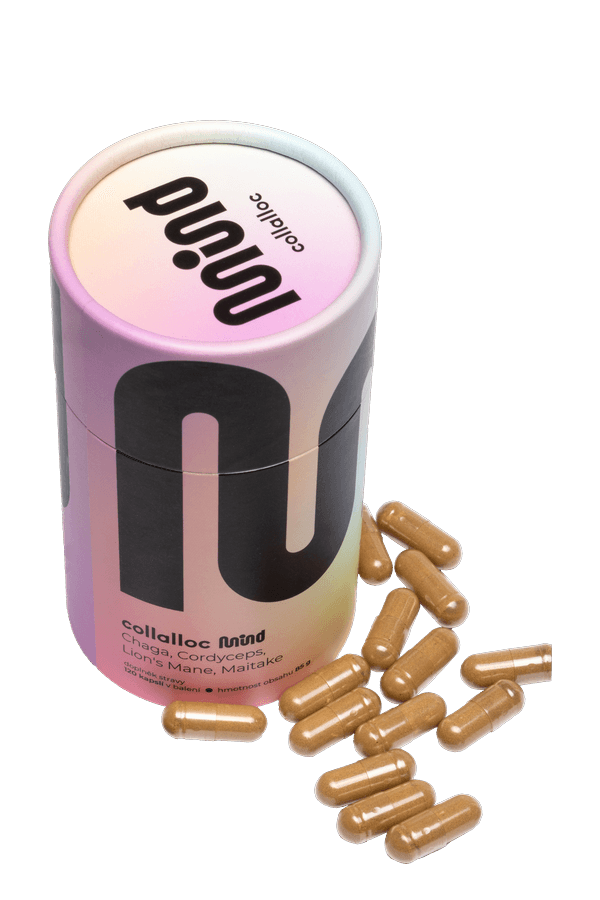
In collalloc MIND there are four mushrooms: Lion’s Mane, Cordyceps sinensis, chaga and maitake, 600 mg of extract from each in a daily dose of 4 capsules. A pack of 120 capsules lasts 30 days. We do not promise how soon, or whether at all, you will notice anything, because the studies do not allow us to say. We see MIND as a daily ritual, not as a medicine or a nootropic. We go through the differences between Lion’s Mane and Cordyceps in the article Lion’s Mane vs. Cordyceps: what the difference is.
Frequently asked questions
How long does it take for mushroom supplements to work?
Nobody knows for sure. Human studies mostly lasted 4 to 18 weeks, and the results were mixed: with Lion’s Mane, a difference from placebo appeared in week 8 at the earliest (Mori et al., 2009); with Cordyceps, in one study after 3 weeks (Hirsch et al., 2017), and in another not even after 5 weeks (Parcell et al., 2004).
How long does it take for Cordyceps to work?
In a study with a mushroom blend containing Cordyceps militaris, maximal oxygen uptake did not change after the first week and was higher than with placebo after 3 weeks, but only 10 participants continued to week 3 (Hirsch et al., 2017). In trained cyclists, even 5 weeks of taking Cordyceps sinensis did not change performance (Parcell et al., 2004). So the result is not certain.
How long does it take for Lion’s Mane to start working?
In a study of 30 people with mild cognitive impairment, a difference from placebo showed in weeks 8, 12 and 16 and disappeared 4 weeks after stopping (Mori et al., 2009). In 41 healthy young people, the results after 28 days did not differ significantly from placebo (Docherty et al., 2023).
Why do I feel no effect after two weeks?
Functional mushrooms are not a stimulant like caffeine, and the studies assessed results only after weeks, for Cordyceps after 3 weeks at the earliest (Hirsch et al., 2017), for Lion’s Mane after 8 to 16 weeks (Mori et al., 2009). It is also possible that you will not notice any change later either, because the studies are small and their results inconsistent.
How do I know that functional mushrooms are working?
Hard to say reliably, because without a placebo you do not know what would have happened without them. It helps to write down before you start what you want to track, to rate it once a week and not to change other habits at the same time. It makes sense to evaluate no earlier than after 8 to 12 weeks; the studies with Lion’s Mane lasted 12 to 16 weeks (Saitsu et al., 2019; Mori et al., 2009).
How long were maitake and chaga studied?
For maitake, we found a study in which 47 people over 60 ate bread with maitake for 18 weeks, and an improvement in a cognitive function test appeared with only one of two strains (Jogi et al., 2026). For chaga, controlled human studies are lacking (Szychowski et al., 2021).
Sources
- Improving effects of the mushroom Yamabushitake (Hericium erinaceus) on mild cognitive impairment: a double-blind placebo-controlled clinical trial Mori K., Inatomi S., Ouchi K., Azumi Y., Tuchida T., Phytotherapy Research, 2009
- Improvement of cognitive functions by oral intake of Hericium erinaceus Saitsu Y., Nishide A., Kikushima K., Shimizu K., Ohnuki K., Biomedical Research, 2019
- The Acute and Chronic Effects of Lion's Mane Mushroom Supplementation on Cognitive Function, Stress and Mood in Young Adults: A Double-Blind, Parallel Groups, Pilot Study Docherty S., Doughty F. L., Smith E. F., Nutrients, 2023
- Cordyceps militaris Improves Tolerance to High-Intensity Exercise After Acute and Chronic Supplementation Hirsch K. R., Smith-Ryan A. E., Roelofs E. J., Trexler E. T., Mock M. G., Journal of Dietary Supplements, 2017
- Effect of Cs-4 (Cordyceps sinensis) on exercise performance in healthy older subjects: a double-blind, placebo-controlled trial Chen S., Li Z., Krochmal R., Abrazado M., Kim W., Cooper C. B., Journal of Alternative and Complementary Medicine, 2010
- Cordyceps Sinensis (CordyMax Cs-4) supplementation does not improve endurance exercise performance Parcell A. C., Smith J. M., Schulthies S. S., Myrer J. W., Fellingham G., International Journal of Sport Nutrition and Exercise Metabolism, 2004
- Current Evidence of Ergogenic and Post-Exercise Recovery Effects of Dietary Supplementation with Cordyceps militaris in Humans: A Narrative Review Jędrejko M., Jędrejko K., Granda D., Kała K., Pokrywka A., Muszyńska B., Nutrients, 2026
- Maitake Mushroom (Grifola frondosa) Enhances Cognitive Function in Healthy Older Japanese: A Randomized, Double-Blind, Placebo-Controlled Trial Jogi E. M., Kato M. C., Masuda Y., Konishi M., Kuwabara N., Sato S., Journal of Nutritional Science and Vitaminology, 2026
- Inonotus obliquus - from folk medicine to clinical use Szychowski K. A., Skóra B., Pomianek T., Gmiński J., Journal of Traditional and Complementary Medicine, 2021