MagazineLion’s Mane vs. Cordyceps: the difference and what studies showed
Lion’s Mane vs. Cordyceps: the difference and what studies showed
Lion’s Mane vs. Cordyceps: how Hericium and Cordyceps differ, what has been studied in humans, how strong the evidence is and whether to take them together.

Short answer: Lion’s Mane (Hericium erinaceus) is an edible mushroom from broadleaf trees, studied mainly in relation to memory and thinking. Cordyceps is a genus of about 750 species of fungi that in nature are parasites mainly of insects (Olatunji et al., 2018), and it is studied mainly in relation to physical exertion. There are few human studies of either, and they are small: with Lion’s Mane, the score on a cognitive function test improved after 16 weeks in 30 older people with mild impairment (Mori et al., 2009); with Cordyceps, the results of studies focused on sports performance diverge (Jędrejko et al., 2026). We did not find a study that compared the two mushrooms or examined their combination.
Overview: Lion’s Mane and Cordyceps side by side
| Comparison | Lion’s Mane | Cordyceps |
|---|---|---|
| What it is | Edible mushroom from broadleaf trees | Genus of fungi that parasitise insects |
| Species in supplements | Hericium erinaceus | Cordyceps sinensis, Cordyceps militaris |
| Substances studied | Hericenones, erinacines, polysaccharides | Nucleosides, cyclic peptides, polysaccharides |
| What was measured in humans | Memory and thinking tests | Oxygen uptake, endurance |
| Study length | 4 to 16 weeks | 1 to 16 weeks |
| Results | Mixed, small studies | Inconsistent, small studies |
What Lion’s Mane is
Lion’s Mane, also known as the bearded tooth fungus, grows on the trunks of broadleaf trees. It forms white fruiting bodies made of long hanging spines, hence the English name Lion’s Mane. In Asian cuisine it is a common edible mushroom, and it is cultivated both for cooking and for food supplements. A review describes polysaccharides and around 70 other substances in the fruiting bodies and mycelium, the best known being hericenones and erinacines (Friedman, 2015). Most research on these substances has been done on cells and animals; there are only a few human studies.
What has been studied in humans with Lion’s Mane
The most cited is the Japanese double-blind study by Mori et al. (2009): 30 people aged 50 to 80 with mild cognitive impairment took roughly 3 g of dried Lion’s Mane a day, or a placebo, for 16 weeks. The mushroom group had higher scores on a cognitive function test in weeks 8, 12 and 16, but 4 weeks after stopping, the score dropped again. Laboratory tests showed no adverse effects. In the study by Saitsu et al. (2019), only one of three memory and thinking tests improved after 12 weeks.
In healthy young people, Lion’s Mane came out more modestly. 41 adults aged 18 to 45 took 1.8 g a day, or a placebo, for 28 days. An hour after the first dose they were faster in one attention test; after 28 days there was only a statistically non-significant trend towards lower perceived stress, and some of the tests came out unchanged or worse (Docherty et al., 2023). The authors themselves write that the results need to be treated with caution because of the small number of participants.
What Cordyceps is
Cordyceps is not one mushroom but a genus with about 750 described species, which in nature grow mainly on insects. For 35 of them, the literature describes traditional use, or scientists have isolated active substances from them. The most used and most studied is Cordyceps sinensis. More than 200 substances have been described from the genus Cordyceps, and the most studied are cyclic peptides, nucleosides and polysaccharides (Olatunji et al., 2018). The nucleosides include cordycepin. Human studies used either the preparation Cs-4 from Cordyceps sinensis (Chen et al., 2010; Parcell et al., 2004) or Cordyceps militaris (Hirsch et al., 2017).
What has been studied in humans with Cordyceps
In the study by Hirsch et al. (2017), 28 young people took 4 g a day of a mushroom blend with Cordyceps militaris, or a placebo. After a week, maximal oxygen uptake (VO2 max) did not differ from placebo. Up to week 3, 10 people from both groups continued, and in the mushroom blend group VO2 max rose by 4.8 ml/kg/min, in the placebo group by 0.9. In 20 healthy people aged 50 to 75, the metabolic threshold rose by 10.5% and the ventilatory threshold by 8.5% after 12 weeks of taking Cs-4, while VO2 max did not change (Chen et al., 2010). In 22 trained cyclists, 5 weeks of taking 3 g of Cs-4 a day changed neither oxygen uptake nor the time trial result (Parcell et al., 2004).
A review of five studies with Cordyceps militaris from 2017 to 2024, with 321 participants aged 16 to 35, summarises that the results are not consistent. According to the authors, the certainty of the evidence is reduced by small numbers of participants, missing study registration, non-standardised preparations and blends of several substances (Jędrejko et al., 2026).
Which mushroom to choose?
The studies did not compare Lion’s Mane and Cordyceps with each other, so we cannot say which is better for whom. Lion’s Mane was studied in memory and thinking tests, mainly in older people with mild cognitive impairment. Cordyceps was studied in exercise tests, mainly in young people who do sport. In addition, the results of one study cannot be transferred to another product, because the species, forms and doses differed. Neither mushroom replaces sleep, exercise and food, and if you are troubled by worsening memory or long-term fatigue, that is a matter for a doctor.
Can you take Lion’s Mane and Cordyceps together?
They are often sold together, including in blends with four mushrooms. We did not find a study in the PubMed database that examined the combination of Lion’s Mane and Cordyceps in humans, so we do not know whether they act differently together than each one separately. The study by Hirsch et al. (2017) used a mushroom blend with Cordyceps militaris, so even there the result cannot be attributed to a single mushroom. If you combine mushrooms and take medication, especially blood thinners or diabetes medication, consult a doctor. More about combining them in the article Can you combine different functional mushrooms?
How we do it with collalloc MIND
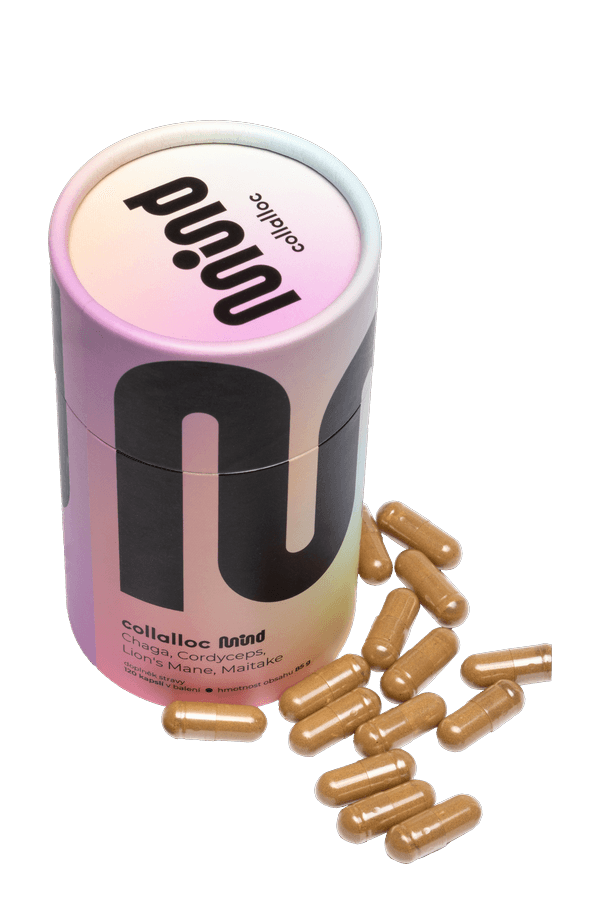
In collalloc MIND there are both Lion’s Mane and Cordyceps sinensis, together with chaga and maitake. The daily dose of 4 capsules contains 600 mg of extract from each mushroom, and the extract has at least 50% polysaccharides and at least 20% beta-glucans. MIND is caffeine-free, in plant-based capsules. We do not promise better memory or performance: MIND is a daily ritual, not a medicine or a nootropic. We discuss Lion’s Mane in detail in the article Lion’s Mane, and how long the studies lasted in the article How long does it take for functional mushrooms to start working?
Frequently asked questions
What is the difference between Cordyceps and Lion’s Mane?
Lion’s Mane (Hericium erinaceus) is an edible mushroom from broadleaf trees and is studied mainly in memory and thinking tests. Cordyceps is a genus of about 750 species of fungi that are parasites mainly of insects (Olatunji et al., 2018), and it is studied mainly in relation to physical exertion. They also differ in their substances: Lion’s Mane contains hericenones and erinacines (Friedman, 2015), Cordyceps nucleosides and cyclic peptides.
Is Lion’s Mane a type of Cordyceps?
No. Lion’s Mane belongs to the genus Hericium and grows on trees. Cordyceps is a separate genus with about 750 species, which in nature grow mainly on insects (Olatunji et al., 2018).
Can you take Lion’s Mane and Cordyceps together?
They are often sold together, but we did not find a study of the combination in humans. In a study with a mushroom blend containing Cordyceps militaris, maximal oxygen uptake rose after 3 weeks (Hirsch et al., 2017), but the result cannot be attributed to one mushroom. If you take medication, especially blood thinners or diabetes medication, consult a doctor.
What did studies on Lion’s Mane show?
In a study of 30 people aged 50 to 80 with mild cognitive impairment, the test score after 16 weeks was higher than with placebo and dropped 4 weeks after stopping (Mori et al., 2009). In a 12-week study, only one of three tests improved (Saitsu et al., 2019), and in healthy young people, the results after 28 days did not differ significantly from placebo (Docherty et al., 2023).
What did studies on Cordyceps show?
The results diverge. In 20 people aged 50 to 75, exercise thresholds improved after 12 weeks, but maximal oxygen uptake did not (Chen et al., 2010); in trained cyclists, nothing changed after 5 weeks (Parcell et al., 2004). A review of five studies with Cordyceps militaris rates the results as inconsistent (Jędrejko et al., 2026).
Do Lion’s Mane and Cordyceps really work?
This has not been reliably documented. The studies are small and their results inconsistent; a review of studies with Cordyceps militaris rates the certainty of the evidence as limited (Jędrejko et al., 2026).
Sources
- Improving effects of the mushroom Yamabushitake (Hericium erinaceus) on mild cognitive impairment: a double-blind placebo-controlled clinical trial Mori K., Inatomi S., Ouchi K., Azumi Y., Tuchida T., Phytotherapy Research, 2009
- Improvement of cognitive functions by oral intake of Hericium erinaceus Saitsu Y., Nishide A., Kikushima K., Shimizu K., Ohnuki K., Biomedical Research, 2019
- The Acute and Chronic Effects of Lion's Mane Mushroom Supplementation on Cognitive Function, Stress and Mood in Young Adults: A Double-Blind, Parallel Groups, Pilot Study Docherty S., Doughty F. L., Smith E. F., Nutrients, 2023
- Chemistry, Nutrition, and Health-Promoting Properties of Hericium erinaceus (Lion's Mane) Mushroom Fruiting Bodies and Mycelia and Their Bioactive Compounds Friedman M., Journal of Agricultural and Food Chemistry, 2015
- Cordyceps militaris Improves Tolerance to High-Intensity Exercise After Acute and Chronic Supplementation Hirsch K. R., Smith-Ryan A. E., Roelofs E. J., Trexler E. T., Mock M. G., Journal of Dietary Supplements, 2017
- Effect of Cs-4 (Cordyceps sinensis) on exercise performance in healthy older subjects: a double-blind, placebo-controlled trial Chen S., Li Z., Krochmal R., Abrazado M., Kim W., Cooper C. B., Journal of Alternative and Complementary Medicine, 2010
- Cordyceps Sinensis (CordyMax Cs-4) supplementation does not improve endurance exercise performance Parcell A. C., Smith J. M., Schulthies S. S., Myrer J. W., Fellingham G., International Journal of Sport Nutrition and Exercise Metabolism, 2004
- Current Evidence of Ergogenic and Post-Exercise Recovery Effects of Dietary Supplementation with Cordyceps militaris in Humans: A Narrative Review Jędrejko M., Jędrejko K., Granda D., Kała K., Pokrywka A., Muszyńska B., Nutrients, 2026
- The genus Cordyceps: An extensive review of its traditional uses, phytochemistry and pharmacology Olatunji O. J., Tang J., Tola A., Auberon F., Oluwaniyi O., Ouyang Z., Fitoterapia, 2018