Magazinecollalloc MIND: what it contains and what research says about its mushrooms
collalloc MIND: what it contains and what research says about its mushrooms
collalloc MIND: capsule contents, extract per mushroom, how to take it and what human research says so far about Lion’s Mane, Cordyceps, chaga and maitake.

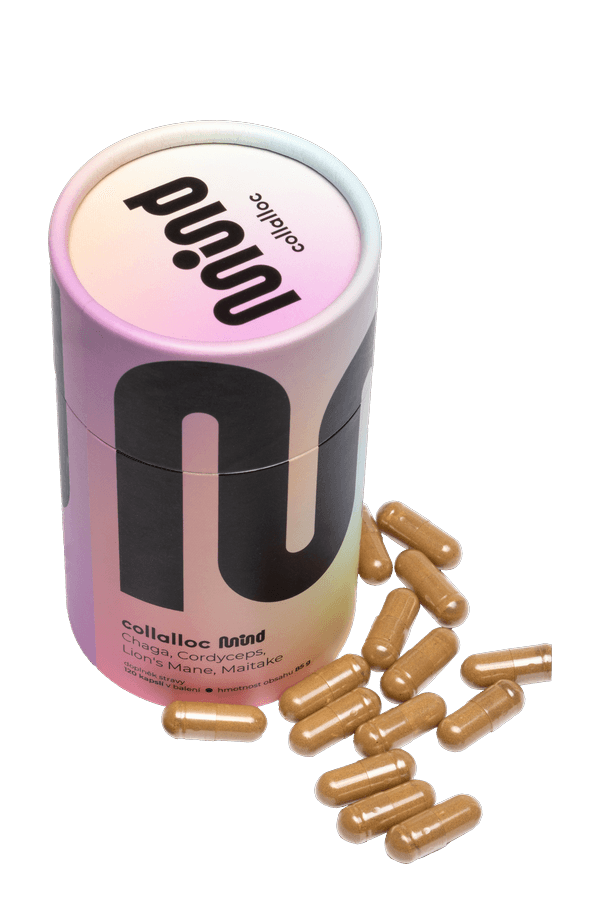
Short answer: collalloc MIND is a food supplement with four functional mushrooms: Lion’s Mane, Cordyceps, chaga and maitake. The daily dose of 4 capsules contains 600 mg of extract from each mushroom, 2,400 mg in total, and a pack of 120 capsules lasts 30 days. Human research on these mushrooms is still limited: with Lion’s Mane, the test score improved in a 16-week study of 30 older people with mild cognitive impairment (Mori et al., 2009), while chaga research comes mainly from the laboratory and from animal experiments (Duru et al., 2019). We offer MIND as a daily ritual, not as a medicine or a nootropic.
What is in collalloc MIND
| Ingredient | In the daily dose (4 capsules) |
|---|---|
| Lion’s Mane (Hericium erinaceus), extract | 600 mg |
| Cordyceps (Cordyceps sinensis), extract | 600 mg |
| Chaga (Inonotus obliquus), extract | 600 mg |
| Maitake (Grifola frondosa), extract | 600 mg |
| Polysaccharides in the extract | at least 50% |
| of which beta-glucans (β-1,3/1,6-D-glucans) | at least 20% |
collalloc MIND is organic, comes in plant-based capsules suitable for vegans and contains no caffeine, sugar, gluten, lactose or GMOs. A pack contains 120 capsules for 30 days.
How to take MIND
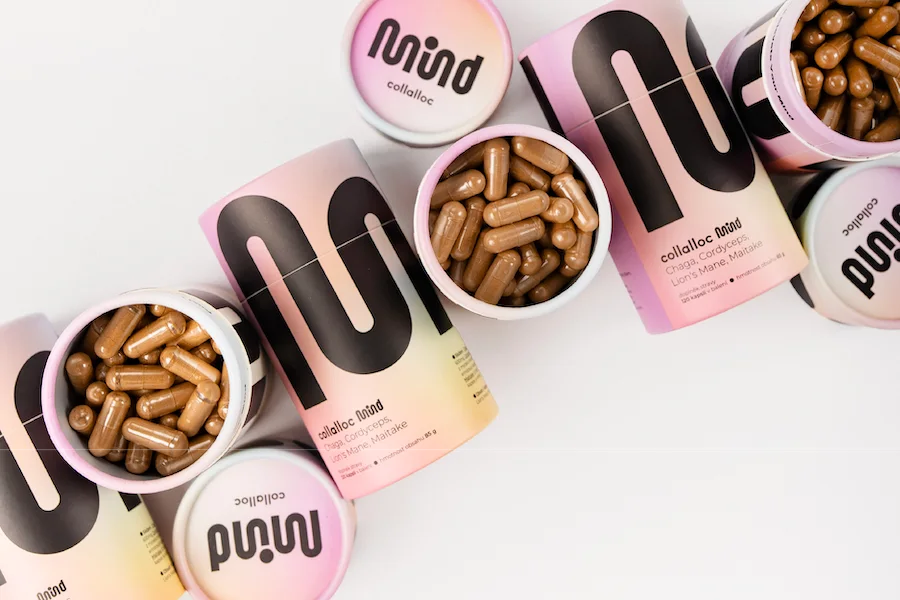
The daily dose is 4 capsules in the morning on an empty stomach: 30 minutes before a meal, or an hour after. We do not recommend an evening dose. Because they are capsules, you do not taste the mushrooms. MIND is meant for regular daily use, and one pack lasts 30 days. We do not promise how soon, or whether at all, you will notice anything. We explain why in our article How long does it take for functional mushrooms to start working?
Why we state polysaccharides and beta-glucans
Mushroom supplements differ in form: they can be dried ground mushroom, mycelium or extract. Milligrams of different forms therefore cannot be compared directly, and the share of polysaccharides and beta-glucans says more about the content. In mushroom products, beta-glucans are measured separately from starch: the laboratory method measures total glucans, subtracts the alpha-glucans, that is starch and glycogen, and the rest is beta-glucans (McCleary and Draga, 2016). For MIND we state at least 50% polysaccharides and at least 20% beta-glucans in the extract.
What research says about Lion’s Mane
Several small human studies have been carried out with Lion’s Mane. In a Japanese double-blind study, 30 people aged 50 to 80 with mild cognitive impairment took about 3 g of dried mushroom a day, or a placebo, for 16 weeks. The mushroom group had higher scores on a cognitive function test at weeks 8, 12 and 16, but 4 weeks after stopping, the score fell again (Mori et al., 2009). In 41 healthy people aged 18 to 45, results after 28 days of taking 1.8 g a day did not differ significantly from placebo, and only one attention test was faster an hour after the first dose (Docherty et al., 2023). More in our article Lion’s Mane.
What research says about Cordyceps
MIND contains the species Cordyceps sinensis. Two small studies have been done with it, using the product Cs-4. In 20 healthy people aged 50 to 75, the metabolic threshold rose by 10.5% and the ventilatory threshold by 8.5% after 12 weeks, while maximal oxygen uptake did not change (Chen et al., 2010). In 22 trained cyclists, 5 weeks of taking 3 g a day changed neither oxygen uptake nor the time trial result (Parcell et al., 2004). So the results diverge, and both studies are small.
What research says about chaga
Chaga, also known as the clinker polypore, grows mainly on birch trees. A review describes melanins, phenolic compounds and triterpenes in chaga and summarises research in cells and animals, for example on antioxidant activity or blood sugar levels (Duru et al., 2019). We did not find a controlled study of chaga in humans in the PubMed database. Chaga also contains a lot of oxalates: doctors in Japan described kidney failure in a 72-year-old woman who had taken 4 to 5 teaspoons of chaga powder a day for half a year (Kikuchi et al., 2014). More in our article Chaga and sleep: what research says.
What research says about maitake
Maitake, also known as hen of the woods, is also a popular edible mushroom. In a recent controlled study, 47 healthy Japanese people over 60 ate bread with 50 g of maitake from one of two strains, or bread without mushrooms, for 18 weeks. With one strain, the score on a cognitive function test was better than with placebo, and with the other it did not differ (Jogi et al., 2026). This was the whole mushroom in food, not an extract, and the first author of the study works for the company YUKIGUNI FACTORY. A case has also been described in which a person taking the blood thinner warfarin had a rise in INR, the value that shows how well the blood clots, after a maitake extract (Hanselin et al., 2010).
Why we do not call MIND a nootropic
Nootropics are substances from which people expect a quick boost in mental performance, and they are often stimulants. There is nothing of the kind in MIND: it contains no caffeine or other stimulants. We offer MIND as a daily ritual, not as a medicine. More on what nootropics are in our article What are nootropics, and are functional mushrooms among them?
When to talk to your doctor
Talk to your doctor before you start taking MIND if any of these points apply to you:
- You take blood thinners, diabetes medication or immunosuppressants. Mushrooms can interact with them, and a case of raised INR has been described with warfarin and maitake (Hanselin et al., 2010).
- You have kidney disease or a tendency to kidney stones, because chaga contains a lot of oxalates (Kikuchi et al., 2014).
- You are pregnant or breastfeeding. Reliable data for these periods are lacking.
- You are allergic to mushrooms.
Frequently asked questions
What is collalloc MIND?
A food supplement with four functional mushrooms: Lion’s Mane, Cordyceps, chaga and maitake, with 600 mg of extract from each in a daily dose of 4 capsules. It is free from caffeine, sugar, gluten and lactose, comes in plant-based capsules and is organic.
What effects does collalloc MIND have?
Human research on the individual mushrooms is limited: with Lion’s Mane, the score on a cognitive function test improved in a 16-week study of 30 older people with mild impairment (Mori et al., 2009), but in healthy young people, results after 28 days did not differ significantly from placebo (Docherty et al., 2023).
Is collalloc MIND free from artificial additives?
According to its composition, MIND contains extracts of four mushrooms in a plant-based capsule suitable for vegans. It is free from caffeine, sugar, gluten, lactose and GMOs, and it is organic. You will find the full composition on the product page.
How do you take collalloc MIND?
The daily dose is 4 capsules in the morning on an empty stomach, 30 minutes before a meal, or an hour after. We do not recommend an evening dose. A pack of 120 capsules lasts 30 days.
Is collalloc MIND a nootropic?
No. MIND contains no caffeine or other stimulants, and we do not offer it as a product for mental performance, but as a daily ritual.
Can I take MIND with medication?
Talk to your doctor first. Mushrooms can interact with blood thinners, diabetes medication and immunosuppressants, and a case has been described, for example, in which the INR value rose in a person taking warfarin after a maitake extract (Hanselin et al., 2010). Chaga also contains a lot of oxalates, which matters if you have kidney disease (Kikuchi et al., 2014).
Sources
- Improving effects of the mushroom Yamabushitake (Hericium erinaceus) on mild cognitive impairment: a double-blind placebo-controlled clinical trial Mori K., Inatomi S., Ouchi K., Azumi Y., Tuchida T., Phytotherapy Research, 2009
- The Acute and Chronic Effects of Lion's Mane Mushroom Supplementation on Cognitive Function, Stress and Mood in Young Adults: A Double-Blind, Parallel Groups, Pilot Study Docherty S., Doughty F. L., Smith E. F., Nutrients, 2023
- Effect of Cs-4 (Cordyceps sinensis) on exercise performance in healthy older subjects: a double-blind, placebo-controlled trial Chen S., Li Z., Krochmal R., Abrazado M., Kim W., Cooper C. B., Journal of Alternative and Complementary Medicine, 2010
- Cordyceps Sinensis (CordyMax Cs-4) supplementation does not improve endurance exercise performance Parcell A. C., Smith J. M., Schulthies S. S., Myrer J. W., Fellingham G., International Journal of Sport Nutrition and Exercise Metabolism, 2004
- The pharmacological potential and possible molecular mechanisms of action of Inonotus obliquus from preclinical studies Duru K. C., Kovaleva E. G., Danilova I. G., van der Bijl P., Phytotherapy Research, 2019
- Chaga mushroom-induced oxalate nephropathy Kikuchi Y., Seta K., Ogawa Y., Takayama T., Nagata M., Taguchi T., Clinical Nephrology, 2014
- Maitake Mushroom (Grifola frondosa) Enhances Cognitive Function in Healthy Older Japanese: A Randomized, Double-Blind, Placebo-Controlled Trial Jogi E. M., Kato M. C., Masuda Y., Konishi M., Kuwabara N., Sato S., Journal of Nutritional Science and Vitaminology, 2026
- INR elevation with maitake extract in combination with warfarin Hanselin M. R., Vande Griend J. P., Linnebur S. A., Annals of Pharmacotherapy, 2010
- Measurement of β-Glucan in Mushrooms and Mycelial Products McCleary B. V., Draga A., Journal of AOAC International, 2016