MagazineWhat rapid weight loss does to your skin and how marine collagen helps
What rapid weight loss does to your skin and how marine collagen helps
When fat disappears faster than the skin can tighten, that is biology, not a failure of willpower. With GLP-1 medications there is also a direct effect on collagen production itself. What happens in the skin, why the body is short of raw materials right now, and what marine collagen peptides can do about it.

The short answer
- When you lose weight quickly, subcutaneous fat disappears before the skin has time to adapt structurally. The result is a loss of firmness, most visible on the face.
- With GLP-1 medications, according to a review in Endocrine (2025), there is also a direct effect on collagen production, not just the loss of volume itself.
- At the same time you eat less, so the body gets less protein and fewer nutrients exactly when it needs more of them to rebuild connective tissue.
- Peptides from hydrolysed collagen demonstrably reach the bloodstream intact and, in laboratory experiments, act as a signal for fibroblasts, the cells that make collagen in the skin.
- Vitamin C is the only ingredient with an officially authorised claim: it contributes to normal collagen formation.
What GLP-1 medications are
GLP-1 is a hormone produced naturally in the gut that regulates blood sugar and the feeling of fullness. GLP-1 agonist medications, such as semaglutide or liraglutide, mimic its effect: they slow stomach emptying and suppress appetite.
As a result, weight comes off faster than the body is used to from an ordinary diet. And the pace is what the skin notices first.
What rapid weight loss does to the skin
Think of skin as fabric stretched over a frame. As long as there is volume underneath, it holds its shape. Once the volume disappears quickly, it needs time to tighten back, and it usually does not get that time.
Two things happen at once:
- Subcutaneous fat disappears, the fat that gave the face and body volume and support from below. On the face this shows as hollow cheeks and a more prominent bone structure, popularly called “Ozempic face”.
- Collagen and elastin renewal cannot keep up. These fibres give skin its firmness and its ability to snap back. Their production naturally declines with age, and rapid weight loss only makes the gap more visible.
This applies to any rapid weight loss, after a strict diet as well as after bariatric surgery. The medications have simply sped the process up and made it available to far more people.
Why GLP-1s affect collagen beyond the loss of fat
A review by Paschou and colleagues (Endocrine, 2025) sums up why skin comes up more often with GLP-1 than with a conventional diet. GLP-1 receptors are not only found on cells of the pancreas and brain. They also sit on adipose-derived stem cells and on fibroblasts, the very cells that make collagen.
According to the authors, activating these receptors reduces the ability of adipose-derived stem cells to produce protective signalling molecules, which leads to oxidative damage to fibroblasts. At the same time, estrogen production in subcutaneous fat falls, and fibroblasts need the estrogen signal to synthesise collagen.
The authors themselves add that direct studies are still scarce and the picture is mixed: GLP-1s also reduce systemic inflammation, which slows ageing. The practical conclusion stands, though: during weight loss on GLP-1, the skin faces more than just a loss of volume.
The quiet problem: you eat less just when your body needs more
This is the part most often overlooked in the “Ozempic face” discussion. GLP-1 medications work by reducing food intake. Smaller portions, however, mean less protein, fewer vitamins and fewer trace elements.
Collagen is a protein. To build it, the body needs the amino acids glycine, proline and lysine, plus vitamin C, zinc and copper as cofactors. A period of rapid weight loss is therefore a paradox: the demands on connective tissue repair go up while the supply of raw materials goes down.
A collagen supplement will not close that gap on its own. What it can do is deliver the specific amino acids that are scarcest in a calorie-restricted diet. Glycine, which makes up roughly a third of collagen, is practically nowhere else in an ordinary diet at that concentration.
How marine collagen peptides work
The most common objection goes: surely collagen is broken down in the stomach like any other protein. Partly yes, but not completely, and it is the remainder that is interesting.
Iwai and colleagues (Journal of Agricultural and Food Chemistry, 2005) measured people’s blood after they drank a collagen hydrolysate. They found intact peptides in it, above all prolyl-hydroxyproline (Pro-Hyp). The concentration peaked one to two hours after drinking and had halved by four hours.
That is the key finding. Pro-Hyp works not only as a building material but also as a signal: in a laboratory experiment, human skin fibroblasts multiplied more and produced more hyaluronic acid once it was added (Ohara et al., Journal of Dermatology, 2010).
Molecule size is what matters here. The shorter the peptides, the more easily they pass through the gut wall. Our marine collagen has molecules of around 500 Daltons and 95 % absorption. The lower molecular weight does not come from the collagen being from fish, but from how it is hydrolysed. Compared with bovine collagen, fish collagen has a different amino acid profile and a lower denaturation temperature, which is also why we never mix it into boiling water.
You cannot top up collagen in your skin from the outside. You give the body peptides and a signal, and the fibroblasts do the rest.
What the clinical studies showed
A meta-analysis by de Miranda and colleagues (International Journal of Dermatology, 2021) pooled 19 studies with a total of 1,125 participants, 95 % of them women aged 20 to 70. Compared with placebo, it came out in favour of hydrolysed collagen on three measures: skin hydration, elasticity and the appearance of wrinkles.
A concrete example from that set: Kim and colleagues (Nutrients, 2018) gave 64 people 1,000 mg of low-molecular-weight collagen peptide a day for 12 weeks. Skin hydration was higher than with placebo after just 6 weeks and stayed higher at twelve. The wrinkle score improved after 12 weeks.
Twelve weeks is the typical period in these studies after which the effect appears. A shorter course does not give the body enough time for the change to become measurable.
Where the dispute lies and why we are telling you
In 2025 The American Journal of Medicine published a meta-analysis (Myung and Park) of 23 randomised trials with 1,474 participants. Overall, it confirmed improvements in hydration, elasticity and wrinkles. But when the authors separated studies funded by manufacturers from independent ones, the effect appeared only in the first group. Neither the independent studies nor the high-quality studies measured an improvement, and the authors conclude that clinical evidence for collagen against skin ageing is still lacking. Manufacturers objected that the analysis lumps together different types and sources of collagen and contains errors in how studies were classified.
We are writing this here because we sell collagen and do not want you to hear it from someone else. Our position: peptide absorption is documented by blood measurements, and their signal to fibroblasts by laboratory experiments. Clinical results on skin are promising, but independent data are still scarce. Anyone promising you certainty on this is overstating it.
Vitamin C: the only claim we are allowed to make about collagen
In the European Union, collagen as such has no authorised health claim. So we cannot write that it firms the skin, and we do not.
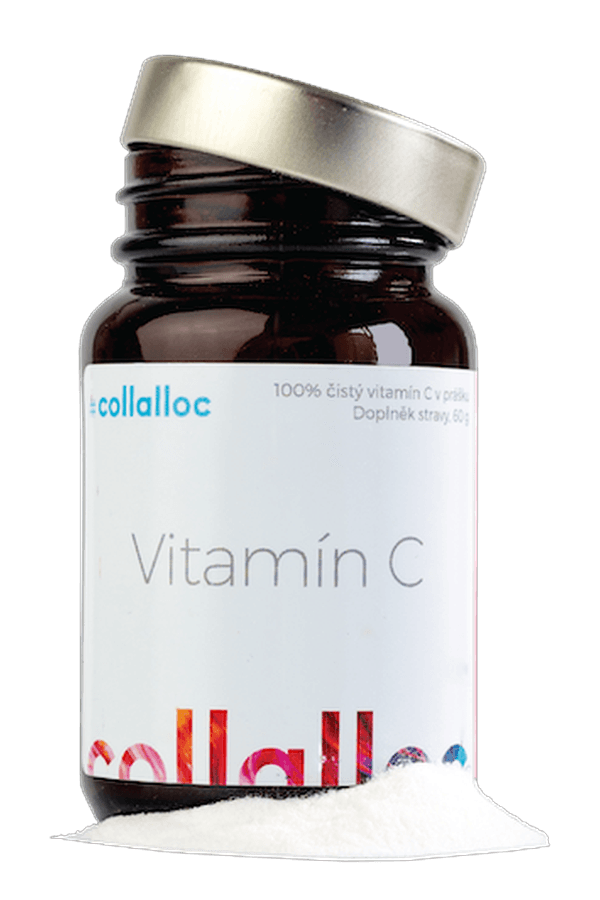
Vitamin C does have an authorised claim: it contributes to normal collagen formation for the normal function of skin. That is not a formality. Vitamin C is a cofactor for the enzymes without which the body cannot assemble a stable collagen fibre from amino acids. Supplying the raw materials without it is like delivering bricks to a building site with no mortar.
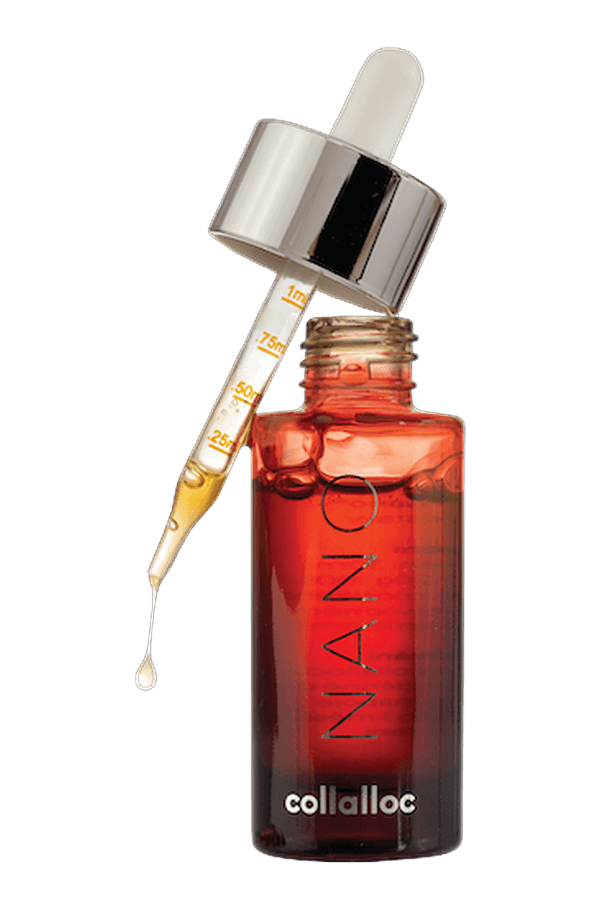
That is why the liquid NANO 2.0 contains 80 mg of vitamin C alongside 700 mg of marine collagen in every dose.
How to fit it into your day
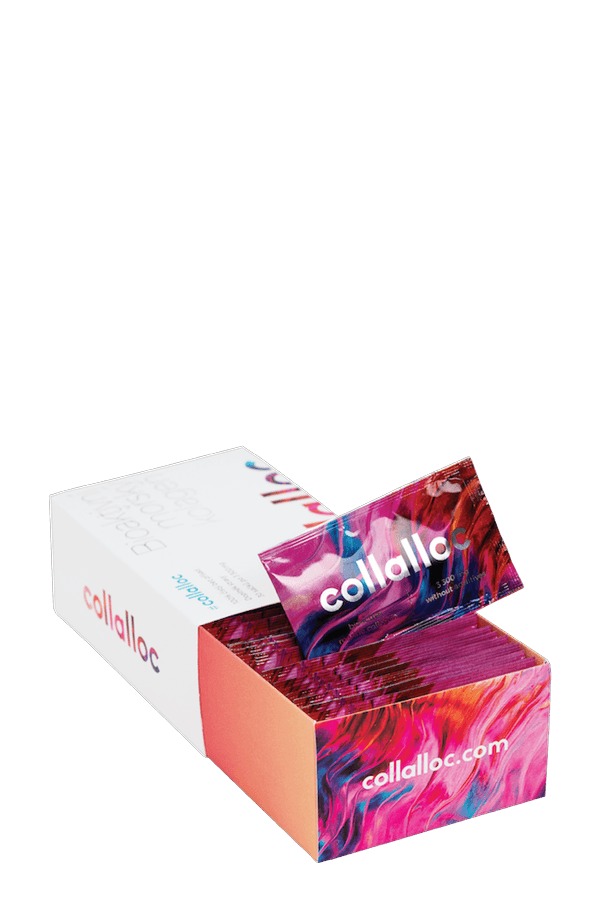
- Dose. The studies above used 1,000 mg a day and more. Our sachet contains 3,300 mg of marine collagen; the liquid NANO 2.0 has 700 mg in one millilitre plus vitamin C.
- Duration. Allow 8 to 12 weeks. Customers describe subjective changes from the third week; the studies measured the full effect at twelve.
- Temperature. Mix collagen into a cold or lukewarm drink, up to 60 °C at most. Higher temperatures denature the protein.
- Protein overall. Collagen is a supplement, not a replacement. While cutting calories, watch your total protein intake: it protects the muscle mass that creates volume under the skin.
- What else helps. A slower pace of weight loss, strength training and sun protection. UV radiation breaks down collagen in the skin faster than anything else on this list.
What collagen will not do
It will not fully prevent loose skin, and it will not override genetics, age, the starting condition of your skin and, above all, the speed and extent of the weight loss. For significant excess skin after major weight loss, the answer is a dermatologist or plastic surgery, not a food supplement.
If you are taking weight-loss medication, discuss any changes to your diet and supplements with a doctor who knows your health. Collagen supports a process the body carries out on its own. At a time when the body is changing faster than usual, that support makes sense.
Sources
- Iwai K. et al. Identification of food-derived collagen peptides in human blood after oral ingestion of gelatin hydrolysates. Journal of Agricultural and Food Chemistry, 2005. doi.org/10.1021/jf050206p
- de Miranda R. B. et al. Effects of hydrolyzed collagen supplementation on skin aging: a systematic review and meta-analysis. International Journal of Dermatology, 2021. doi.org/10.1111/ijd.15518
- Ohara H. et al. Collagen-derived dipeptide, proline-hydroxyproline, stimulates cell proliferation and hyaluronic acid synthesis in cultured human dermal fibroblasts. Journal of Dermatology, 2010. doi.org/10.1111/j.1346-8138.2010.00827.x
- Kim D. U. et al. Oral intake of low-molecular-weight collagen peptide improves hydration, elasticity, and wrinkling in human skin. Nutrients, 2018. doi.org/10.3390/nu10070826
- Myung S. K., Park Y. Effects of collagen supplements on skin aging: a systematic review and meta-analysis of randomized controlled trials. The American Journal of Medicine, 2025. doi.org/10.1016/j.amjmed.2025.04.034
- Paschou I. A. et al. GLP-1RA and the possible skin aging. Endocrine, 2025. doi.org/10.1007/s12020-025-04293-w
Frequently asked questions
Will collagen help with so-called Ozempic face?
Hollow cheeks during rapid weight loss are mainly caused by the loss of subcutaneous fat, and a food supplement will not bring that back. Collagen peptides target the other part of the problem: the firmness and elasticity of the skin itself. Studies report improvements in hydration and elasticity after 8 to 12 weeks, but independent data are still scarce.
How much collagen should I take a day while losing weight?
Clinical studies on skin most often used doses from 1,000 mg a day upwards. Improvements in hydration and wrinkles appeared with as little as 1,000 mg of low-molecular-weight peptide after 12 weeks (Kim et al., 2018). Our sachet contains 3,300 mg of marine collagen; the liquid NANO 2.0 has 700 mg per dose plus 80 mg of vitamin C.
How long until I see results?
Customers usually describe subjective changes in their skin between the third and fourth week. Studies measured improved hydration after 6 weeks and improved appearance of wrinkles after 12 weeks. A course shorter than 8 weeks does not give the body enough time for the change to become measurable.
Why marine collagen in particular?
Molecule size is what matters. Hydrolysed peptides of around 500 Daltons pass through the gut wall more easily than longer chains, and it is intact peptides such as Pro-Hyp that are measured in the blood after drinking (Iwai et al., 2005). Fish collagen also has a different amino acid profile and a lower denaturation temperature than bovine collagen, which is why we do not mix it into hot drinks.
Can collagen replace protein in my diet while losing weight?
No. Collagen does not contain all the essential amino acids; it lacks tryptophan, so it is not a complete protein. While cutting calories, treat it as a targeted source of glycine, proline and hydroxyproline alongside your normal protein intake, not instead of it.