MagazineCollagen bioavailability and daltons: molecular weight made simple
Collagen bioavailability and daltons: molecular weight made simple
What do daltons and bioavailability on a collagen pack mean? Simply explained: molecular weight, peptide absorption and what studies have actually found.
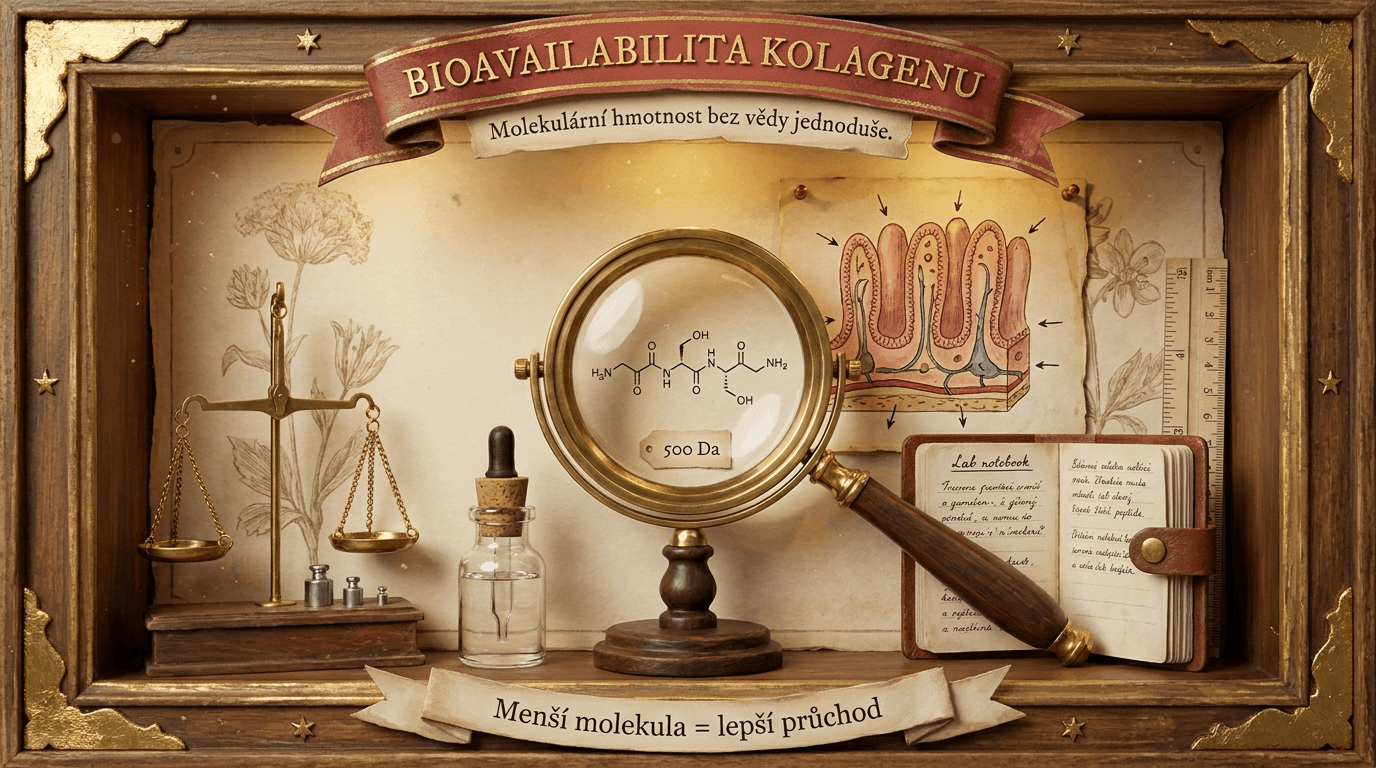
Short answer: bioavailability tells you what share of the collagen you swallow reaches the blood, and molecular weight in daltons (Da) tells you how large its peptides are. Collagen that had undergone further enzymatic splitting was absorbed faster and in greater amounts in a Danish study with 10 men (Skov et al., 2019). But the differences need not be large: in a study that compared fish, pork and bovine hydrolysates, the bovine ones at both 2,000 and 5,000 Da, the uptake of free hydroxyproline was comparable (Virgilio et al., 2024). The well-known 500 Da threshold comes from research on the skin, not the intestine (Bos and Meinardi, 2000). So take the number on the pack as information about the raw material, not as a promise of an effect.
What collagen bioavailability is
Bioavailability, also called biological availability, is the share of a substance from a swallowed dose that reaches the bloodstream. For medicines it is measured fairly directly. For collagen it is more complicated: it is a protein, the body breaks it down into amino acids and short peptides, and these mix with amino acids from other food.
Researchers therefore rely on the amino acid hydroxyproline. Collagen is rich in it, just as it is in glycine and proline (Skov et al., 2019), so when hydroxyproline in the blood rises after drinking collagen, it is a trace of the collagen that was drunk. Both free hydroxyproline and hydroxyproline bound in peptides are measured. In a study with five men, peptides made up about 30% of all hydroxyproline in the blood (Ohara et al., 2007).
What a dalton and molecular weight are
The dalton (Da) is a unit of molecular mass. One dalton is roughly the mass of a hydrogen atom, a water molecule has 18 Da and glucose 180 Da. A collagen hydrolysate is a mixture of peptides of different lengths, so the figure in daltons on the pack describes the typical size of the peptides in the raw material.
| Molecule | Size | Note |
|---|---|---|
| Water | 18 Da | For comparison |
| Glucose | 180 Da | For comparison |
| Pro-Hyp | about 228 Da | Dipeptide from blood |
| Gly-Pro-Hyp | about 285 Da | Tripeptide |
| collalloc kolagen | around 500 Da | Raw material figure |
| Typical hydrolysate | 3,000 to 6,000 Da | Review of studies |
| Whole collagen | many times more | Not absorbed intact |
Pro-Hyp is the main collagen peptide found in the blood after drinking collagen (Iwai et al., 2005). The range of 3,000 to 6,000 Da for typical hydrolysed collagen is given in the review by León-López et al. (2019).
How peptides get into the blood
In the intestine, collagen peptides are split further. Free amino acids then enter the cells of the intestinal lining, along with dipeptides and tripeptides carried by the transporter PEPT1. It can handle practically any dipeptide and tripeptide, but it does not take up peptides of four or more amino acids (Daniel, 2004). That is why, after drinking collagen, mainly short peptides are found in the blood, most of all the dipeptide Pro-Hyp, peaking after 1 to 2 hours (Iwai et al., 2005).
However, longer peptides can also pass through the intestinal wall. In experiments in mice, peptides of 2,500 to 15,000 Da were also found after passage through the intestine (Oesser et al., 1999). The idea that collagen above a certain dalton threshold “does not get through at all” therefore does not match what the studies saw. We describe it step by step in the article Collagen absorption.
Is a smaller molecule always better?
More extensively split collagen was absorbed faster, but the differences are not as big as adverts suggest. Two studies in humans:
- A Danish study with 10 men compared 35 g of collagen that had undergone further enzymatic splitting with the same dose without this splitting and with a placebo. After the split collagen, glycine, proline and hydroxyproline in the blood rose faster and more overall (Skov et al., 2019).
- A randomised double-blind study compared hydrolysates from fish, pigs and cattle, the bovine one in two sizes, 2,000 and 5,000 Da. The uptake of free hydroxyproline was comparable for all of them, and all led to substantial levels of the measured substances in the blood. Most of the authors work for a collagen manufacturer. The authors themselves write that larger studies are needed (Virgilio et al., 2024).
So the results are mixed: further splitting sped up absorption, but no big difference was seen between 2,000 and 5,000 Da. The dose also plays a role: in four volunteers, the level of peptides in the blood rose with the amount of collagen drunk (Shigemura et al., 2014).
Where the 500 Da rule comes from
You know the 500 Da threshold from collagen adverts, but it originally belongs to the skin. The 500 dalton rule says that only substances up to about 500 Da pass through intact skin, and larger molecules do not penetrate the horny layer (Bos and Meinardi, 2000). For collagen in a cream this holds: the whole collagen molecule is many times larger and therefore stays on the surface of the skin. For collagen you drink, what matters most is digestion into short peptides in the intestine. We describe the difference in the article Collagen vs. collagen cream.
What an absorbability percentage on the pack means
The human studies we went through for this article do not give collagen bioavailability as a single percentage. They track how fast and how high hydroxyproline and collagen peptides rise in the blood (Shigemura et al., 2014; Virgilio et al., 2024). When you see a percentage on a pack, ask which study it comes from, how many people it was measured in and at what dose.
The marine collagen from collalloc has a molecular weight of around 500 Da and an absorbability of 95%.
How to read a collagen pack: three questions
- How many daltons? Look for a specific number, not just “low molecular weight” or “small molecule”.
- From what raw material? Fish, cattle or pigs. The composition of peptides in the blood depends on the raw material (Ohara et al., 2007), and so does who must not take the collagen because of an allergy, more in the article Marine or bovine collagen?
- Where does the absorbability figure come from? A study with a stated dose and number of people carries more weight than a percentage without a source.
How we do it at collalloc
collalloc kolagen is marine collagen from North Sea fish, and the raw material is hydrolysed in Switzerland to a molecular weight of around 500 Da. A sachet contains 3,300 mg of type I, II and III collagen without fillers, colourings or sweeteners and is stirred into a cold or lukewarm drink up to 60 °C. The liquid collalloc NANO 2.0 contains 700 mg of marine collagen and 80 mg of vitamin C in 1 ml. Vitamin C contributes to normal collagen formation for the normal function of skin. We test microbiology in every batch and heavy metals every month.
Frequently asked questions
What is a dalton?
The dalton (Da) is a unit of molecular mass. One dalton corresponds roughly to the mass of a hydrogen atom, a water molecule has 18 Da and glucose 180 Da. For collagen, the figure in daltons describes how large the peptides in the hydrolysate are.
How many daltons should collagen have?
There is no fixed threshold. Typical hydrolysed collagen has 3,000 to 6,000 Da (León-López et al., 2019), and in one study bovine hydrolysates of 2,000 and 5,000 Da were absorbed comparably (Virgilio et al., 2024). collalloc kolagen has around 500 Da.
What is collagen bioavailability?
It is the share of swallowed collagen that reaches the blood. It is measured indirectly by hydroxyproline and collagen peptides in the blood, whose level is highest 1 to 2 hours after drinking (Iwai et al., 2005).
What are tripeptides?
A tripeptide is three amino acids joined together, a dipeptide two. In the intestine they are carried into the cells by the transporter PEPT1, which does not take up peptides of four or more amino acids (Daniel, 2004). A typical collagen tripeptide is Gly-Pro-Hyp.
Is collagen with a smaller molecule absorbed better?
Faster, yes, but the differences are smaller than adverts suggest. After collagen that had undergone further enzymatic splitting, amino acids in the blood rose faster and more (Skov et al., 2019), but in another study bovine hydrolysates of 2,000 and 5,000 Da were absorbed comparably (Virgilio et al., 2024).
Does the 500 Da rule apply to collagen?
The 500 dalton rule describes the penetration of substances through intact skin (Bos and Meinardi, 2000), not absorption in the intestine. So it applies to collagen in a cream, while for collagen you drink, what matters most is digestion into short peptides.
Sources
- Enzymatic Hydrolysis of a Collagen Hydrolysate Enhances Postprandial Absorption Rate-A Randomized Controlled Trial Skov K., Oxfeldt M., Thøgersen R., Hansen M., Bertram H. C., Nutrients, 2019
- Absorption of bioactive peptides following collagen hydrolysate intake: a randomized, double-blind crossover study in healthy individuals Virgilio N., Schön C., Mödinger Y., van der Steen B., Vleminckx S., van Holthoon F. L., Frontiers in Nutrition, 2024
- The 500 Dalton rule for the skin penetration of chemical compounds and drugs Bos J. D., Meinardi M. M., Experimental Dermatology, 2000
- Comparison of quantity and structures of hydroxyproline-containing peptides in human blood after oral ingestion of gelatin hydrolysates from different sources Ohara H., Matsumoto H., Ito K., Iwai K., Sato K., Journal of Agricultural and Food Chemistry, 2007
- Hydrolyzed Collagen-Sources and Applications León-López A., Morales-Peñaloza A., Martínez-Juárez V. M., Vargas-Torres A., Zeugolis D. I., Aguirre-Álvarez G., Molecules, 2019
- Identification of food-derived collagen peptides in human blood after oral ingestion of gelatin hydrolysates Iwai K., Hasegawa T., Taguchi Y., Morimatsu F., Sato K., Nakamura Y., Journal of Agricultural and Food Chemistry, 2005
- Molecular and integrative physiology of intestinal peptide transport Daniel H., Annual Review of Physiology, 2004
- Oral administration of (14)C labeled gelatin hydrolysate leads to an accumulation of radioactivity in cartilage of mice (C57/BL) Oesser S., Adam M., Babel W., Seifert J., The Journal of Nutrition, 1999
- Dose-dependent changes in the levels of free and peptide forms of hydroxyproline in human plasma after collagen hydrolysate ingestion Shigemura Y., Kubomura D., Sato Y., Sato K., Food Chemistry, 2014