MagazineCollagen cream vs. collagen in a sachet: what each can and cannot do
Collagen cream vs. collagen in a sachet: what each can and cannot do
Does collagen cream work for skin? Why collagen from a cream does not reach the dermis, what a cream can do and what studies of drinkable collagen showed.

Short answer: a collagen cream and collagen in a sachet each do something different. A collagen molecule is around 300 kDa, roughly 300,000 Da, and intact skin generally lets through only substances smaller than 500 Da (Agustina et al., 2023; Bos and Meinardi, 2000). Collagen from a cream therefore stays mainly on the surface, where it hydrates the skin. Drinkable collagen is broken down into peptides that appear in the blood (Iwai et al., 2005), and placebo-controlled studies with it measured skin elasticity and hydration. Independent and high-quality studies, however, did not confirm an improvement (Myung and Park, 2025).
Why collagen from a cream does not reach the dermis
The skin has three main layers: the epidermis, beneath it the dermis, and the subcutaneous tissue. The collagen people talk about in connection with skin firmness is in the dermis, where it is made by cells called fibroblasts. At the very surface of the epidermis lies the horny layer (stratum corneum), the skin’s main barrier.
According to the 500 Dalton rule, only molecules smaller than about 500 Da pass through intact skin. The authors base it on the fact that practically all common contact allergens, the most widely used drugs in dermatology and all drugs in transdermal patches are below this limit, and larger molecules do not pass through the horny layer (Bos and Meinardi, 2000). Native collagen is around 300 kDa, about 600 times more, and its penetration through the skin is limited by its size (Agustina et al., 2023).
Native collagen is collagen in its original form, as the body makes it: three long protein chains twisted into a triple helix. Hydrolysed collagen is the same protein split by enzymes into short peptides, which is why it is much smaller.
What a collagen cream can do
In cosmetics, collagen works mainly as a moisturising ingredient. A review of hydrolysed collagen describes it as a safe cosmetic ingredient with good moisturising properties in the horny layer of the skin (Aguirre-Cruz et al., 2020). Some of the authors work for the Mexican collagen manufacturer Uni-Collagen. A cream can therefore soften and hydrate the skin on the surface, but this is an effect in the epidermis, not a change to the collagen in the dermis.
Research on small collagen peptides in cosmetics is more interesting. In a laboratory model (a Franz diffusion cell), peptides from tilapia scales passed through the horny layer into the epidermis and dermis, and the larger ones, of 3,500 and 4,500 Da, did so better than the smaller ones (Chai et al., 2010). This contradicts the 500 Dalton rule and shows that the penetration of peptides through the skin is not a simple question. However, it was a laboratory model, not a measurement in human skin. In the same study, 62 women applied a serum with 5 to 10% of these peptides twice a day for 30 days, and measured skin elasticity rose by 24 to 35%. The study had no placebo group, though, so it is impossible to say how much was due to the collagen itself and how much to the serum base or regular skincare.
What studies of drinkable collagen looked at
Drinkable collagen takes a different route. In the digestive tract it is broken down into small peptides and amino acids, and some of the peptides reach the blood. When volunteers drank 9.4 to 23 g of collagen hydrolysate, the level of hydroxyproline-containing peptides in the blood peaked after 1 to 2 hours and fell to half after 4 hours. The main one was the dipeptide Pro-Hyp (Iwai et al., 2005). We describe how this works in the article Is the collagen I drink absorbed?
Randomised placebo-controlled studies looked at the skin. In one frequently cited study, 69 women aged 35 to 55 took 2.5 g or 5 g of collagen hydrolysate daily for 8 weeks, or a placebo. Skin elasticity improved in both collagen groups, the difference in hydration did not reach statistical significance, and no side effects occurred (Proksch et al., 2014). A meta-analysis of 19 studies with 1,125 participants aged 20 to 70, the vast majority of them women, came out favourably for hydration, elasticity and wrinkles, and according to the authors the results showed after about 90 days of use (de Miranda et al., 2021).
To be fair, the other side has to be added too. A more recent meta-analysis of 23 randomised studies with 1,474 participants found improvements in hydration, elasticity and wrinkles only in studies funded by companies. Studies without such funding and high-quality studies found no effect, and the authors conclude that evidence from human studies to support the use of collagen supplements against skin ageing is still lacking (Myung and Park, 2025).
Cream or supplement: a comparison
| Question | Collagen cream | Drinkable collagen |
|---|---|---|
| Where it goes | Onto the skin surface | Peptides into the blood |
| What is measured | Surface hydration | Elasticity, hydration |
| When | Right after applying | Studies of 8 weeks or longer |
| Strength of evidence | Few studies | Conflicting results |
| Protects against UV | Only with an SPF filter | No |
How to read the label
- A cream with the ingredient “Collagen” or “Soluble Collagen”: native collagen. It hydrates the surface of the skin but does not get into the dermis.
- A cream with the ingredient “Hydrolyzed Collagen”: collagen split into smaller peptides. It also hydrates, and there are only laboratory data on penetration into deeper layers (Chai et al., 2010).
- Drinkable collagen: look for hydrolysed collagen, a clearly stated source (fish, cattle, pigs), the dose in grams per day and a composition without unnecessary additives. In the study by Proksch et al. (2014), skin elasticity improved with 2.5 g just as with 5 g a day, so more does not automatically mean better.
Does it make sense to combine a cream and a supplement?
A cream and a supplement do not rule each other out, as each concerns a different layer and a different question. A cream deals with surface hydration straight away, while research on drinkable collagen looks at the skin after weeks of use. We did not find a study in the PubMed database that directly compared a cream with a supplement or examined their combination. You can find more about the research in the article Marine collagen for skin: what the science really says.
How we do it at collalloc
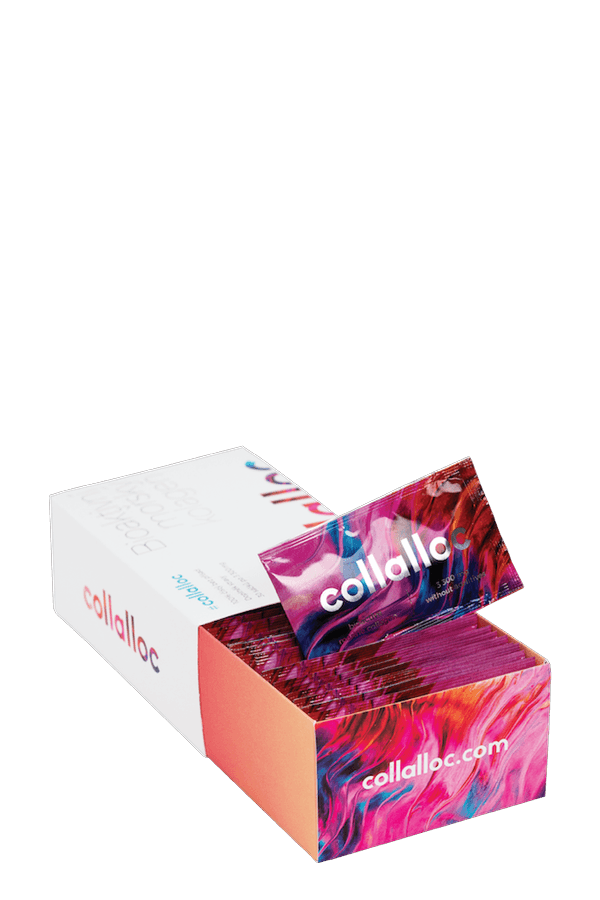
collalloc kolagen is drinkable collagen: one sachet contains 3,300 mg of hydrolysed marine collagen types I, II and III with a molecular weight of around 500 Da, with no fillers, colourings or sweeteners. Stir it into 200 ml of a cold or lukewarm drink up to 60 °C. What molecular weight means for drinkable collagen is explained in the article Collagen bioavailability and molecular weight. What studies on collagen and skin show is summarised on our Collagen for skin page.
Frequently asked questions
Does collagen cream work for skin?
On the surface, yes, mainly as a moisturising ingredient in the horny layer of the skin (Aguirre-Cruz et al., 2020). Native collagen from a cream does not, however, reach the dermis, where the skin’s collagen is: it is around 300 kDa, and generally only substances smaller than 500 Da pass through the skin (Agustina et al., 2023; Bos and Meinardi, 2000).
Is collagen absorbed through the skin?
Not into the deeper layers of the skin. A native collagen molecule is around 300 kDa, roughly 300,000 Da, while generally only substances up to about 500 Da penetrate intact skin (Bos and Meinardi, 2000; Agustina et al., 2023). Smaller peptides from fish collagen passed into the epidermis and dermis in a laboratory model (Chai et al., 2010), but measurements in human skin are lacking.
What is native collagen?
Native collagen is collagen in its original form, as the body makes it: three protein chains twisted into a triple helix with a molecular weight of around 300 kDa (Agustina et al., 2023). In creams it is listed as Collagen or Soluble Collagen. Hydrolysed collagen is split into much smaller peptides.
Is collagen better in a cream or in a sachet?
It depends on what you expect from it. A cream hydrates the surface of the skin right after you apply it, while drinkable collagen was assessed in studies after weeks, for example 69 women took 2.5 or 5 g a day for 8 weeks (Proksch et al., 2014). However, the results of supplement studies are conflicting, and independent studies found no improvement (Myung and Park, 2025).
How do I recognise good-quality collagen on the label?
For drinkable collagen, look for hydrolysed collagen, a stated source (fish, cattle, pigs), the dose in grams per day and a composition without unnecessary additives. On a cream, “Collagen” stands for native collagen, which stays on the surface, and “Hydrolyzed Collagen” for smaller peptides, for which there are so far only laboratory data on penetration into the skin (Chai et al., 2010).
What did studies of drinkable collagen show?
A meta-analysis of 19 studies with 1,125 participants came out favourably for hydration, elasticity and wrinkles (de Miranda et al., 2021). A more recent meta-analysis of 23 studies with 1,474 participants, however, found improvements only in studies funded by companies, not in independent and high-quality studies (Myung and Park, 2025).
Sources
- The 500 Dalton rule for the skin penetration of chemical compounds and drugs Bos J. D., Meinardi M. M., Experimental Dermatology, 2000
- Challenges and strategies for collagen delivery for tissue regeneration Agustina L., Miatmoko A., Hariyadi D. M., Journal of Public Health in Africa, 2023
- Collagen Hydrolysates for Skin Protection: Oral Administration and Topical Formulation Aguirre-Cruz G., León-López A., Cruz-Gómez V., Jiménez-Alvarado R., Aguirre-Álvarez G., Antioxidants (Basel), 2020
- Effects of sizes and conformations of fish-scale collagen peptides on facial skin qualities and transdermal penetration efficiency Chai H. J., Li J. H., Huang H. N., Li T. L., Chan Y. L., Shiau C. Y., Journal of Biomedicine and Biotechnology, 2010
- Identification of food-derived collagen peptides in human blood after oral ingestion of gelatin hydrolysates Iwai K., Hasegawa T., Taguchi Y., Morimatsu F., Sato K., Nakamura Y., Journal of Agricultural and Food Chemistry, 2005
- Oral supplementation of specific collagen peptides has beneficial effects on human skin physiology: a double-blind, placebo-controlled study Proksch E., Segger D., Degwert J., Schunck M., Zague V., Oesser S., Skin Pharmacology and Physiology, 2014
- Effects of hydrolyzed collagen supplementation on skin aging: a systematic review and meta-analysis de Miranda R. B., Weimer P., Rossi R. C., International Journal of Dermatology, 2021
- Effects of Collagen Supplements on Skin Aging: A Systematic Review and Meta-Analysis of Randomized Controlled Trials Myung S. K., Park Y., The American Journal of Medicine, 2025