MagazineWhat to avoid when taking collagen: 8 common mistakes
What to avoid when taking collagen: 8 common mistakes
What to avoid when taking collagen: hot drinks, fish allergy, double doses, sweeteners and other mistakes. Plus: does collagen make you gain weight or poop?

Short answer: when taking collagen, avoid three things above all: drinks hotter than 60 °C, marine collagen if you have a fish allergy, and doubling the dose. Take it every day rather than now and then, and judge the result after 8 to 12 weeks at the earliest, since most studies lasted 8 to 24 weeks (Choi et al., 2019). Do not use it to replace protein from food, as it lacks the amino acid tryptophan (Paul et al., 2019), and read the label, because sweeteners such as sorbitol can have a laxative effect (Lenhart and Chey, 2017). If you are prone to kidney stones, are pregnant or take medication, talk to your doctor first.
At a glance: 8 mistakes and what to do instead
| Mistake | Why it matters | Instead |
|---|---|---|
| Boiling coffee or tea | Marine collagen is sensitive to heat | A drink up to 60 °C |
| Fish allergy | Fish collagen is an allergen | Skip marine collagen |
| Taking it now and then | Studies used a daily dose | One sachet a day |
| Judging after a week | Most studies lasted 8 to 24 weeks | Wait at least 8 weeks |
| Double dose | More is not better | The dose on the pack |
| Collagen instead of food | It lacks tryptophan | Keep eating protein |
| Not reading the label | Sweeteners can be laxative | Read the label |
| Skipping the doctor | Stones, medication, pregnancy | Ask your doctor |
1. Stirring collagen into hot coffee or boiling water
This mistake is the easiest to fix. Collagen belongs in a cold or lukewarm drink, up to 60 °C at most: water, juice, milk, a smoothie or yoghurt. Freshly boiled water and hot coffee are well above that, so let them cool first. Marine collagen is more sensitive to heat than bovine collagen because it contains fewer of the amino acids that hold its structure together. We explain this in detail in Why marine collagen only up to 60 °C, and cover coffee in Collagen and hot coffee.
2. Taking marine collagen with a fish allergy
Marine collagen is made from fish, and fish collagen is a proven allergen. In a Japanese study, antibodies in the blood of five out of eight patients with a fish allergy reacted to tuna collagen. The reaction was shared across different fish species but did not extend to collagen from other animals (Hamada et al., 2001). If you have a fish allergy, do not take marine collagen and ask an allergist about other sources. Itching, a rash or swollen lips after the first doses are a reason to stop straight away and see a doctor. If you have trouble breathing, call 112.
3. Taking collagen only now and then
In the studies, people took collagen every day for weeks: eight of the 11 placebo-controlled studies in the review by Choi et al. (2019) gave 2.5 to 10 g of collagen hydrolysate a day for 8 to 24 weeks. No study has looked at taking it in bursts, three days on and a week off, so there is no reason to expect the same result. Choose a time when you will not forget it, such as your morning glass of water. Whether you take it in the morning or at night does not appear to be decisive in the available studies; more in How to take collagen.
4. Expecting results in a week, or a guaranteed result
Most studies in the review by Choi et al. (2019) assessed results after 8 to 24 weeks, so there is no point judging anything sooner. Photos in the same light at the start and after three months will tell you more than a glance in the mirror after a week. How to judge the result is covered in Taking collagen? 3 clear signs.
To be honest: even after three months, a result is not guaranteed. A meta-analysis of 23 randomised studies with 1,474 participants found improvements in skin only in studies funded by companies, while independent and high-quality studies did not measure any (Myung and Park, 2025). What research on collagen and skin shows so far is summarised on our Collagen for skin page.
5. Thinking more collagen is better
A double dose will not speed anything up. In a study of 69 women aged 35 to 55, skin elasticity improved compared with placebo at both 2.5 g and 5 g a day (Proksch et al., 2014), and the skin studies in the review by Choi et al. (2019) did not go above 10 g a day. We have not found a study that sets a safe upper limit for collagen. A higher dose does mean more hydroxyproline, part of which the body turns into oxalate: in an experiment with gelatin, urinary oxalate rose significantly after single doses of 5 and 10 g, but not after 1 and 2 g (Knight et al., 2006). If you forget a day, do not double up the next day, simply carry on. Stick to the dose on the pack, which for collalloc is one sachet a day.
6. Using collagen to replace protein from food
Collagen is a protein, but an incomplete one: it lacks the essential amino acid tryptophan (Paul et al., 2019). On its own it is not enough as a protein source and will not replace breakfast or lunch. The same paper calculated that collagen peptides can make up as much as 36% of the protein in a typical Western diet while essential amino acid needs are still met, and that the doses used in studies, 2.5 to 15 g a day, fall below that level (Paul et al., 2019; one of the authors works for a collagen manufacturer). So treat collagen as an addition to a varied diet, not a substitute for meat, fish, eggs, dairy or pulses.
7. Not reading the label: sweeteners and other additives
If a collagen product does not agree with you, look at the ingredients first. Polyols, sweeteners such as sorbitol, xylitol or maltitol, cause wind, abdominal discomfort and a laxative effect, more so the higher the dose, according to a review of 79 studies (Lenhart and Chey, 2017). Under EU Regulation 1169/2011, a product with more than 10% added polyols must carry the warning ‘excessive consumption may produce laxative effects’. Read the label especially carefully on gummies and flavoured drinks; the differences between forms are covered in Liquid collagen vs powder, capsules or gummies.
Combination products also carry the risks of their other ingredients: glucosamine is often made from shellfish, and biotin can distort some blood tests. You will find an overview in Collagen side effects.
8. Not checking with a doctor when there is a reason to
Collagen contains the amino acid hydroxyproline, part of which the body converts into oxalate, the main component of the most common type of kidney stone. After 30 g of gelatin a day, urinary oxalate was 43% higher than after the same amount of whey protein (Knight et al., 2006). The study does not claim that collagen causes stones. But if you are prone to oxalate stones, discuss it with a urologist and drink plenty of fluids.
Ask your doctor too if you are pregnant or breastfeeding, as targeted studies are lacking (more in Collagen during pregnancy and breastfeeding), if you have chronic kidney disease and your protein intake is being monitored, and if you take medication regularly, since interactions between collagen and medicines are not well described.
Does collagen make you gain weight?
Collagen is a protein, and under the conversion factors in EU Regulation 1169/2011 protein provides 17 kJ, or 4 kcal, per gram. One sachet with 3.3 g of collagen therefore provides about 56 kJ (13 kcal), a small amount of energy across a whole day of eating. More energy comes from whatever you mix it into, such as sweetened juice or a milkshake, and from products with added sugar or syrup, so count the whole drink. Collagen is not a weight loss product either, and we do not promise anything of the kind.
Does collagen make you poop or cause bloating?
Studies with collagen hydrolysate have not reported digestive problems: the review by Choi et al. (2019) lists no adverse events, and in the study by Proksch et al. (2014) no side effects appeared over 8 weeks. We have not found a study that looked at bowel movements, diarrhoea or constipation with pure collagen. If diarrhoea or wind follows a collagen product, check the sweeteners on the label first (see mistake 7). If your digestion is sensitive, start with half a dose for the first week, and if the problems continue, stop taking it and talk to your doctor.
How we do it at collalloc
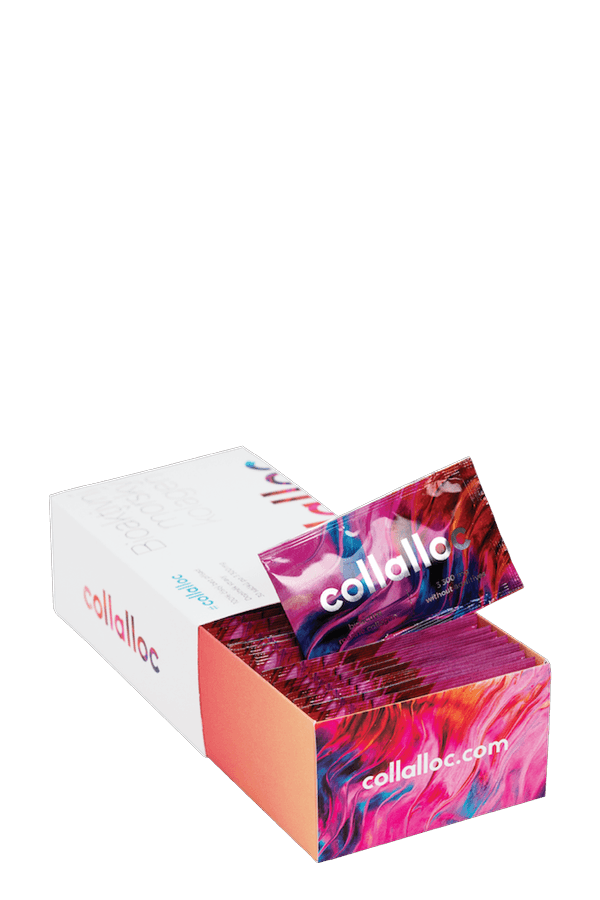
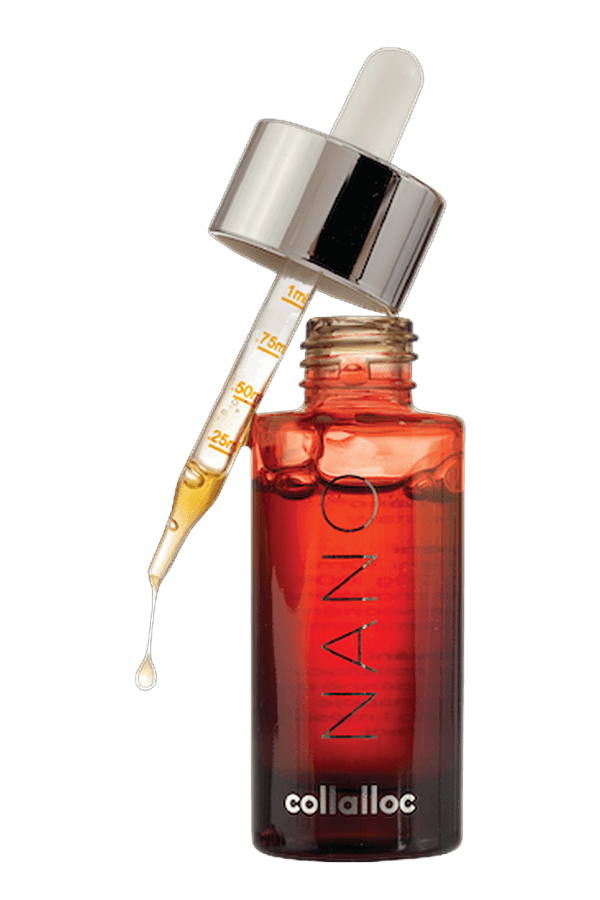
One sachet of collalloc collagen contains 3,300 mg of hydrolysed marine collagen with a molecular weight of around 500 Da, with no fillers, sweeteners, colourings or flavourings. A pack holds 30 sachets, one for each day. As the collagen comes from fish, it is not suitable if you have a fish allergy. If you would rather not mix anything, there is the liquid NANO 2.0 with vitamin C. Vitamin C contributes to normal collagen formation for the normal function of skin. Collagen itself has no approved health claim in the EU (Regulation 432/2012), which is why we talk about research, not promises. Microbiology is tested for every production batch and heavy metals every month by an external laboratory. You will find the results on our Laboratory page.
Frequently asked questions
What should you avoid when taking collagen?
Avoid drinks hotter than 60 °C, marine collagen if you have a fish allergy, double doses and using collagen to replace protein from food. Take it every day rather than now and then, and judge the result after 8 to 12 weeks at the earliest, since most studies lasted 8 to 24 weeks (Choi et al., 2019).
Can I put collagen in hot coffee?
Not in hot coffee, but lukewarm is fine. The drink should not be above 60 °C, so let hot coffee or tea cool first. Marine collagen is more sensitive to heat than bovine collagen.
Can you take too much collagen?
No study we found has set a safe upper limit. Skin studies used 2.5 to 10 g a day (Choi et al., 2019), and a higher dose does not mean a better result. If you are prone to kidney stones, be careful, because urinary oxalate rises after 5 g of gelatin or more (Knight et al., 2006). Stick to the dose on the pack.
Does collagen make you gain weight?
One sachet with 3.3 g of collagen provides about 13 kcal, as protein has 4 kcal per gram under EU Regulation 1169/2011. Any extra energy is more likely to come from a sweetened drink you mix it into.
Does collagen make you poop?
Studies with collagen hydrolysate have not reported adverse events (Choi et al., 2019), and we have not found a study on collagen and bowel movements. Sweeteners such as sorbitol or xylitol, found in some products, can have a laxative effect (Lenhart and Chey, 2017), so check the label.
Who should not take marine collagen?
People with a fish allergy, as fish collagen is a proven allergen (Hamada et al., 2001). If you are prone to kidney stones, have kidney disease, are pregnant or breastfeeding, or take medication regularly, talk to your doctor first.
Sources
- Oral Collagen Supplementation: A Systematic Review of Dermatological Applications Choi F. D., Sung C. T., Juhasz M. L., Mesinkovsk N. A., Journal of Drugs in Dermatology, 2019
- Oral supplementation of specific collagen peptides has beneficial effects on human skin physiology: a double-blind, placebo-controlled study Proksch E., Segger D., Degwert J., Schunck M., Zague V., Oesser S., Skin Pharmacology and Physiology, 2014
- Identification of collagen as a new fish allergen Hamada Y., Nagashima Y., Shiomi K., Bioscience, Biotechnology, and Biochemistry, 2001
- Hydroxyproline ingestion and urinary oxalate and glycolate excretion Knight J., Jiang J., Assimos D. G., Holmes R. P., Kidney International, 2006
- Significant Amounts of Functional Collagen Peptides Can Be Incorporated in the Diet While Maintaining Indispensable Amino Acid Balance Paul C., Leser S., Oesser S., Nutrients, 2019
- A Systematic Review of the Effects of Polyols on Gastrointestinal Health and Irritable Bowel Syndrome Lenhart A., Chey W. D., Advances in Nutrition, 2017
- Effects of Collagen Supplements on Skin Aging: A Systematic Review and Meta-Analysis of Randomized Controlled Trials Myung S. K., Park Y., The American Journal of Medicine, 2025
- Regulation (EU) No 1169/2011 on the provision of food information to consumers, Annex III and Annex XIV European Parliament and Council, Official Journal of the European Union, 2011
- Commission Regulation (EU) No 432/2012 establishing a list of permitted health claims made on foods European Commission, Official Journal of the European Union, 2012