MagazineHow to tell if collagen is working: 3 signs to watch
How to tell if collagen is working: 3 signs to watch
How do you know if collagen is working? Signs that collagen is working in skin, nails and hair, what studies measured, after how long, and how to track it yourself.

Short answer: you can tell whether collagen is working by three things: the elasticity and hydration of your skin, how often your nails break, and the condition of your hair. In studies, skin elasticity improved compared with placebo after 8 weeks (Proksch et al., 2014), hydration after 6 and 12 weeks (Kim et al., 2018), and nails and hair were assessed only after 24 weeks (Hexsel et al., 2017; Hwang et al., 2026). So judge the result after 8 to 12 weeks of daily use at the earliest, based on photos in the same light and short notes. It is not guaranteed, though: studies that were not funded by pharmaceutical companies did not measure any improvement in skin (Myung and Park, 2025).
What the studies measured and after how long
Collagen studies do not assess the impression from a look in the mirror. They measure specific values with instruments and compare them with placebo. Of the 11 placebo-controlled studies in the review by Choi et al. (2019), eight gave 2.5 to 10 g of collagen hydrolysate a day for 8 to 24 weeks. Research says almost nothing about shorter use.
| Sign | What was measured | When |
|---|---|---|
| Skin elasticity | Elasticity by instrument | After 8 weeks |
| Skin hydration | Skin moisture | After 6 and 12 weeks |
| Nails | Growth and breakage | After 24 weeks |
| Hair | Hair thickness | After 24 weeks |
Sign 1: skin elasticity and hydration
The skin is the best researched. In a randomised study, 69 women aged 35 to 55 received 2.5 g or 5 g of collagen peptides, or a placebo, every day for 8 weeks. At the end, skin elasticity had improved more in both collagen groups than with placebo. Skin hydration, however, did not change significantly in statistical terms, and only a hint of a change appeared in part of the group (Proksch et al., 2014).
In another study, 64 people took 1,000 mg of a low-molecular-weight collagen peptide a day, or a placebo. Skin hydration was higher in the collagen group after both 6 and 12 weeks (Kim et al., 2018). Some of the authors work for companies in the field, which is a common situation in collagen studies.
What this means for you: the changes that instruments pick up tend to be small and are easy to miss in the mirror. Your skin also changes its appearance with sleep, weather, your cycle and cosmetics. So it only makes sense to compare photos taken under the same conditions and to look at a longer period, not a single day. What research shows so far about collagen and skin is summarised on our page Collagen for skin.
Sign 2: nails that break less
For nails, we have one smaller study. Twenty-five people with brittle nails took 2.5 g of collagen peptides a day for 24 weeks. Their nails grew 12% faster and there were 42% fewer broken nails (Hexsel et al., 2017). The study had no placebo group, however, so we do not know how much of this would have changed without collagen too.
Nails also grow slowly: a fingernail grows by 3.47 mm a month on average (Yaemsiri et al., 2010). The new part of the nail therefore only grows out after several months, and an earlier assessment will not tell you much. A simple way to track it: write down how many of your nails broke or chipped in a month. You will find more about nails on our page Collagen for nails.
Sign 3: hair
Hair has the least research. In a randomised study, 114 women aged 20 to 50 who reported thinning hair took 1,000 mg of a low-molecular-weight fish collagen peptide a day, or a placebo. After 24 weeks, hair thickness in the collagen group was significantly greater than with placebo (Hwang et al., 2026). This is a single study, in which people from the development team of a food supplement company were also involved, and it measured hair thickness, not how much hair falls out.
So judge your hair after six months at the earliest. Compare photos of your parting or ponytail in the same light. How many hairs stay in your comb changes from day to day, so on its own it is not a sufficient measure. We write about this in more detail in the article Collagen for hair.
How to track the result yourself
- A photo at the start. Before you begin, photograph your face, nails and hair. Same place, same time of day, light from a window, no make-up and the same distance.
- The same photos every 4 weeks. Without the same conditions, you are comparing the light rather than your skin.
- Short notes. How many nails broke in a month, how your skin looks after washing without cream, and what else changed: sleep, sun, new cosmetics, illness.
- The same dose every day. The studies relied on daily use. Stir collagen into a cold or lukewarm drink up to 60 °C.
- Assessment at the right time. Skin after 8 to 12 weeks at the earliest, nails and hair after 24 weeks, that is, after roughly six months.
The most common mistakes that distort the result, such as a hot drink or taking it only now and then, are described in the article What to avoid when taking collagen.
Why the result is not guaranteed
To be honest: even after three months, you may not see a change. A meta-analysis of 23 randomised studies with 1,474 participants did show better hydration, elasticity and wrinkles overall. Studies that were not funded by pharmaceutical companies, however, did not measure any effect, and neither did the high-quality studies. The authors conclude that evidence for using collagen against skin ageing is still lacking (Myung and Park, 2025).
Results also vary from person to person. If after 12 weeks of regular use you see no difference in your photos or in your notes, that is a result too, and it is fine to stop taking collagen.
How we do it at collalloc
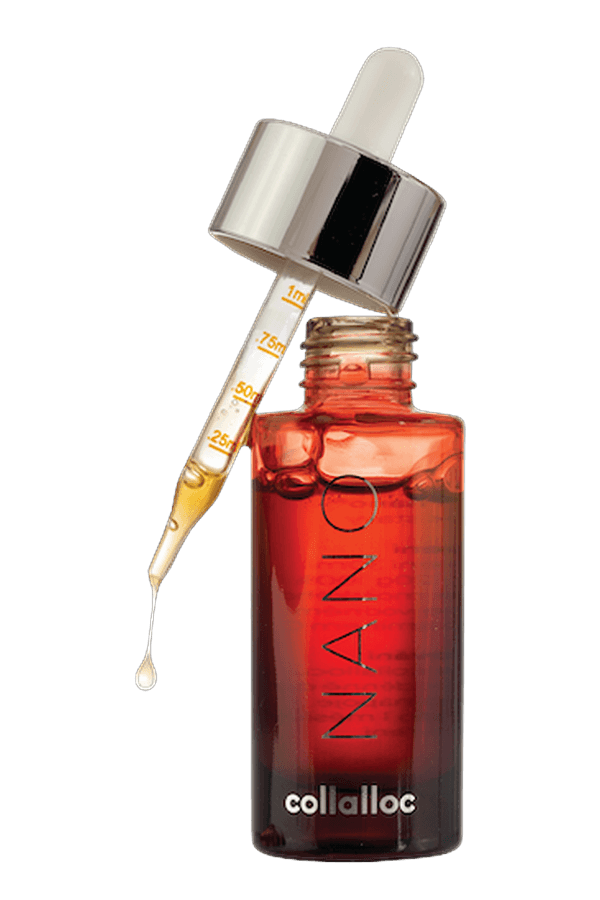
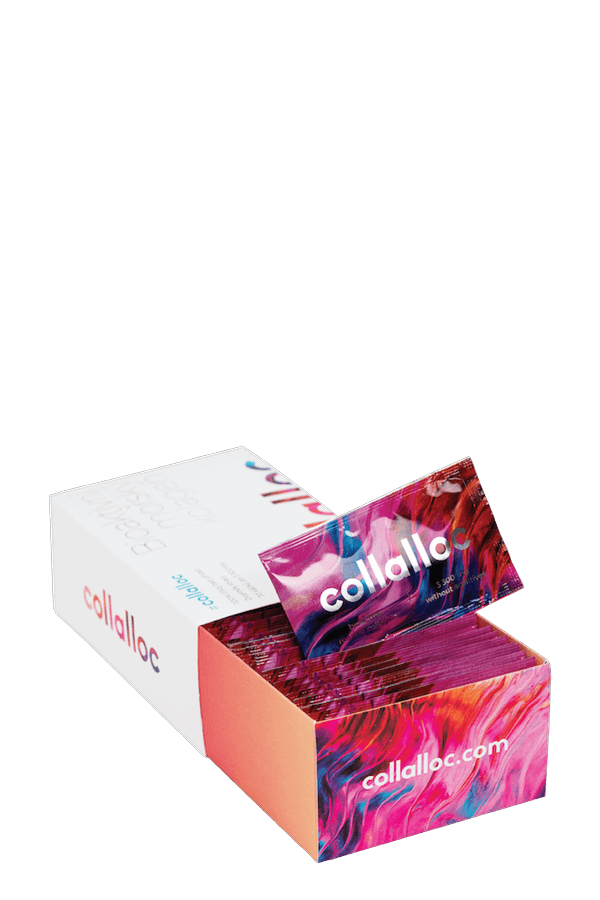
One sachet of collalloc kolagen contains 3,300 mg of marine collagen from North Sea fish with a molecular weight of around 500 Da, with no fillers, colourings or sweeteners. Its absorbability is 95%. A pack contains 30 sachets, one for each day, and three packs will last the 12 weeks after which it makes sense to assess your skin. If you would rather not mix anything, you can reach for the liquid NANO 2.0 with 700 mg of collagen and 80 mg of vitamin C in 1 ml. Vitamin C contributes to normal collagen formation for the normal function of skin.
Frequently asked questions
How do you know if collagen is working?
There is no reliable home test. Watch the elasticity and hydration of your skin, how often your nails break and the condition of your hair, and compare photos taken in the same light. In studies, skin elasticity improved compared with placebo after 8 weeks (Proksch et al., 2014), and nails and hair were assessed after 24 weeks (Hexsel et al., 2017; Hwang et al., 2026).
How long does it take to see signs that collagen is working?
For skin, count on at least 8 to 12 weeks of daily use, and on 24 weeks for nails and hair. The studies mostly gave collagen for 8 to 24 weeks (Choi et al., 2019) and say almost nothing about shorter periods. The result is not guaranteed, though.
What did studies show for nails and hair?
In a study of 25 people, nails grew 12% faster after 24 weeks and there were 42% fewer broken nails, but the study had no placebo (Hexsel et al., 2017). For hair, a study of 114 women found greater hair thickness after 24 weeks than with placebo (Hwang et al., 2026). Both studies are small, so take their conclusions with caution.
How can I track the result myself?
Take a photo of yourself before the first dose and repeat it every 4 weeks in the same place, in the same light and without make-up. Write down how many nails broke in a month. A fingernail grows by 3.47 mm a month on average (Yaemsiri et al., 2010), so only assess changes in your nails after several months.
Is it better to take collagen in the morning or in the evening?
We found no study that compared taking it in the morning and in the evening. What the studies mainly had in common was daily use over whole weeks, most often 2.5 to 10 g a day for 8 to 24 weeks (Choi et al., 2019). Choose a time when you will not forget your collagen.
What if I see no change after 60 days?
Check that you take collagen every day at the dose on the pack, for collalloc 1 sachet with 3,300 mg, and in a drink up to 60 °C. The studies lasted 8 to 24 weeks (Choi et al., 2019), so 60 days is more of a beginning. The result is not guaranteed, though: studies without funding from pharmaceutical companies did not measure any improvement in skin (Myung and Park, 2025).
Sources
- Oral supplementation of specific collagen peptides has beneficial effects on human skin physiology: a double-blind, placebo-controlled study Proksch E., Segger D., Degwert J., Schunck M., Zague V., Oesser S., Skin Pharmacology and Physiology, 2014
- Oral Intake of Low-Molecular-Weight Collagen Peptide Improves Hydration, Elasticity, and Wrinkling in Human Skin: A Randomized, Double-Blind, Placebo-Controlled Study Kim D. U., Chung H. C., Choi J., Sakai Y., Lee B. Y., Nutrients, 2018
- Oral supplementation with specific bioactive collagen peptides improves nail growth and reduces symptoms of brittle nails Hexsel D., Zague V., Schunck M., Siega C., Camozzato F. O., Oesser S., Journal of Cosmetic Dermatology, 2017
- Low-Molecular-Weight Collagen Peptide Supplementation Improves Cellulite Severity, Skin Elasticity, and Hair Shaft Diameter: A Clinical Study with Pharmacokinetic Evaluation Hwang S., Won J., Kim S., Kang W., Park M., Journal of Medicinal Food, 2026
- Oral Collagen Supplementation: A Systematic Review of Dermatological Applications Choi F. D., Sung C. T., Juhasz M. L., Mesinkovsk N. A., Journal of Drugs in Dermatology, 2019
- Effects of Collagen Supplements on Skin Aging: A Systematic Review and Meta-Analysis of Randomized Controlled Trials Myung S. K., Park Y., The American Journal of Medicine, 2025
- Growth rate of human fingernails and toenails in healthy American young adults Yaemsiri S., Hou N., Slining M. M., He K., Journal of the European Academy of Dermatology and Venereology, 2010