MagazineCollagen during pregnancy and breastfeeding: can you take it?
Collagen during pregnancy and breastfeeding: can you take it?
Is collagen OK in pregnancy and breastfeeding? A short answer, your protein needs now, what to watch for with marine collagen and why to always ask a doctor.

Short answer: yes. Collagen is a protein we commonly eat in broths, gelatin or fish, and we consider pure hydrolysed collagen without other additives fine during pregnancy and breastfeeding. Clinical studies have not yet looked at pregnant and breastfeeding women, which is why we always recommend talking to your doctor before taking it. They know your state of health, and individual recommendations apply in pregnancy.
Why you ask about collagen in pregnancy
On social media and by email, it is one of the questions we get most often. The body changes, the need for protein grows and many women are concerned about their skin, hair and nails. According to the European Food Safety Authority (EFSA), on top of the usual recommended protein intake, a pregnant woman needs roughly an extra 1 g a day in the first trimester, 9 g in the second and 28 g in the third. During breastfeeding, it is an extra 19 g a day in the first six months and 13 g a day after that (EFSA, 2012).
But collagen cannot cover this need on its own. It lacks the essential amino acid tryptophan, which is why it is classed as an incomplete protein (Paul et al., 2019). The foundation remains a varied diet with meat, fish, eggs, dairy products or pulses. A sachet of collagen (3.3 g) is a supplement to it, not a replacement.
What we know about safety, and what we do not
The safety of collagen is well described by studies in healthy adults. A review of 11 placebo-controlled studies with 805 participants found no reported adverse effects (Choi et al., 2019). Pregnant and breastfeeding women were not included in these studies, as is usual for food supplements, so direct data for them are missing.
At the same time, collagen is not a substance foreign to the body. In the digestive tract, like other dietary proteins, it is broken down into amino acids and short peptides, which then appear in the blood (Iwai et al., 2005). It is not a herb or a medicine, but a protein of the kind the body knows from ordinary food. That is why we consider taking pure collagen fine during pregnancy and breastfeeding, and we leave the final word to your doctor.
When to be careful
| Situation | Why | What to do |
|---|---|---|
| Fish allergy | Fish collagen is a proven allergen and the reaction is shared across different fish species (Hamada et al., 2001). | Do not take marine collagen; ask an allergist about another source. |
| Mercury and heavy metals from fish | In pregnancy, it is recommended to limit fish with a high mercury content (EFSA, 2015). | Choose collagen for which the manufacturer publishes heavy metal test results. |
| Combination products | Added vitamins, herbs or mushrooms have their own rules. High doses of vitamin A from supplements are linked to a higher risk of birth defects (Rothman et al., 1995). | Read the ingredients and, with combinations, follow the label and your doctor. |
| Tendency to kidney stones | The body partly converts hydroxyproline from collagen into oxalate (Knight et al., 2006). | Talk to your doctor and drink enough fluids. |
| Pregnancy complications | With gestational diabetes, high blood pressure or kidney disease, your doctor may adjust your intake of protein and supplements. | Always discuss supplements with your treating doctor. |
Stretch marks, skin and hair
Many of you want to know whether collagen helps against stretch marks. The honest answer: there are no studies that have tested this in pregnant women. Even for creams and oils against stretch marks, a Cochrane review found no convincing evidence that they prevent them (Brennan et al., 2012). So see collagen as part of taking care of yourself, not as a promise that stretch marks will not appear.
After giving birth, many women notice increased hair loss. It is usually temporary and linked to hormonal changes. If it is severe or lasts a long time, see a doctor about it.
How to take collagen during pregnancy and breastfeeding
- Talk to your doctor first. Take the packaging or the list of ingredients with you.
- Choose pure collagen. Without sweeteners, flavourings, herbs and added vitamins, with test results for heavy metals and microbiology.
- Stick to the recommended dose. For collalloc it is one sachet (3.3 g) a day.
- Dissolve it in a cold or lukewarm drink, no hotter than 60 °C. In water, juice, milk or a smoothie.
- Do not forget a varied diet. Collagen does not replace protein from food or the vitamins your doctor recommends.
How we do it at collalloc
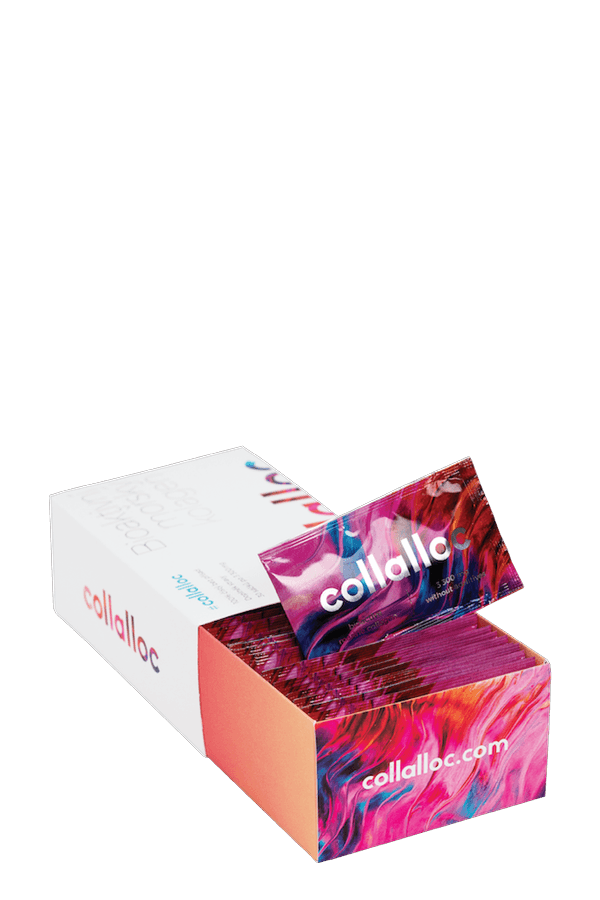
collalloc kolagen contains only hydrolysed marine collagen, with no sweeteners, colourings or flavourings. Microbiology is tested in every production batch and heavy metals every month in an external laboratory. You can find the results, including the limits, on the product page and on the Laboratory page, so you can also show them to your doctor. Because the collagen comes from fish, it is not suitable if you have a fish allergy.
How to take collagen so that it is well absorbed is described in the article How to take collagen correctly. Possible risks in general are summarised in Collagen side effects.
Frequently asked questions
Can I take collagen during pregnancy?
We consider pure hydrolysed collagen fine during pregnancy; it is a protein the body also knows from ordinary food. However, studies in pregnant women are lacking, so always talk to your doctor before taking it.
Can I take collagen while breastfeeding?
Yes, the same applies as in pregnancy. Collagen is broken down into amino acids and peptides like other dietary proteins. Targeted studies in breastfeeding women are lacking, so talk to your doctor beforehand.
Which collagen to choose during pregnancy and breastfeeding?
For pregnancy and breastfeeding, choose pure collagen: hydrolysed, without sweeteners, herbs and added vitamins, with published heavy metal test results. If you have a fish allergy, do not take marine collagen.
Will collagen help against stretch marks?
There are no studies that have tested this in pregnant women. Even for creams against stretch marks, a Cochrane review found no convincing evidence that they prevent them (Brennan et al., 2012).
How much collagen a day during pregnancy?
Stick to the dose on the packaging, which for collalloc is one sachet (3.3 g) a day. Collagen does not replace protein from food, which you need more of during pregnancy and breastfeeding.
Can I add collagen to warm tea?
To lukewarm tea yes, to hot tea no. The drink should not be hotter than 60 °C; cold water, juice, milk or a smoothie is best.
Sources
- Scientific Opinion on Dietary Reference Values for protein EFSA Panel on Dietetic Products, Nutrition and Allergies (NDA), EFSA Journal, 2012
- Significant Amounts of Functional Collagen Peptides Can Be Incorporated in the Diet While Maintaining Indispensable Amino Acid Balance Paul C., Leser S., Oesser S., Nutrients, 2019
- Oral Collagen Supplementation: A Systematic Review of Dermatological Applications Choi F. D., Sung C. T., Juhasz M. L., Mesinkovsk N. A., Journal of Drugs in Dermatology, 2019
- Identification of food-derived collagen peptides in human blood after oral ingestion of gelatin hydrolysates Iwai K., Hasegawa T., Taguchi Y. et al., Journal of Agricultural and Food Chemistry, 2005
- Identification of collagen as a new fish allergen Hamada Y., Nagashima Y., Shiomi K., Bioscience, Biotechnology, and Biochemistry, 2001
- Statement on the benefits of fish/seafood consumption compared to the risks of methylmercury in fish/seafood EFSA Scientific Committee, EFSA Journal, 2015
- Teratogenicity of high vitamin A intake Rothman K. J., Moore L. L., Singer M. R. et al., New England Journal of Medicine, 1995
- Hydroxyproline ingestion and urinary oxalate and glycolate excretion Knight J., Jiang J., Assimos D. G., Holmes R. P., Kidney International, 2006
- Topical preparations for preventing stretch marks in pregnancy Brennan M., Young G., Devane D., Cochrane Database of Systematic Reviews, 2012