MagazineHow to take collagen: morning or evening, how much a day and how long
How to take collagen: morning or evening, how much a day and how long
How to take collagen: when (morning, evening, empty stomach), how much a day, when to judge results, what to combine it with and why only in a drink up to 60 °C.

Short answer: take collagen every day, in the same dose, at a time you will not forget. In studies, people took 2.5 to 10 g of hydrolysed collagen a day for 8 to 24 weeks (Choi et al., 2019). Whether you drink it in the morning or in the evening, on an empty stomach or with food, is not decisive according to the available studies: we have not found a study that compared these options. Dissolve it in a cold or lukewarm drink up to 60 °C and judge the result after 8 to 12 weeks at the earliest.
How much collagen a day
Doses in the studies ranged from 2.5 to 10 g a day, and skin elasticity improved compared with placebo with as little as 2.5 g (Proksch et al., 2014).
| Study | How much a day | How long | What was found |
|---|---|---|---|
| Proksch et al., 2014 | 2.5 g or 5 g | 8 weeks | 69 women aged 35 to 55; skin elasticity better than with placebo at both doses |
| Choi et al., 2019 (review) | 2.5 to 10 g | 8 to 24 weeks | 11 studies with 805 people; promising results for skin, no reported adverse events |
| de Miranda et al., 2021 (meta-analysis) | Various doses | Results after 90 days | 19 studies with 1,125 people; hydration, elasticity and wrinkles better than with placebo |
| Zdzieblik et al., 2021 | 5 g | 12 weeks | 180 active people aged 18 to 30 with knee pain during activity; the pain eased more than with placebo |
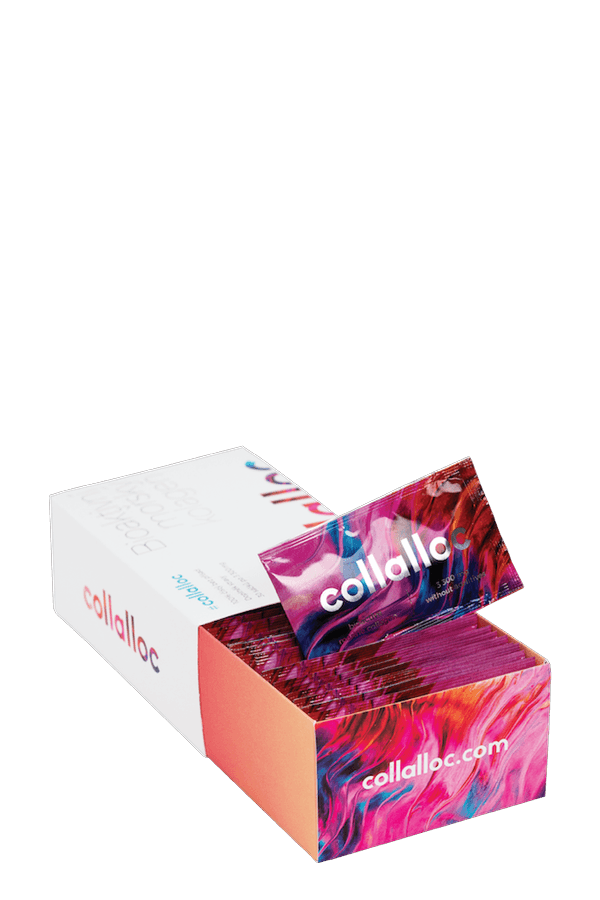
One collalloc sachet contains 3.3 g of collagen, a dose within this range. Each study tested a specific raw material, though, so the result of one does not automatically apply to every collagen. A maximum dose? The skin studies in the review by Choi et al. (2019) did not go above 10 g a day.
When to take collagen: morning or evening?
The studies above looked at dose and duration, not time of day. We have not found a study showing that collagen taken in the morning or in the evening works better. Nor has the claim that an evening dose works better, because the body makes collagen mainly at night, been tested in studies with collagen supplements.
What all the studies shared was regularity: collagen was taken every day for weeks. Pick a time that suits you and stick to it.
On an empty stomach or with food?
Absorption studies give collagen on an empty stomach because that makes it easiest to measure what reaches the blood. Collagen peptides, mainly Pro-Hyp, made of proline and hydroxyproline, peaked there after 1 to 2 hours (Iwai et al., 2005). That is how the measurement was set up, not a recommendation: we have not found a study showing a better result on an empty stomach than with food.
If it does not sit well on an empty stomach, take it with a meal. How collagen is absorbed is covered in Is the collagen I drink absorbed?
What to mix collagen with: only up to 60 °C
Collagen belongs in a cold or lukewarm drink, at most 60 °C: water, juice, milk, a smoothie or yoghurt. Do not use boiling water or hot tea; let them cool first. Why marine collagen is more sensitive to heat than bovine collagen is explained in Why marine collagen only up to 60 °C.
And coffee? Lukewarm yes, hot no. In a study with bovine collagen, its bioactive peptides reached the blood from coffee much as they did from water (Virgilio et al., 2025). The study, however, looked at the effect of coffee compounds. So for marine collagen the same rule still applies as for tea: below 60 °C.
What to combine collagen with, and what to watch out for
| Combination | What we know | What to do |
|---|---|---|
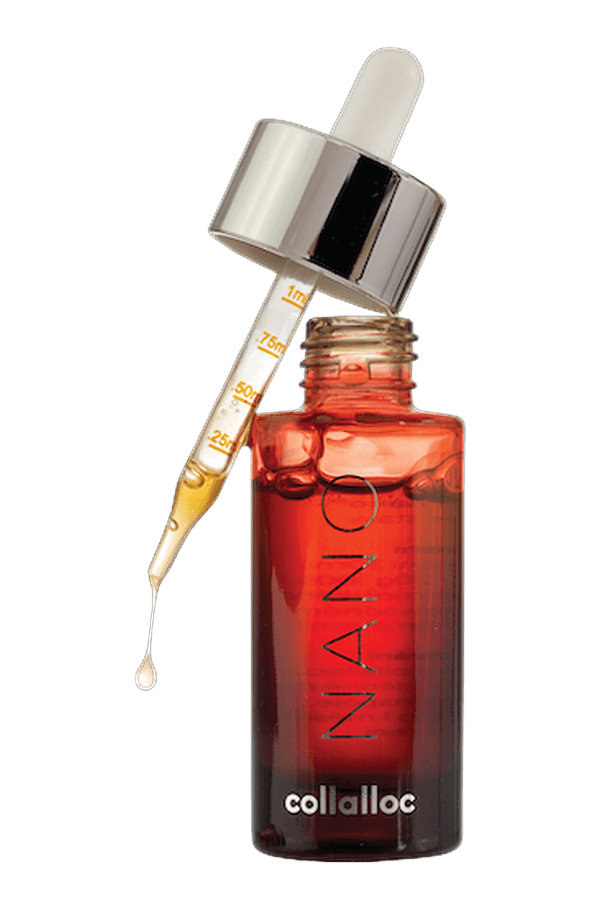
| Vitamin C | Vitamin C contributes to normal collagen formation for the normal function of skin. In the EU this claim is approved for vitamin C, not for collagen (Regulation 432/2012). | The collalloc collagen sachet does not contain vitamin C. You will find it in fruit and vegetables, in the liquid NANO 2.0 or in collalloc Vitamin C. |
| Medication | Interactions between collagen on its own and medicines are not well described. | If you take medication regularly, talk to your doctor or pharmacist. |
| Pregnancy and breastfeeding | Targeted studies in pregnant and breastfeeding women are lacking. | We consider pure collagen fine, but always talk to your doctor first. |
Collagen does not replace protein from food; see it as an addition to a varied diet. Possible problems are summed up in Collagen side effects, and taking collagen in pregnancy in Collagen during pregnancy and breastfeeding.
When to judge the result, and how long to take collagen
Studies assessed results after 8 to 24 weeks (Choi et al., 2019). In a meta-analysis of 26 studies, taking collagen for longer than 8 weeks came out slightly better for skin elasticity than shorter use (Pu et al., 2023). So judge the result after 8 to 12 weeks at the earliest, ideally from photos taken in the same light.
To be honest: the results are not clear-cut. A meta-analysis of 23 studies found that studies not funded by pharmaceutical companies, and higher quality studies, showed no improvement in skin (Myung and Park, 2025). Collagen does not guarantee a result.
How long to take it? The longest studies in the review by Choi et al. (2019) lasted 24 weeks, and there is less data on longer use. After three months, assess whether collagen makes sense for you.
How to take collalloc collagen, step by step
- One sachet a day, that is 3.3 g of hydrolysed marine collagen.
- In 200 ml of a cold or lukewarm drink, at most 60 °C. Pour the powder in slowly and stir.
- Every day at the same time, morning or evening, whichever suits you.
- If your digestion is sensitive, start with half a sachet for the first week.
- At least 8 to 12 weeks, only then compare photos.
- Taking medication, pregnant or breastfeeding? Talk to your doctor first.
How we do it at collalloc
collalloc collagen is hydrolysed marine collagen with a molecular weight of around 500 Da, with no sweeteners, colourings or flavourings. We test microbiology for every production batch and heavy metals every month in an external laboratory. You will find the results on the product page and on our Laboratory page. As the collagen comes from fish, it is not suitable if you have a fish allergy.
Frequently asked questions
When is the best time to take collagen, morning or evening?
According to the available studies, the time of day does not matter; we have not found a study that compared morning and evening use. Regularity is what counts: take collagen every day at a time you will not forget.
Should I take collagen on an empty stomach?
You do not have to. Absorption studies give collagen on an empty stomach for accurate measurement. We have not found a study showing that it works better that way than with food. If it does not sit well on an empty stomach, take it with a meal.
How much collagen should I take a day?
In studies, people took 2.5 to 10 g of hydrolysed collagen a day (Choi et al., 2019). In one study, skin elasticity improved with as little as 2.5 g a day (Proksch et al., 2014). For collalloc, that is one sachet (3.3 g) a day.
How long before I see results from collagen?
Studies assessed results after 8 to 24 weeks (Choi et al., 2019). There is no point judging the result before 8 to 12 weeks of daily use.
Can I put collagen in coffee?
In lukewarm coffee yes, in hot coffee no. The drink should not be hotter than 60 °C, so let hot coffee cool first. In one study, bioactive collagen peptides were absorbed from coffee much as from water (Virgilio et al., 2025).
What should I combine collagen with?
With a cold or lukewarm drink up to 60 °C and a varied diet. Vitamin C contributes to normal collagen formation for the normal function of skin; you will find it in fruit, vegetables or the liquid NANO 2.0. If you take medication or are pregnant, talk to your doctor first.
Sources
- Oral Collagen Supplementation: A Systematic Review of Dermatological Applications Choi F. D., Sung C. T., Juhasz M. L., Mesinkovska N. A., Journal of Drugs in Dermatology, 2019
- Oral supplementation of specific collagen peptides has beneficial effects on human skin physiology: a double-blind, placebo-controlled study Proksch E., Segger D., Degwert J., Schunck M., Zague V., Oesser S., Skin Pharmacology and Physiology, 2014
- Effects of hydrolyzed collagen supplementation on skin aging: a systematic review and meta-analysis de Miranda R. B., Weimer P., Rossi R. C., International Journal of Dermatology, 2021
- Effects of Oral Collagen for Skin Anti-Aging: A Systematic Review and Meta-Analysis Pu S. Y., Huang Y. L., Pu C. M., Kang Y. N., Hoang K. D., Chen K. H., Chen C., Nutrients, 2023
- Effects of Collagen Supplements on Skin Aging: A Systematic Review and Meta-Analysis of Randomized Controlled Trials Myung S. K., Park Y., The American Journal of Medicine, 2025
- The Influence of Specific Bioactive Collagen Peptides on Knee Joint Discomfort in Young Physically Active Adults: A Randomized Controlled Trial Zdzieblik D., Brame J., Oesser S., Gollhofer A., König D., Nutrients, 2021
- Identification of food-derived collagen peptides in human blood after oral ingestion of gelatin hydrolysates Iwai K., Hasegawa T., Taguchi Y. et al., Journal of Agricultural and Food Chemistry, 2005
- Unravelling the bioavailability of amino acids and bioactive peptides from collagen hydrolysate in coffee in healthy volunteers Virgilio N., Schoen C., van der Steen B. et al., Food Research International, 2025
- Commission Regulation (EU) No 432/2012 establishing a list of permitted health claims made on foods European Commission, Official Journal of the European Union, 2012