MagazineMarine collagen for skin: what the science really says
Marine collagen for skin: what the science really says
Marine collagen for skin: what randomised studies and meta-analyses showed, how strong the evidence is, whether fish collagen beats bovine and what research did not find.

Short answer: research on marine collagen and skin is interesting but not yet convincing. Small randomised studies with fish collagen measured better skin elasticity or hydration after 4 to 12 weeks than with placebo (Sangsuwan and Asawanonda, 2021; Kim et al., 2018). However, a meta-analysis of 23 studies with 1,474 participants showed that only company-funded studies found an improvement, while independent and high-quality studies did not (Myung and Park, 2025). We did not find any study in humans that directly compared marine with bovine or porcine collagen on the skin.
Where collagen is in the skin and what marine collagen is
Collagen is the main protein of the dermis, the layer of skin beneath the epidermis. It is made by cells called fibroblasts and gives the skin firmness and elasticity. Skin collagen is mainly in the dermis, not in the epidermis on the surface. The human body makes collagen itself, from amino acids in the diet.
Marine collagen is made from fish skin or scales. The raw material is broken down enzymatically (hydrolysed) into short peptides that dissolve in water. The collagen in it is predominantly type I, the type most abundant in the skin. Collagen from seaweed does not exist, as neither algae nor plants make collagen.
What studies of drinkable marine collagen showed
There are several randomised placebo-controlled studies in which people drank fish collagen, but all of them are small and short:
- Postmenopausal women, 4 weeks. 36 women took 5 g of marine collagen hydrolysate daily, or a placebo. Skin elasticity on the cheeks improved compared with placebo, and the difference persisted 4 weeks after stopping. No serious adverse effects occurred (Sangsuwan and Asawanonda, 2021).
- 64 adults, 12 weeks. Participants took 1,000 mg of low-molecular-weight fish collagen peptides daily, or a placebo. Skin hydration was higher after 6 and 12 weeks, wrinkle parameters improved after 12 weeks, and two of three elasticity parameters were higher than with placebo (Kim et al., 2018). Some of the authors worked for the companies Newtree and Jellice.
- Women aged 45 to 60, 12 weeks. The women took hydrolysed fish collagen, or a placebo. The wrinkle score fell by 35% compared with the start of the study, and on the right side of the face wrinkles decreased by 24% more than with placebo (Evans et al., 2021). The study was funded by the collagen manufacturer Vinh Hoan.
These studies describe what was measured in groups of participants, not a result that could be promised to every woman. They used different products and doses, and two of the three were carried out in collaboration with companies.
What the meta-analyses say
A meta-analysis of 19 randomised studies with 1,125 participants aged 20 to 70, the vast majority of them women, came out favourably for hydration, elasticity and wrinkles, and according to the authors the results showed after about 90 days of use (de Miranda et al., 2021). A frequently cited individual study followed 69 women aged 35 to 55 who took 2.5 g or 5 g of collagen hydrolysate, or a placebo, for 8 weeks: skin elasticity improved at both doses (Proksch et al., 2014).
A more recent meta-analysis, however, divided the studies according to who paid for them. Of 23 randomised studies with 1,474 participants, only those funded by companies showed improvements in hydration, elasticity and wrinkles. Studies without company funding and high-quality studies found no effect, and the authors conclude that there is so far no evidence for using collagen supplements against skin ageing (Myung and Park, 2025). Both meta-analyses assess collagen supplements as a whole, and their summaries do not break down the results by whether the collagen came from fish, cattle or pigs.
Is marine collagen better for the skin than bovine or porcine collagen?
So far, the difference has shown up mainly in what appears in the blood after drinking. In a small crossover study, 5 healthy men drank type I collagen hydrolysate from fish scales, fish skin and pig skin. The amount and composition of hydroxyproline-containing peptides in the blood depended on the source: the total over 24 hours was significantly higher after fish scales than after pig skin, and some peptides appeared only after fish collagen (Ohara et al., 2007).
Different peptides in the blood, however, do not yet mean a different result on the skin. We did not find any study in the PubMed database that directly compared marine with bovine or porcine collagen on the skin in humans. It makes sense to choose marine collagen mainly for other reasons: if you do not eat beef or pork, or want to know where the raw material comes from. You can find a detailed comparison in the article Marine vs. bovine collagen.
What the studies did not show and how strong the evidence is
- Small and short studies. The studies with fish collagen had dozens of participants and lasted 4 to 12 weeks.
- Funding. Improvements appeared mainly in studies funded by companies (Myung and Park, 2025).
- Applying is not drinking. The study with tilapia scale peptides tested a serum for the skin: 62 women applied it for 30 days and measured elasticity rose by 24 to 35%, but the study had no placebo and concerned cosmetics, not drinkable collagen (Chai et al., 2010). We explain the difference in the article Collagen cream vs. collagen in a sachet.
- Animals are not humans. In hairless mice, a fish collagen peptide reduced skin changes after UVB (Tanaka et al., 2009), but this cannot be transferred to people. Collagen also does not protect against the sun, more in the article Collagen and the sun.
How we do it at collalloc
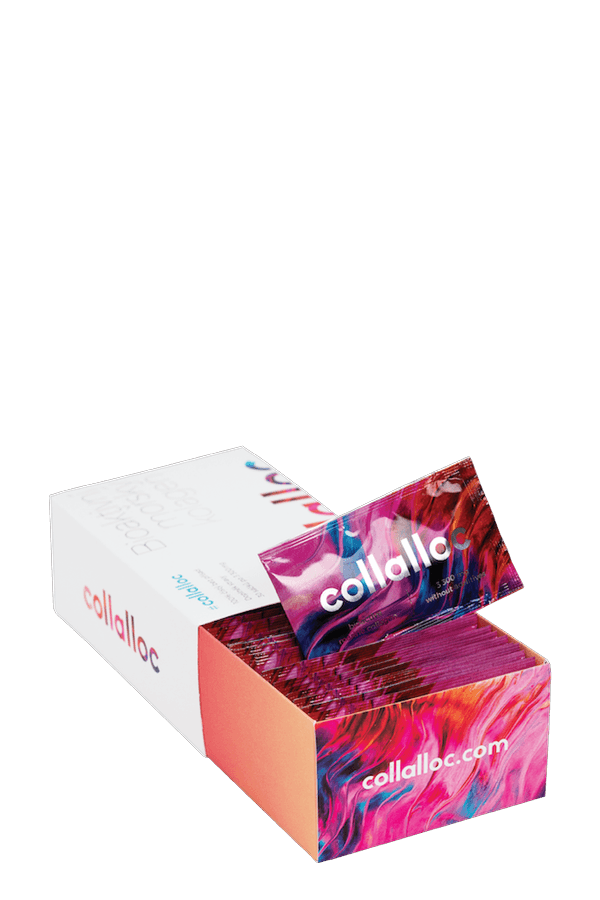
collalloc kolagen is marine collagen from North Sea fish, hydrolysed in Switzerland into peptides with a molecular weight of around 500 Da. One sachet contains 3,300 mg of collagen, of which 2,640 mg is type I, 644 mg type II and 16 mg type III, with no fillers, colourings or sweeteners. Stir it into 200 ml of a cold or lukewarm drink up to 60 °C. Because it is made from fish, it is not suitable if you have a fish allergy. You can find an overview of the research on our Collagen for skin page.
Frequently asked questions
Does marine collagen help the skin?
Research has not yet clearly confirmed it. Small studies with fish collagen measured better skin elasticity or hydration than with placebo (Sangsuwan and Asawanonda, 2021; Kim et al., 2018), but a meta-analysis of 23 studies found improvements only in studies funded by companies (Myung and Park, 2025).
Does collagen work on the skin when I drink it?
After you drink it, collagen is broken down into peptides that appear in the blood, with a different composition after fish collagen than after porcine collagen (Ohara et al., 2007). Studies of drinking fish collagen measured better skin elasticity or hydration after 4 to 12 weeks than with placebo, but they were small, and independent studies did not confirm an improvement (Myung and Park, 2025).
How long does it take to see an effect on the skin?
Studies with fish collagen assessed the skin after 4 to 12 weeks of regular use (Sangsuwan and Asawanonda, 2021; Evans et al., 2021). The authors of a meta-analysis of 19 studies describe results after about 90 days (de Miranda et al., 2021). However, this is not a certain result, and it may be different for every woman.
How is fish collagen made?
From fish skin or scales, which are broken down enzymatically (hydrolysed) into short water-soluble peptides. Such collagen is predominantly type I. collalloc uses raw material from North Sea fish, hydrolysed in Switzerland into peptides of around 500 Da.
Does marine collagen have side effects?
It was well tolerated in studies: in the study by Proksch et al. (2014), no side effects occurred, and in the study by Kim et al. (2018), no one had problems related to the product. Marine collagen is made from fish, however, so it is not suitable if you have a fish allergy.
What did studies find about marine collagen and wrinkles?
In a study of women aged 45 to 60, the wrinkle score fell by 35% from the start after 12 weeks of fish collagen, but the study was funded by the manufacturer (Evans et al., 2021). An improvement in wrinkle parameters after 12 weeks was also described in the study by Kim et al. (2018). Studies without company funding found no improvement in wrinkles (Myung and Park, 2025).
Sources
- Four-weeks daily intake of oral collagen hydrolysate results in improved skin elasticity, especially in sun-exposed areas: a randomized, double-blind, placebo-controlled trial Sangsuwan W., Asawanonda P., The Journal of Dermatological Treatment, 2021
- Oral Intake of Low-Molecular-Weight Collagen Peptide Improves Hydration, Elasticity, and Wrinkling in Human Skin: A Randomized, Double-Blind, Placebo-Controlled Study Kim D. U., Chung H. C., Choi J., Sakai Y., Lee B. Y., Nutrients, 2018
- A randomized, triple-blind, placebo-controlled, parallel study to evaluate the efficacy of a freshwater marine collagen on skin wrinkles and elasticity Evans M., Lewis E. D., Zakaria N., Pelipyagina T., Guthrie N., Journal of Cosmetic Dermatology, 2021
- Oral supplementation of specific collagen peptides has beneficial effects on human skin physiology: a double-blind, placebo-controlled study Proksch E., Segger D., Degwert J., Schunck M., Zague V., Oesser S., Skin Pharmacology and Physiology, 2014
- Effects of hydrolyzed collagen supplementation on skin aging: a systematic review and meta-analysis de Miranda R. B., Weimer P., Rossi R. C., International Journal of Dermatology, 2021
- Effects of Collagen Supplements on Skin Aging: A Systematic Review and Meta-Analysis of Randomized Controlled Trials Myung S. K., Park Y., The American Journal of Medicine, 2025
- Comparison of quantity and structures of hydroxyproline-containing peptides in human blood after oral ingestion of gelatin hydrolysates from different sources Ohara H., Matsumoto H., Ito K., Iwai K., Sato K., Journal of Agricultural and Food Chemistry, 2007
- Effects of sizes and conformations of fish-scale collagen peptides on facial skin qualities and transdermal penetration efficiency Chai H. J., Li J. H., Huang H. N., Li T. L., Chan Y. L., Shiau C. Y., Journal of Biomedicine and Biotechnology, 2010
- Effects of collagen peptide ingestion on UV-B-induced skin damage Tanaka M., Koyama Y., Nomura Y., Bioscience, Biotechnology, and Biochemistry, 2009