MagazineCollagen and skin ageing: what really happens and what can be done
Collagen and skin ageing: what really happens and what can be done
Wrinkles are not just a cosmetic problem. They are a visible sign of a structural process that began long before you noticed them. What supplementation can and cannot do about it.
The anatomy of skin ageing
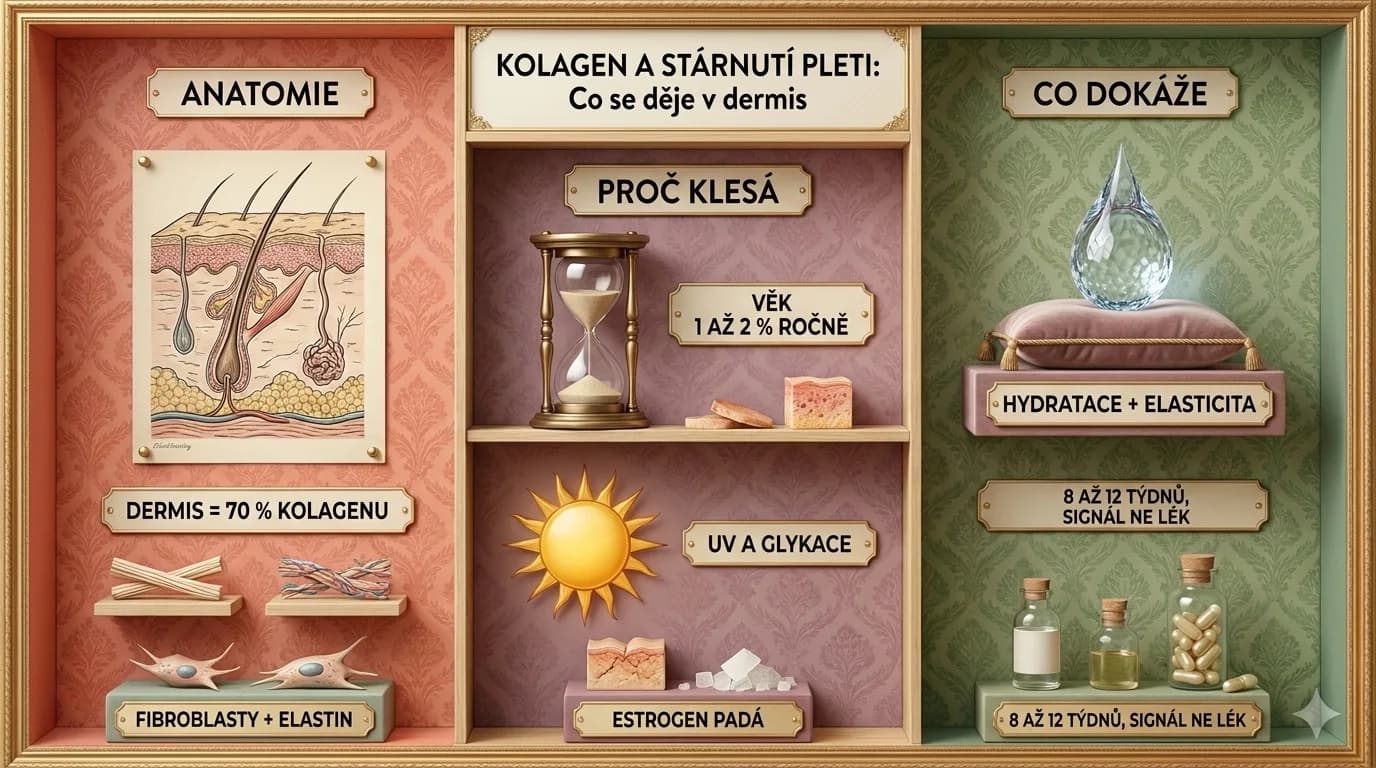
The skin has three layers: the epidermis (surface), the dermis (middle layer) and the hypodermis (deeper fatty layer). Collagen sits mainly in the dermis, where it makes up roughly 70 % of its dry weight. Together with elastin it forms an elastic network that gives skin firmness, density and the ability to snap back after deformation.
Fibroblasts, the cells in the dermis, continuously produce and renew collagen. With age their activity declines. The result: the network of collagen fibres thins, elastin fragments and the dermis loses volume. The surface layer then lacks a sufficient structural base, wrinkles form and the skin looks tired and less defined.
Why collagen declines
Age: a natural decline of 1 to 2 % a year from the mid-twenties. By forty, a woman loses roughly 15 to 20 % of her collagen capacity.
Menopause: estrogen regulates collagen synthesis. According to a review in Dermato-Endocrinology (Thornton, 2013), women lose up to 30 % of skin collagen in the first five years after menopause.
UV radiation: UVA rays activate matrix metalloproteinases (MMP), enzymes that cleave collagen fibres. It is one of the fastest mechanisms of collagen degradation.
Glycation: excess sugar binds sugar molecules to collagen fibres, which stiffen and lose elasticity. This damage is hard to reverse.
Smoking and chronic stress: both raise free radicals and cortisol, which actively suppress collagen production.
What supplementation can actually do
Hydrolysed collagen peptides below 500 Da pass the intestinal barrier and reach the bloodstream. Some of them accumulate in the skin, where they stimulate fibroblasts to produce new collagen, elastin and hyaluronic acid. It is not topping up collagen from outside, it is a biological signal for the body's own production.
A randomized 2024 study (Journal of Clinical Medicine, 112 women, 8 weeks) showed statistically significant improvements in elasticity (p = 0.009), hydration (p < 0.001) and skin texture without any exercise protocol. A 2019 systematic review (11 randomised trials, 805 people) concluded that oral collagen increases skin elasticity and hydration.
What supplementation cannot do
Supplementation will not reverse the genetic factors of ageing, will not replace dermatological procedures in significant photoageing, and will not override the chronic effect of smoking, glycation or UV radiation without changing those factors.
A realistic expectation: after 8 to 12 weeks of consistent use, there is a measurable improvement in hydration and elasticity. Visibly younger skin is the result of combining supplementation, UV protection and a healthy lifestyle, not the sachet alone.
Collagen is not a cure for ageing. It is a tool that works with ageing, not against it.
Frequently asked questions
Why does skin collagen decline with age?
Fibroblast activity drops, estrogen falls after menopause, and UV and glycation cleave the fibres. The decline is 1 to 2 % a year from the mid-twenties.
Does collagen help with wrinkles?
Peptides stimulate fibroblasts to make new collagen, elastin and hyaluronic acid. Studies show improvements in elasticity and hydration after 8 to 12 weeks.
How long until the effect on skin shows?
A measurable improvement in hydration and elasticity appears after 8 to 12 weeks of consistent use.
Does collagen replace dermatological procedures?
No. Supplementation will not reverse genetics or significant photoageing. It works as part of a combination with UV protection and lifestyle.
Sources
- The Efficacy and Safety of CollaSel Pro® Hydrolyzed Collagen Peptide Supplementation without Addons in Improving Skin Health in Adult Females: A Double Blind, Randomized, Placebo-Controlled Clinical Study Using Biophysical and Skin Imaging Techniques Demir-Dora D, Ozsoy U et al., Journal of Clinical Medicine, 2024
- Oral Collagen Supplementation: A Systematic Review of Dermatological Applications Choi FD, Sung CT et al., Journal of Drugs in Dermatology, 2019
- Estrogens and aging skin Thornton MJ, Dermato-Endocrinology, 2013