Magazinecollalloc kolagen and collalloc MIND: ingredients and how to take them together
collalloc kolagen and collalloc MIND: ingredients and how to take them together
collalloc kolagen and MIND: what they contain, why people take them together, how to take them and what research says about collagen and functional mushrooms.

Short answer: collalloc kolagen is marine collagen in sachets, 3,300 mg per daily dose, and collalloc MIND is capsules with four functional mushrooms, 600 mg of extract from each in 4 capsules a day. People take them together mainly because they fit into one morning ritual: you stir the sachet into a drink up to 60 °C and swallow the capsules with the same glass. We have not found a study that examined this particular combination, so we do not attribute any combined effect to it. Collagen research focuses on skin: in a randomised study in 69 women, skin elasticity improved after 8 weeks compared with placebo (Proksch et al., 2014), but independent studies did not measure an improvement (Myung and Park, 2025). If you have a fish allergy, do not take the collagen, and if you take medication or are pregnant, talk to your doctor first.
Overview: the two products side by side
| Detail | collalloc kolagen | collalloc MIND |
|---|---|---|
| Form | powder in a sachet | capsules |
| Daily dose | 1 sachet, 3,300 mg | 4 capsules, 2,400 mg |
| Contents | marine collagen types I, II and III | 4 functional mushrooms |
| Pack | 30 sachets | 120 capsules for 30 days |
| How to take | in a drink up to 60 °C | wash down, mornings on an empty stomach |
| Caffeine | no | no |
| For vegans | no, from fish | yes |
What collalloc kolagen is
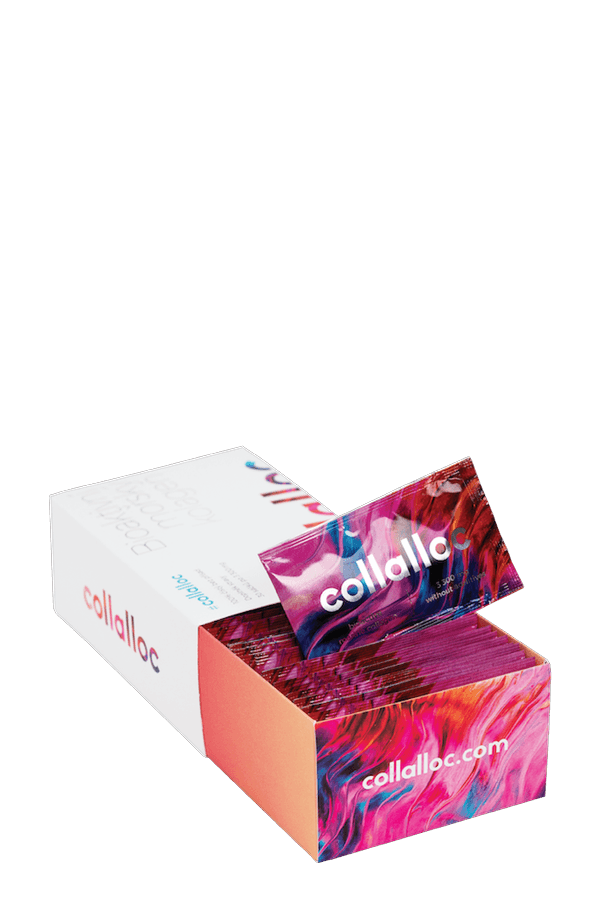
collalloc kolagen is hydrolysed marine collagen from North Sea fish. The raw material is hydrolysed in Switzerland into peptides with a molecular weight of around 500 Da and an absorption rate of 95%. One sachet contains 3,300 mg of collagen, of which 2,640 mg is type I, 644 mg type II and 16 mg type III. There are no other ingredients in it: no fillers, colourings or sweeteners, and no vitamin C either. A pack holds 30 sachets of 3.3 g, one for each day.
Collagen is the main protein of skin and connective tissues, and the body makes it itself from amino acids. We test microbiology in every production batch and heavy metals every month, and you will find the results on our Laboratory page.
What collalloc MIND is
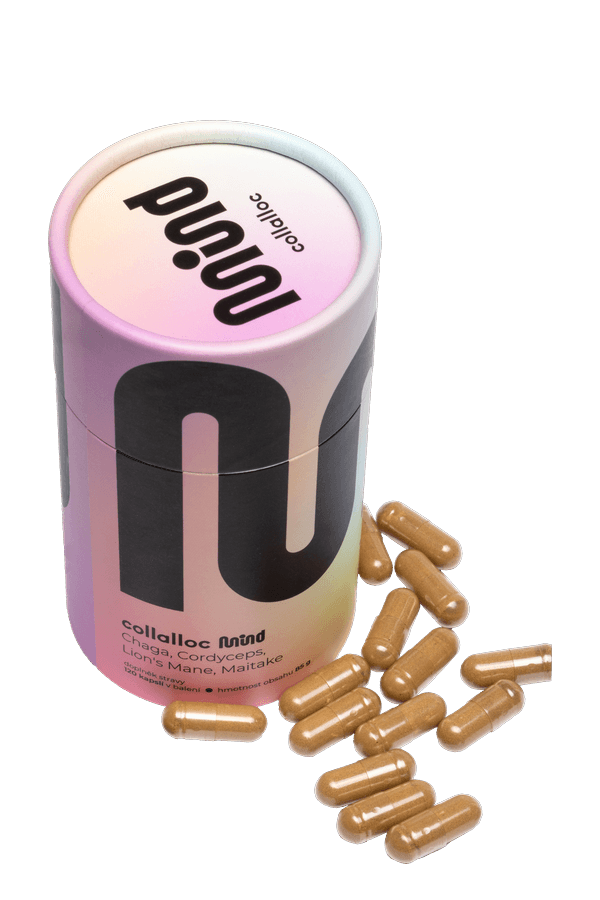
collalloc MIND contains no collagen. These are capsules with four functional mushrooms: Lion’s Mane (bearded tooth fungus, Hericium erinaceus), Cordyceps (Cordyceps sinensis), Chaga (clinker polypore, Inonotus obliquus) and Maitake (hen of the woods, Grifola frondosa). The 4 capsules of the daily dose contain 600 mg of extract from each mushroom, 2,400 mg in total. The extracts contain at least 50% polysaccharides and at least 20% beta-glucans. A pack has 120 capsules for 30 days.
MIND is organic, free from caffeine, sugar, gluten and lactose, and the capsule is plant-based and suitable for vegans. You do not taste the mushrooms, because the capsule only dissolves in the stomach. It is not a nootropic or a medicine: we see it as a daily morning ritual.
Why people take them together
The reason is mostly practical. Both products are taken once a day, ideally in the morning, so they combine into one habit: a glass with the collagen stirred in and four capsules to go with it. One is a protein, the other a mushroom extract. They do not replace each other or build on each other, so you can take just one of them, or both.
Collagen is often part of skincare, because skin is exactly what most studies with collagen peptides examine. MIND adds a caffeine-free moment to the morning, and you can take it with or without coffee. We do not claim, though, that they work better together than each on its own: we have not found a study that examined collagen and functional mushrooms together. How to combine both products in practice is described in our article How to properly combine marine collagen with functional mushrooms.
What research says about collagen, and what it does not
Research on collagen peptides focuses mainly on skin. In a double-blind study, 69 women aged 35 to 55 received 2.5 g or 5 g of collagen hydrolysate, or a placebo, for 8 weeks. Skin elasticity improved in both collagen groups compared with placebo, while for skin moisture the difference was not statistically significant (Proksch et al., 2014). Eight of the 11 placebo-controlled studies with a total of 805 participants in the review by Choi et al. (2019) gave 2.5 to 10 g of collagen hydrolysate a day for 8 to 24 weeks.
A more recent meta-analysis of 23 randomised studies with 1,474 participants added an important note, however: improvements in hydration, elasticity and wrinkles appeared only in studies funded by pharmaceutical companies. Studies without such funding and high-quality studies measured no effect (Myung and Park, 2025). You will find more about the studies on our Collagen for skin page.
What research says about functional mushrooms, and what it does not
For functional mushrooms, research in humans is much more modest. A systematic review of Lion’s Mane included 26 papers, but only 5 of them were randomised studies and 3 were pilot studies in humans, while 15 papers were carried out in the laboratory (Menon et al., 2025). Human studies tend to be small and short, and each uses a different extract, so their results cannot simply be transferred to a specific product.
We talk about MIND as a daily ritual. We did not find a human study in the PubMed database that examined these four mushrooms together, or mushrooms together with collagen.
How to take both products
- collalloc kolagen: stir 1 sachet a day into 200 ml of a cold or lukewarm drink, no hotter than 60 °C, such as water, juice or a smoothie. We recommend the morning, about 30 minutes before breakfast, but with food works too. Do not pour collagen into hot coffee or boiling water, let them cool down first.
- collalloc MIND: 4 capsules a day, in the morning on an empty stomach, 30 minutes before a meal or an hour after. We do not recommend MIND in the evening.
- Together: you can swallow the capsules directly with the collagen drink, or take the two products separately.
- Regularity: collagen studies gave the dose every day for 8 to 24 weeks (Choi et al., 2019). We recommend taking collagen for at least 60 days, and one pack of MIND lasts 30 days.
- Missed dose: do not make up for it with a double dose the next day, just carry on.
What to watch out for
- Fish allergy: collalloc kolagen is made from fish, and fish collagen is an allergen. In a Japanese study, antibodies from five of eight patients with fish allergy reacted to tuna collagen, and the reaction concerned various fish species (Hamada et al., 2001). If you have a fish allergy, do not take the collagen. MIND contains neither fish nor collagen.
- Medication: mushrooms can affect how some medicines work. A case has been described in which the INR value rose in a person taking warfarin after a maitake extract (Hanselin et al., 2010). If you take blood thinners, diabetes medication or immunosuppressants, talk to your doctor before taking MIND.
- Kidneys and oxalates: chaga contains very large amounts of oxalates. In a 72-year-old woman who had taken 4 to 5 teaspoons of chaga powder a day for 6 months, doctors found kidney damage from oxalate crystals, and the patient had to go on dialysis (Kikuchi et al., 2014). The body also makes part of its oxalate from the hydroxyproline in collagen: after 30 g of gelatin a day, urinary oxalate was 43% higher than after whey protein (Knight et al., 2006). If you are prone to kidney stones or have kidney disease, discuss both products with your doctor.
- Pregnancy and breastfeeding: according to its label, MIND is not intended for pregnant women. Ask your doctor about collagen during pregnancy and breastfeeding.
- Side effects: for Lion’s Mane, the review lists stomach upset, headache and allergic reactions as possible problems (Menon et al., 2025). If a rash, itching or swelling appears after the first doses, stop taking the product and see a doctor.
Frequently asked questions
Can I take collalloc kolagen and MIND at the same time?
Yes, on the same day and at the same moment. Stir a sachet of collagen into a drink up to 60 °C and swallow the 4 MIND capsules with it. We have not found a study that examined this combination, so we do not attribute any combined effect to it.
What are the ingredients of collalloc kolagen?
One sachet contains 3,300 mg of hydrolysed marine collagen: 2,640 mg of type I, 644 mg of type II and 16 mg of type III. The collagen comes from North Sea fish and has a molecular weight of around 500 Da. It contains no fillers, colourings, sweeteners or vitamin C.
What does collalloc MIND contain?
Four functional mushrooms: Lion’s Mane, Cordyceps, Chaga and Maitake, with 600 mg of extract from each in 4 capsules a day. The extracts have at least 50% polysaccharides and at least 20% beta-glucans. MIND contains no collagen or caffeine, and a pack has 120 capsules for 30 days.
How and when should I take collalloc kolagen and MIND?
In the morning: a sachet of collagen in 200 ml of a cold or lukewarm drink up to 60 °C, and 4 MIND capsules on an empty stomach, 30 minutes before a meal or an hour after. We do not recommend MIND in the evening. Regularity is what counts: collagen studies gave the dose every day for 8 to 24 weeks (Choi et al., 2019).
Who should not take collalloc kolagen and MIND?
If you have a fish allergy, do not take the collagen, as fish collagen is an allergen (Hamada et al., 2001). According to its label, MIND is not intended for pregnant women. If you take medication, especially warfarin or other blood thinners, talk to your doctor, as a case of raised INR has been described with maitake (Hanselin et al., 2010).
What does research say about collagen and mushrooms?
In a study of 69 women, skin elasticity improved after 8 weeks compared with placebo (Proksch et al., 2014), but independent and high-quality studies did not measure an improvement (Myung and Park, 2025). In a systematic review of Lion’s Mane, only 5 of 26 papers were randomised studies in humans (Menon et al., 2025).
Sources
- Oral supplementation of specific collagen peptides has beneficial effects on human skin physiology: a double-blind, placebo-controlled study Proksch E., Segger D., Degwert J., Schunck M., Zague V., Oesser S., Skin Pharmacology and Physiology, 2014
- Oral Collagen Supplementation: A Systematic Review of Dermatological Applications Choi F. D., Sung C. T., Juhasz M. L., Mesinkovsk N. A., Journal of Drugs in Dermatology, 2019
- Effects of Collagen Supplements on Skin Aging: A Systematic Review and Meta-Analysis of Randomized Controlled Trials Myung S. K., Park Y., The American Journal of Medicine, 2025
- Benefits, side effects, and uses of Hericium erinaceus as a supplement: a systematic review Menon A., Jalal A., Arshad Z., Nawaz F. A., Kashyap R., Frontiers in Nutrition, 2025
- Identification of collagen as a new fish allergen Hamada Y., Nagashima Y., Shiomi K., Bioscience, Biotechnology, and Biochemistry, 2001
- INR elevation with maitake extract in combination with warfarin Hanselin M. R., Vande Griend J. P., Linnebur S. A., The Annals of Pharmacotherapy, 2010
- Chaga mushroom-induced oxalate nephropathy Kikuchi Y., Seta K., Ogawa Y., Takayama T., Nagata M., Taguchi T., Clinical Nephrology, 2014
- Hydroxyproline ingestion and urinary oxalate and glycolate excretion Knight J., Jiang J., Assimos D. G., Holmes R. P., Kidney International, 2006