MagazineDoes vegan collagen exist? The honest answer
Does vegan collagen exist? The honest answer
The short answer: no. The longer answer explains what you actually find on the market under this name and when it makes sense.
Why vegan collagen does not exist
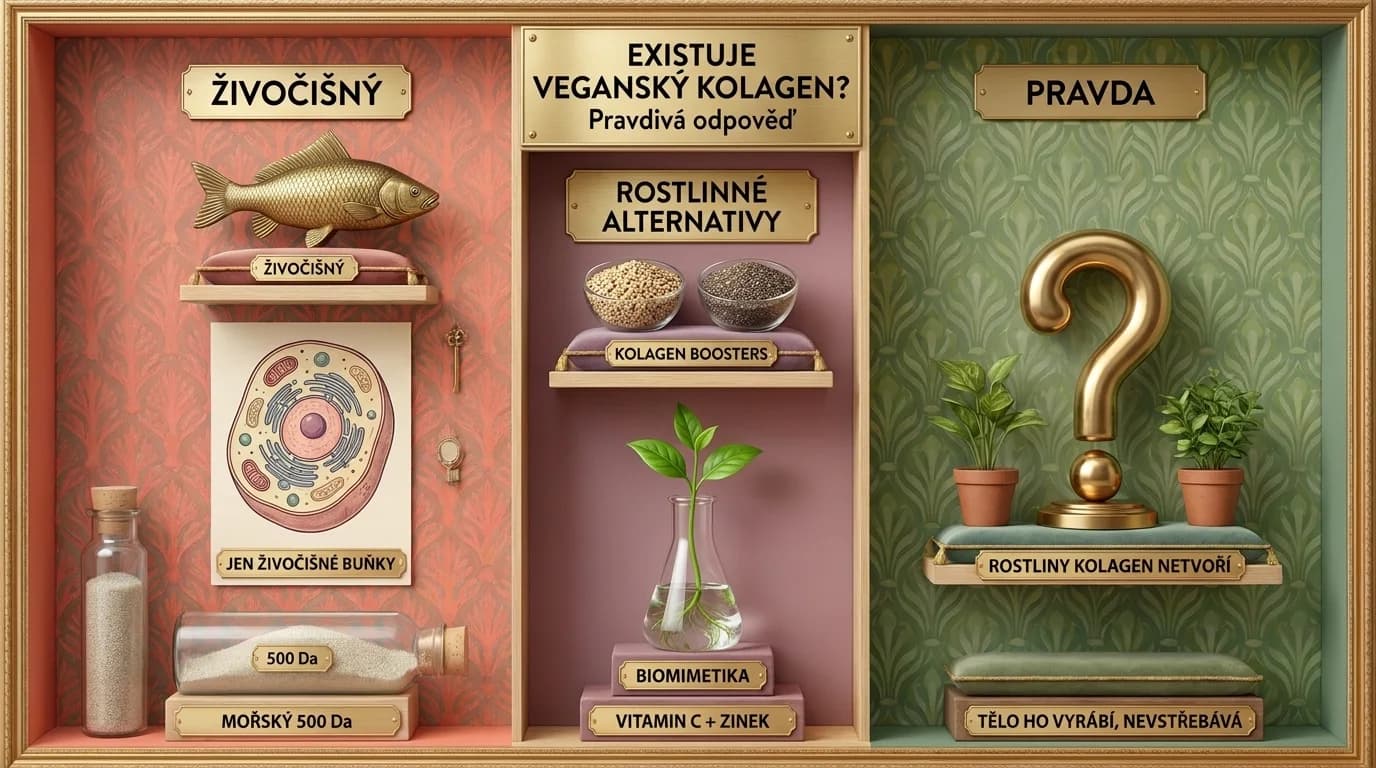
Collagen is a protein produced exclusively by animal cells, specifically fibroblasts, chondroblasts and osteoblasts. Plants do not make this protein and never will. Strictly speaking, vegan collagen is a marketing term, not a scientific category.
Biogena, a respected Austrian nutrition company, puts it precisely: when we talk about vegan collagen, we mean the building blocks the body needs in order to produce collagen itself.
What the term vegan collagen actually hides
Collagen boosters, that is synthesis precursors: supplements providing glycine, proline, lysine and vitamin C, the amino acids and cofactors the body needs for its own collagen production. This is the most common category.
Collagen biomimetics, that is plant imitations: innovative preparations containing plant extracts such as asiaticoside and ginsenosides, plus fermented amino acids that stimulate the natural process of type I collagen synthesis. One 2024 study (Journal of Functional Foods, 90 participants, double-blind) showed a 4.7 % increase in collagen density and 5.1 % in elasticity versus placebo. The effect was comparable to fish collagen, but with fewer studies behind it.
Biotechnological collagen, that is laboratory production: scientists inserted a human collagen gene into yeast or bacteria, which then produce collagen proteins. This technology exists, but commercially available products are still in an early stage.
What to make of vegan alternatives
For vegans and vegetarians who do not want animal collagen, collagen boosters make sense, especially the combination of vitamin C, zinc, copper and plant amino acids. Quinoa and chia seeds are exceptionally rich in glycine and proline for plant sources.
Biomimetics are promising, but research is still limited. One study, however well conducted, is not enough for an equal comparison with a decade of research on hydrolysed marine collagen.
The body does not absorb collagen, it produces it. Animal peptides are the most effective signal for that production. Vegan alternatives can imitate the signal, just with less data behind them.
Why collalloc uses marine collagen
Marine collagen comes from fish, so it is inevitably an animal source. We choose it because it has the lowest molecular weight of all collagen sources (500 Da), the best absorption and the most extensive clinical research for skin applications. For customers looking for a vegan alternative, our honest answer is: collalloc does not have one for you right now. We will recommend collagen boosters with vitamin C, zinc and plant amino acids.