MagazineHow to spot a quality collagen supplement
How to spot a quality collagen supplement
There are hundreds of collagen products on the market. Most will not tell you the most important thing. Here is what to look for on the label and what the warning signs are.

One number that decides everything
The molecular weight of collagen peptides. This number decides whether collagen absorbs as a bioactive peptide or is simply digested like ordinary protein. The skin's stratum corneum lets molecules through up to roughly 500 Da. The intestinal barrier is similarly selective.
Below 500 Da, collagen absorbs as a bioactive peptide and can signal to fibroblasts. Above 1,000 Da it is digested like protein and the signalling effect is minimal. Most cheap products on the market do not state this value on the label. That is no accident.
What to look for on the label
Hydrolysed collagen or collagen peptides: the label hydrolysed means the protein was cleaved into shorter peptides. Without hydrolysis, the molecule is too large.
A stated molecular weight: good products write it out, 500 Da or below 1,000 Da. If the label only says hydrolysed collagen with no detail, ask the manufacturer.
The collagen source: marine (fish) has the best absorption for type I and III. Bovine suits type I and III, with a slightly higher molecular weight. Chicken is naturally rich in type II for joints.
The dose in grams, not milligrams: clinical studies show an effect from roughly 2.5 g a day. A product that boasts only 500 mg of collagen complex per dose is too little for a measurable effect. At the same time, absorption decides: a gram of well-absorbed peptide below 500 Da means more than several grams of collagen that never gets absorbed.
The length of the ingredient list: the shorter, the better. Sweeteners, colourants, binders and flavourings are needless ballast with no added biological value.
Red flags that signal a poor product
Promises without data: if a maker claims it raises collagen by 300 % with no reference to a study, that is marketing.
A high share of fillers: products with lots of binders and a low content of active peptide look cheap, but the dose of real collagen is small.
An unclear source: the maker does not state where the collagen comes from, that is fish, beef or chicken. The origin affects both the type of collagen and safety.
Gummies and chews: the form is convenient, but the collagen content tends to be much lower than in powder or a drink. Always check the grams per serving.
The most expensive collagen is not necessarily the best. But the cheapest almost never meets the conditions for a measurable effect.
How to verify collalloc
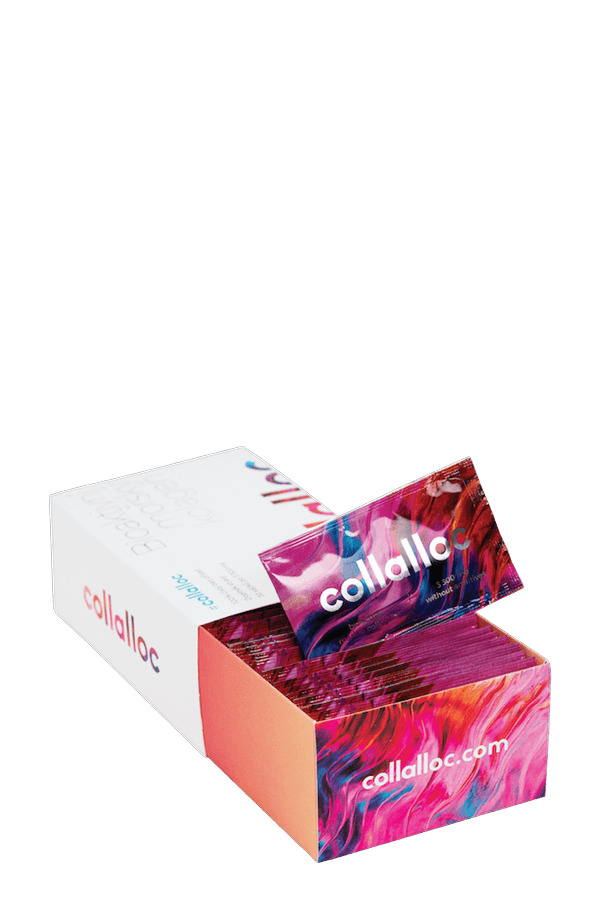
collalloc sachets contain hydrolysed marine collagen at 500 Da. This value is analytically verified for every batch. Composition: only hydrolysed marine collagen, no sweeteners, colourants or binders. Daily dose: 3,300 mg of pure bioactive peptide, of which about 95 % is absorbed thanks to the 500 Da size.