MagazineWhat really happens to collagen in the body? From peptides to skin
What really happens to collagen in the body? From peptides to skin
What happens to collagen in the body after drinking? Digestion, Pro-Hyp and Hyp-Gly peptides in blood, skin experiments, complexion studies. What we know and don't.
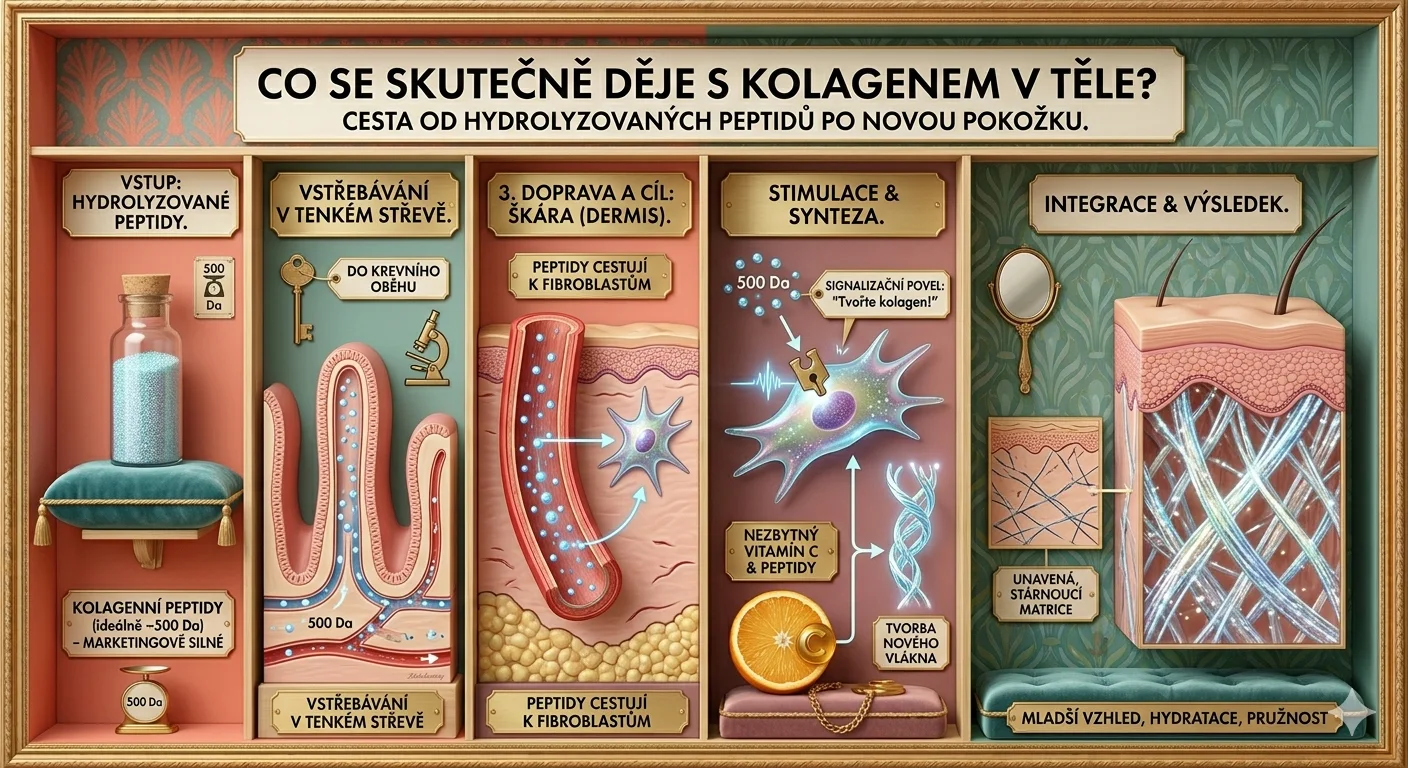
Short answer: collagen you drink is not absorbed whole. Digestive enzymes break it down into amino acids and short peptides, and peptides containing hydroxyproline, mainly Pro-Hyp, peak in the blood after 1 to 2 hours (Iwai et al., 2005). In mice, collagen peptides were also found in the skin (Yazaki et al., 2017). In a placebo-controlled study of 69 women, measured skin elasticity improved after 8 weeks (Proksch et al., 2014), but a meta-analysis of 23 studies found no difference from placebo in the independent and higher quality studies (Myung and Park, 2025). Collagen is therefore not a medicine, and the result on the skin is not certain.
Overview: what was measured where
| Step | What was measured | In whom |
|---|---|---|
| Digestion | Peptides after gelatin and hydrolysate | 9 volunteers |
| Blood | Pro-Hyp, Hyp-Gly and other peptides | Volunteers |
| Skin | Peptides in the skin | Mice, rats |
| Cells | Fibroblast growth | Mouse cells |
| Complexion | Elasticity, hydration | People, 4 to 12 weeks |
| Summary | 23 studies, 1,474 people | Meta-analysis |
The figures in the table come from these papers: digestion (Iwasaki et al., 2022), animal skin (Yazaki et al., 2017; Kawaguchi et al., 2012), cells (Shigemura et al., 2009), complexion (Proksch et al., 2014; Asserin et al., 2015) and summary (Myung and Park, 2025).
Step 1: Stomach and small intestine
In the stomach, collagen is acted on by acid and the enzyme pepsin, in the small intestine by enzymes from the pancreas. The body does not absorb a large collagen molecule or gelatin whole, it breaks them down into free amino acids and into short pieces of two or three amino acids, dipeptides and tripeptides. A collagen hydrolysate is collagen that the manufacturer has already split into short peptides with enzymes beforehand. We describe how collagen from ordinary food is digested in the article Collagen-rich foods.
The degree of splitting matters. In a Japanese study with nine volunteers, the peptide Pro-Hyp in the blood rose after gelatin to 15.5 nmol/ml within 2 hours and Hyp-Gly to 2.3 nmol/ml within an hour. A low molecular weight hydrolysate raised the levels of both peptides significantly more, and more free hydroxyproline was absorbed after it too, 169.1 nmol/ml versus 94.4 nmol/ml after gelatin (Iwasaki et al., 2022).
Step 2: Blood and collagen peptides
Part of the collagen reaches the blood as free amino acids, part as short peptides containing hydroxyproline, an amino acid typical of collagen. In a Japanese study, volunteers were given 9.4 to 23 g of gelatin hydrolysates from pig skin, chicken feet and cartilage after 12 hours of fasting. The peptide form of hydroxyproline rose to 20 to 60 nmol/ml of plasma within 1 to 2 hours and had fallen to half after 4 hours. The main peptide was Pro-Hyp (Iwai et al., 2005).
The second common peptide is Hyp-Gly. It was found in four of five volunteers, its ratio to Pro-Hyp varied between people from 0 to 5.04, and enzymes in human serum break it down more slowly than Pro-Hyp (Shigemura et al., 2011). After a hydrolysate with a high share of tripeptides, researchers distinguished 17 kinds of collagen peptides in human blood, and among them the tripeptide Gly-Pro-Hyp was especially abundant (Yazaki et al., 2017). We write about the amino acids these peptides are made of in the article Glycine, proline, hydroxyproline, and about absorption in detail in the article Is the collagen I drink absorbed?
Step 3: Do the peptides reach the skin?
So far, the answer comes mainly from animal experiments. In mice given a collagen hydrolysate, collagen peptides appeared in the blood and in the skin, in the skin with a higher share of Pro-Hyp, which had formed through the splitting of the tripeptide Gly-Pro-Hyp (Yazaki et al., 2017). Researchers gave rats Pro-Hyp labelled with radioactive carbon. After 30 minutes, the radioactivity was spread across many tissues, including the skin, and fibroblasts in the skin took it up too. Unchanged Pro-Hyp, however, made up only a small part in the tissues, while most consisted of its modified forms and other conversion products (Kawaguchi et al., 2012).
Researchers from companies that sell food supplements were involved in both studies, and results from animals cannot simply be transferred to humans. These studies lack measurements of collagen peptides directly in human skin.
What the peptides do to skin cells
In the lab, researchers study how fibroblasts, the cells in the dermis that make collagen, respond to the peptides. When Pro-Hyp at a concentration of 200 nmol/ml was added to pieces of mouse skin, more fibroblasts migrated out of them within 72 hours. On a collagen gel, fibroblasts with Pro-Hyp grew more, and the higher its concentration, the more they grew (Shigemura et al., 2009). Hyp-Gly increased the growth of mouse fibroblasts on collagen gel even more than Pro-Hyp (Shigemura et al., 2011).
To read this correctly: a concentration of 200 nmol/ml is several times higher than the 20 to 60 nmol/ml of peptide hydroxyproline measured in human blood after taking hydrolysates (Iwai et al., 2005). Experiments on cells show a possible mechanism, not what happens in human skin after drinking collagen.
What studies on skin showed
In a double-blind study, 69 women aged 35 to 55 received 2.5 g or 5 g of collagen hydrolysate, or a placebo, once a day for 8 weeks. At the end of the study, measured skin elasticity was statistically significantly better in both collagen groups than with placebo. For skin moisture and water evaporation from the skin, a difference appeared only in one subgroup and did not reach statistical significance. No side effects occurred (Proksch et al., 2014).
In two placebo-controlled studies, measured skin hydration increased after 8 weeks of taking collagen peptides. Collagen density in the dermis, measured by ultrasound, increased and its fragmentation decreased as early as 4 weeks, and both differences persisted at 12 weeks. One of the authors works for Rousselot, a company that makes collagen peptides (Asserin et al., 2015).
How strong the evidence is
Individual studies look encouraging, summaries are more cautious. A meta-analysis of 23 randomised studies with 1,474 participants found improvements in hydration, elasticity and wrinkles in the pooled assessment. Studies without funding from pharmaceutical companies, however, found no effect, whereas studies with such funding did, and high-quality studies found no significant difference in any of the areas assessed. The authors therefore conclude that evidence from studies in humans for using collagen against skin ageing is still lacking (Myung and Park, 2025).
That is why we do not describe collagen as a medicine or as a remedy for wrinkles. It is a food supplement, and we summarise what research shows about skin so far on the page Collagen for skin.
How we do it at collalloc
collalloc kolagen is marine collagen from North Sea fish, hydrolysed in Switzerland into peptides with a molecular weight of around 500 Da. One sachet contains 3,300 mg of type I, II and III collagen and is stirred into 200 ml of a cold or lukewarm drink up to 60 °C. The sachets do not contain vitamin C, the liquid NANO 2.0 does, 80 mg in 1 ml. Vitamin C contributes to normal collagen formation for the normal function of skin. We test microbiology in every production batch and heavy metals every month in an external laboratory.
Frequently asked questions
What happens to collagen in the body after you drink it?
Digestive enzymes break it down into amino acids and short peptides, which are absorbed into the blood. Peptides containing hydroxyproline, mainly Pro-Hyp, peak in the blood after 1 to 2 hours (Iwai et al., 2005). In mice, collagen peptides were also found in the skin (Yazaki et al., 2017).
What are collagen peptides?
Short pieces of collagen that form when it is split during the production of a hydrolysate or during digestion. The peptides most often measured in the blood after drinking collagen are the dipeptides Pro-Hyp and Hyp-Gly, but their ratio varies between people, from 0 to 5.04 (Shigemura et al., 2011).
How soon do collagen peptides appear in the blood?
In a study with gelatin hydrolysates, peptide hydroxyproline peaked at 20 to 60 nmol/ml of plasma after 1 to 2 hours and had fallen to half after 4 hours (Iwai et al., 2005). After gelatin, Pro-Hyp peaked at 2 hours (Iwasaki et al., 2022). But this is only absorption, not an effect on the skin.
Do collagen peptides reach the skin?
In mice and rats, yes: peptides or their conversion products were found in the skin (Yazaki et al., 2017; Kawaguchi et al., 2012). In rats, however, unchanged Pro-Hyp made up only a small part. The studies cited did not provide measurements directly in human skin.
Is collagen a medicine?
No. Collagen is a food supplement. In addition, a meta-analysis of 23 studies found no difference from placebo on the skin in the independent and high-quality studies (Myung and Park, 2025).
What do studies say about collagen and skin?
In one study, skin elasticity improved in 69 women after 8 weeks compared with placebo (Proksch et al., 2014), and in another, skin hydration and collagen density in the dermis increased (Asserin et al., 2015). A summary of 23 studies, however, showed improvement only in studies funded by pharmaceutical companies (Myung and Park, 2025).
Sources
- Identification of food-derived collagen peptides in human blood after oral ingestion of gelatin hydrolysates Iwai K., Hasegawa T., Taguchi Y., Morimatsu F., Sato K., Nakamura Y. et al., Journal of Agricultural and Food Chemistry, 2005
- Identification of a novel food-derived collagen peptide, hydroxyprolyl-glycine, in human peripheral blood by pre-column derivatisation with phenyl isothiocyanate Shigemura Y., Akaba S., Kawashima E., Park E. Y., Nakamura Y., Sato K., Food Chemistry, 2011
- Comparison of gelatin and low-molecular weight gelatin hydrolysate ingestion on hydroxyproline (Hyp), Pro-Hyp and Hyp-Gly concentrations in human blood Iwasaki Y., Nakatogawa M., Shimizu A., Sato Y., Shigemura Y., Food Chemistry, 2022
- Oral Ingestion of Collagen Hydrolysate Leads to the Transportation of Highly Concentrated Gly-Pro-Hyp and Its Hydrolyzed Form of Pro-Hyp into the Bloodstream and Skin Yazaki M., Ito Y., Yamada M., Goulas S., Teramoto S., Nakaya M. A. et al., Journal of Agricultural and Food Chemistry, 2017
- Distribution of prolylhydroxyproline and its metabolites after oral administration in rats Kawaguchi T., Nanbu P. N., Kurokawa M., Biological and Pharmaceutical Bulletin, 2012
- Effect of Prolyl-hydroxyproline (Pro-Hyp), a food-derived collagen peptide in human blood, on growth of fibroblasts from mouse skin Shigemura Y., Iwai K., Morimatsu F., Iwamoto T., Mori T., Oda C. et al., Journal of Agricultural and Food Chemistry, 2009
- Oral supplementation of specific collagen peptides has beneficial effects on human skin physiology: a double-blind, placebo-controlled study Proksch E., Segger D., Degwert J., Schunck M., Zague V., Oesser S., Skin Pharmacology and Physiology, 2014
- The effect of oral collagen peptide supplementation on skin moisture and the dermal collagen network: evidence from an ex vivo model and randomized, placebo-controlled clinical trials Asserin J., Lati E., Shioya T., Prawitt J., Journal of Cosmetic Dermatology, 2015
- Effects of Collagen Supplements on Skin Aging: A Systematic Review and Meta-Analysis of Randomized Controlled Trials Myung S. K., Park Y., The American Journal of Medicine, 2025