MagazineCollagen in summer: when to start a course and how to take it in the heat
Collagen in summer: when to start a course and how to take it in the heat
When to take collagen to judge the result in summer? Skin studies lasted 8 to 12 weeks. How to drink it in the heat and why it does not replace sunscreen.

Short answer: spring has no special effect on collagen, and we found no study comparing starting it in different seasons. The reason to start earlier is simple: randomised studies on skin usually lasted 8 to 12 weeks (Proksch et al., 2014; Asserin et al., 2015). If you want to judge the result in summer, start roughly 2 to 3 months ahead, that is, between March and May. In summer, mix collagen into cold drinks, always at 60 °C at most, and do not expect it to protect you from the sun, as that is the job of sunscreen (Hughes et al., 2013).
Why plan collagen ahead
Studies with collagen peptides assessed the skin only after weeks of regular use. In a randomised study of 69 women aged 35 to 55, measured skin elasticity improved compared with placebo after 8 weeks of taking 2.5 g or 5 g a day (Proksch et al., 2014). In two placebo-controlled studies, skin hydration rose after 8 weeks, collagen density in the dermis measured by ultrasound increased after just 4 weeks, and the changes were still present after 12 weeks. The collagen peptide manufacturer Rousselot was involved in the study (Asserin et al., 2015).
The authors of a meta-analysis of 19 studies with 1,125 participants aged 20 to 70 speak of 90 days of use in their conclusion (de Miranda et al., 2021), and an older review of 11 studies gives a range of 8 to 24 weeks for collagen hydrolysate (Choi et al., 2019). The maths is then simple: if you want to judge in June or July whether collagen has done anything for you, you need to start in March, April or May. You could just as well start in September and judge in December, as the season plays no role here. What counts is regularity and length of use. How to look at the result is described in the article Taking collagen? 3 clear signs.
When to start: a rough calendar
If you decide to try collagen, this is how the length of use the studies worked with comes out:
| Start | After 8 weeks | After 12 weeks |
|---|---|---|
| 1 March | 26 April | 24 May |
| 1 April | 27 May | 24 June |
| 1 May | 26 June | 24 July |
| 1 June | 27 July | 24 August |
Photos taken in the same light at the start and at the end will tell you more than a look in the mirror after a week. And be prepared for the possibility that no result comes at all, more on that below.
Collagen and the sun: what happens in the skin
UV radiation triggers enzymes in the skin that break down collagen, the so-called matrix metalloproteinases. In an experiment with 59 volunteers, the breakdown of type I collagen fibres after a single exposure was 58% higher than in unexposed skin, and after four exposures every other day, enzyme activity stayed raised for a whole week (Fisher et al., 1997). That is why sun protection matters most in summer.
A food supplement with collagen will not stop this process, and we make no such promise for it. In a randomised study of 903 adults, it was sunscreen applied every day that led to 24% fewer new signs of skin ageing over 4.5 years than occasional use (Hughes et al., 2013). Sunscreen only protects when you use enough of it: the SPF on the pack applies to 2 mg per cm², but people usually apply 0.39 to 1.0 mg per cm². Apply it before going out in the sun and once more within an hour (Petersen and Wulf, 2014).
How to take collagen in the heat
Marine collagen belongs in a cold or lukewarm drink, at 60 °C at most. In summer this comes naturally: stir a sachet into a glass of cold water, chilled tea, juice, milk or a smoothie. Let hot coffee or tea cool down first. Why exactly 60 °C is explained in the article Why marine collagen only up to 60 °C.
The time of day does not seem to matter: we found no study comparing taking it in the morning and in the evening. Choose a moment you will not forget, such as a glass of water after breakfast, and pack as many sachets for your holiday as you have days. You will find more practical tips in the article How to take collagen.
What matters more than collagen in summer
- Sunscreen every day. Broad-spectrum protection, SPF 30 or higher, a sufficient layer and a second application within an hour.
- Shade and clothing. Around midday, shade, a hat and sunglasses.
- Drinking. In the heat, drink steadily throughout the day, not only once you are thirsty.
- Collagen, if you take it. One sachet a day in a cold drink. A double dose will not speed anything up.
How to prepare your skin for the sun as early as spring is discussed in the article Spring skin reset.
What if you only start in summer?
That is fine. Collagen has no season: if you start in June, judge the result in August or September, again after 8 to 12 weeks. And be prepared for the possibility that no result comes at all. A meta-analysis of 23 randomised studies with 1,474 participants showed an improvement in skin only in studies funded by manufacturers, while independent and high-quality studies did not measure one (Myung and Park, 2025). Another meta-analysis of 26 studies with 1,721 participants did find an improvement in hydration and elasticity. However, it points to bias in the included studies and to the fact that the results for hydration varied with the source of collagen and the length of use (Pu et al., 2023).
How we do it at collalloc
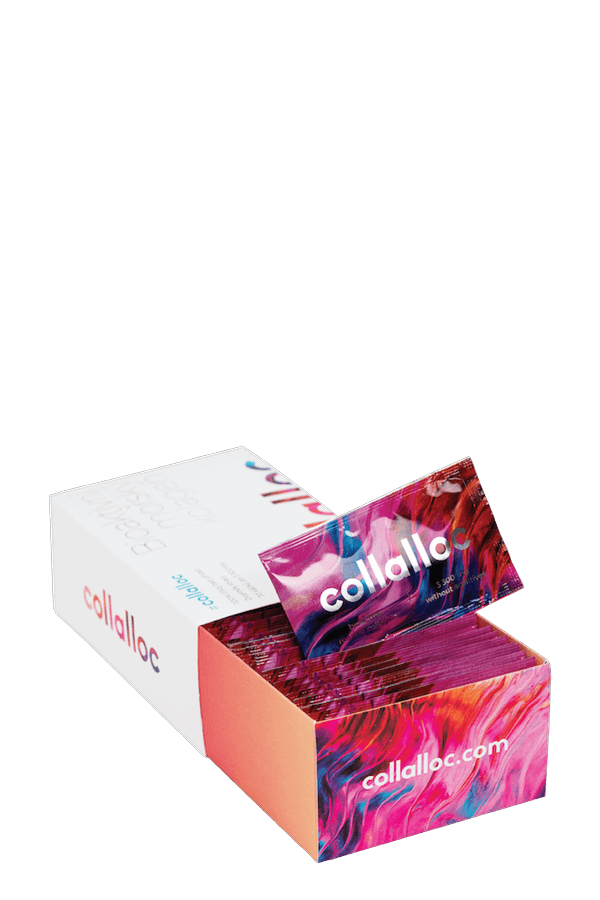
One sachet of collalloc kolagen contains 3,300 mg of hydrolysed marine collagen from North Sea fish with a molecular weight of around 500 Da. A pack contains 30 sachets of 3.3 g, one for each day, with no fillers, colourings or sweeteners. Stir a sachet into 200 ml of a cold or lukewarm drink up to 60 °C. The sachets do not contain vitamin C.
Frequently asked questions
When should I start taking collagen if I want to judge the result in summer?
Roughly 2 to 3 months ahead, that is, between March and May. Randomised studies on skin usually lasted 8 to 12 weeks (Proksch et al., 2014; Asserin et al., 2015). Spring itself has no special effect: it is only about the length of use.
When to take collagen: morning or evening?
We found no study comparing taking it in the morning and in the evening, so the time of day does not seem to matter. Taking it every day matters more: in studies, people took 2.5 to 10 g of collagen hydrolysate a day for 8 to 24 weeks (Choi et al., 2019).
When does collagen start to work?
A definite result cannot be promised. In studies, the first measured changes appeared after 4 weeks and skin hydration increased after 8 weeks (Asserin et al., 2015), and a meta-analysis of 19 studies speaks of 90 days of use in its conclusion (de Miranda et al., 2021). Independent and high-quality studies, however, did not measure any improvement in skin (Myung and Park, 2025).
Can I drink collagen with ice in summer?
Yes. A cold drink does not harm collagen. The limit works the other way round: the drink should not be warmer than 60 °C. Iced water, chilled tea, juice, milk or a smoothie are all fine.
Does collagen protect the skin from the sun?
No. A food supplement with collagen will not replace sunscreen, and we do not attribute UV protection to it. In a randomised study, people using sunscreen daily gained 24% fewer signs of skin ageing over 4.5 years than with occasional use (Hughes et al., 2013).
How can you restore collagen in the skin in summer?
The body makes the collagen in the skin itself. In summer, the most important thing is to limit UV radiation, which triggers enzymes that break down collagen: after a single exposure, the breakdown of collagen fibres was 58% higher (Fisher et al., 1997). Daily sunscreen helps, applied in a sufficient layer and a second time within an hour (Petersen and Wulf, 2014).
Sources
- Oral supplementation of specific collagen peptides has beneficial effects on human skin physiology: a double-blind, placebo-controlled study Proksch E., Segger D., Degwert J., Schunck M., Zague V., Oesser S., Skin Pharmacology and Physiology, 2014
- The effect of oral collagen peptide supplementation on skin moisture and the dermal collagen network: evidence from an ex vivo model and randomized, placebo-controlled clinical trials Asserin J., Lati E., Shioya T., Prawitt J., Journal of Cosmetic Dermatology, 2015
- Effects of hydrolyzed collagen supplementation on skin aging: a systematic review and meta-analysis de Miranda R. B., Weimer P., Rossi R. C., International Journal of Dermatology, 2021
- Oral Collagen Supplementation: A Systematic Review of Dermatological Applications Choi F. D., Sung C. T., Juhasz M. L., Mesinkovsk N. A., Journal of Drugs in Dermatology, 2019
- Effects of Oral Collagen for Skin Anti-Aging: A Systematic Review and Meta-Analysis Pu S. Y., Huang Y. L., Pu C. M., Kang Y. N., Hoang K. D., Chen K. H., Nutrients, 2023
- Effects of Collagen Supplements on Skin Aging: A Systematic Review and Meta-Analysis of Randomized Controlled Trials Myung S. K., Park Y., The American Journal of Medicine, 2025
- Sunscreen and prevention of skin aging: a randomized trial Hughes M. C., Williams G. M., Baker P., Green A. C., Annals of Internal Medicine, 2013
- Pathophysiology of premature skin aging induced by ultraviolet light Fisher G. J., Wang Z. Q., Datta S. C., Varani J., Kang S., Voorhees J. J., The New England Journal of Medicine, 1997
- Application of sunscreen--theory and reality Petersen B., Wulf H. C., Photodermatology, Photoimmunology & Photomedicine, 2014