MagazineWhat is collagen and what does it do in the body? Series introduction
What is collagen and what does it do in the body? Series introduction
What is collagen and what does it do? The most abundant protein in skin, tendons and bone, 28 types, why it declines with age, what studies say on supplements.

Short answer: collagen is the most abundant protein in the mammalian body, or more precisely a family of 28 related proteins that give tissues strength and shape (Ricard-Blum, 2011). You will find it mainly in skin, tendons, ligaments, bones and cartilage. The body makes it itself, but less of it with age: fibroblasts from the skin of people over 80 produced 56 ng/ml of type I procollagen in the laboratory, while fibroblasts from people aged 18 to 29 produced 82 ng/ml (Varani et al., 2006). Scientists study collagen supplements mainly for the skin, and the results are not clear-cut: in a review of 23 studies, only company-funded studies measured an improvement (Myung and Park, 2025).
You may know collagen from creams, from the supplement shelves or from advertising. This article opens our series on collagen. In the first part, we explain what collagen is, where you find it in the body and how its production changes with age. We cover the types of collagen and the sources supplements are made from in detail in the second part: types and sources of collagen.
What collagen is: a protein made of three coiled chains
A collagen molecule is made up of three long protein chains that coil into a strong triple helix. For the chains to pack together like this, every third amino acid in the chain has to be glycine, and the chain also contains a lot of proline and hydroxyproline (Brodsky and Shah, 1995). All types of collagen have the triple helix, and scientists have described 28 of them so far (Ricard-Blum, 2011).
Collagen is laid down outside the cells, in what is known as the extracellular matrix. There, most types assemble into fibres and networks that give tissues strength, elasticity and shape (Ricard-Blum, 2011). In the skin, it is made by cells called fibroblasts (Varani et al., 2006).
Where collagen is found in the body
Collagen is the main structural protein of connective tissues. In all tissues except cartilage, type I makes up most of the collagen, accompanied by small amounts of type V (Wenstrup et al., 2004). In articular cartilage, collagen makes up two thirds of the dry weight, and type II predominates there (Eyre, 2002).
| Where | Main type | Role of collagen |
|---|---|---|
| Skin (dermis) | I | gives it strength |
| Tendons and ligaments | I | fibres bear tension |
| Bones | I | organic part of bone |
| Cartilage | II | 2/3 of dry weight |
In the body, collagen thus acts as scaffolding that holds tissues in place. It is most often discussed in connection with the skin, because skin contains a lot of it and its loss with age is well described.
How collagen production changes with age
The body continuously makes and breaks down collagen, but with age it makes less. Fibroblasts from the skin of people over 80 produced 56 ng/ml of type I procollagen, a precursor of collagen, in the laboratory, while fibroblasts from young people aged 18 to 29 produced 82 ng/ml. The authors see two causes: the ageing of the cells themselves and the fact that the surrounding tissue stretches them less mechanically (Varani et al., 2006).
In women, menopause plays a role. In a study of postmenopausal women, skin collagen and skin thickness decreased by 1 to 2% for every year since menopause (Brincat et al., 1987). So collagen production does not stop at a particular age but declines gradually.
Lifestyle also plays its part. In 47 smokers, production of type I collagen in the skin was 18% lower and of type III 22% lower than in 51 people who had never smoked (Knuutinen et al., 2002).
Losing collagen with age is a normal part of ageing. Collagen diseases are something else: changes in genes that disrupt the repeating structure of collagen cause a number of inherited disorders (Brodsky and Shah, 1995). These belong in the care of a doctor.
What research says about collagen supplements
Collagen supplements mostly contain hydrolysed collagen, that is, collagen broken down into short peptides. In the digestive tract, these are broken down further into amino acids and small peptides that are absorbed into the blood. Research on them focuses mainly on the skin. In a double-blind study, 69 women aged 35 to 55 took 2.5 g or 5 g of collagen peptides, or a placebo, every day for 8 weeks. Skin elasticity improved more in both collagen groups than with the placebo, the difference in skin moisture was not statistically significant, and no side effects occurred (Proksch et al., 2014).
One study is not enough, though. A meta-analysis of 23 randomised controlled trials with 1,474 participants found improved hydration, elasticity and wrinkles when the studies were assessed together. However, when the authors divided the studies by funding, only those paid for by pharmaceutical companies showed an improvement. Independent studies measured no effect, and high-quality studies found no significant difference either (Myung and Park, 2025). The authors therefore conclude that evidence for using collagen against skin ageing is still lacking.
We summarise what research on collagen and skin shows so far on our Collagen for skin page.
Collagen in food and in food supplements
Only animal tissues contain collagen: skin, tendons, cartilage and bones. In food, you will therefore find it in bone broth, gelatine, fish or poultry skin and cartilage. Plants do not make collagen. You will find an overview of foods in the article Collagen-rich foods.
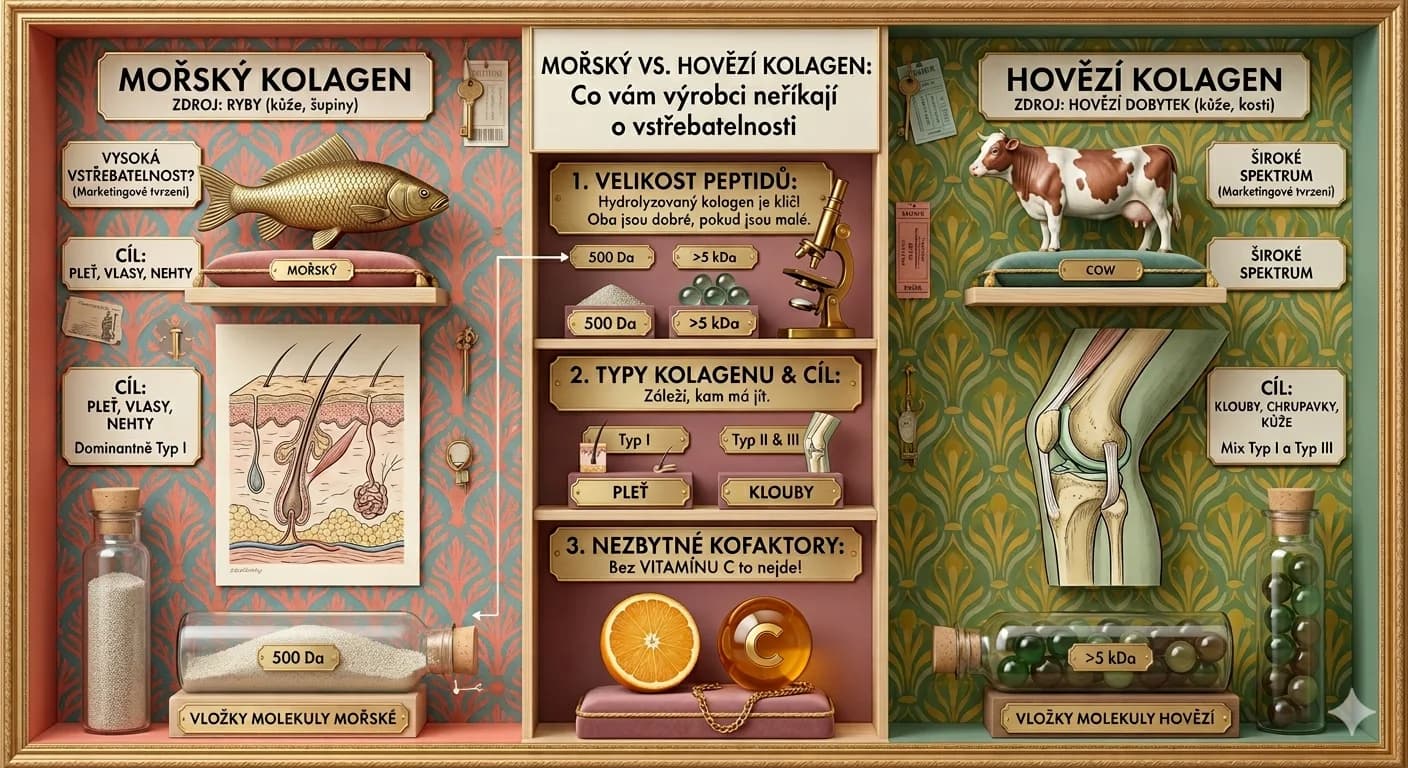
Food supplements are made from fish, from beef and pork, or from eggshell membranes. How these sources differ and which type of collagen predominates in them is described in the second part of the series. There you will also find out what happens to collagen in the digestive tract.
How we do it at collalloc
One sachet of collalloc kolagen contains 3,300 mg of hydrolysed marine collagen from North Sea fish, of which 2,640 mg is type I, 644 mg type II and 16 mg type III. The raw material is hydrolysed in Switzerland into peptides with a molecular weight of around 500 Da. Stir the sachet into 200 ml of a cold or lukewarm drink up to 60 °C. It contains no fillers, colourings, sweeteners or vitamin C. If you want collagen with vitamin C, there is the liquid NANO 2.0: 1 ml contains 700 mg of marine collagen and 80 mg of vitamin C. Vitamin C contributes to normal collagen formation for the normal function of skin. We test microbiology in every batch and heavy metals every month. Because the collagen comes from fish, it is not suitable if you have a fish allergy.
Frequently asked questions
What is collagen?
Collagen is the most abundant protein in the mammalian body, or more precisely a family of 28 related proteins (Ricard-Blum, 2011). Its molecule consists of three chains coiled into a triple helix, in which every third amino acid is glycine (Brodsky and Shah, 1995). It gives strength and shape to skin, tendons, ligaments, bones and cartilage.
What does collagen do in the body?
It serves as the structural scaffolding of connective tissues. In all tissues except cartilage, type I predominates (Wenstrup et al., 2004), and in articular cartilage collagen makes up two thirds of the dry weight (Eyre, 2002).
How many types of collagen are there?
Scientists have described 28 types of collagen (Ricard-Blum, 2011). Type I is the most common in the body, while cartilage is made mainly of type II (Eyre, 2002). We discuss types I, II and III and their sources in the second part of the series.
What are the signs of collagen deficiency?
Losing collagen with age is natural: fibroblasts from the skin of people over 80 produced 56 ng/ml of type I procollagen, those from people aged 18 to 29 produced 82 ng/ml (Varani et al., 2006). In postmenopausal women, skin collagen and skin thickness decreased by 1 to 2% a year (Brincat et al., 1987). Inherited disorders of collagen structure are rare diseases that belong in the care of a doctor (Brodsky and Shah, 1995).
What contains collagen?
Only animal tissues: skin, tendons, cartilage and bones. In food, it is found in bone broth, gelatine, fish and poultry skin or cartilage. In articular cartilage, collagen makes up two thirds of the dry weight (Eyre, 2002), while plants do not make it at all.
Is it worth taking collagen as a food supplement?
Research focuses mainly on the skin. In a study of 69 women, skin elasticity improved compared with placebo after 8 weeks of 2.5 g or 5 g of collagen a day (Proksch et al., 2014). However, a meta-analysis of 23 studies found an improvement only in studies funded by companies (Myung and Park, 2025), so no one can promise a result.
Sources
- The collagen family Ricard-Blum S., Cold Spring Harbor Perspectives in Biology, 2011
- Protein motifs. 8. The triple-helix motif in proteins Brodsky B., Shah N. K., The FASEB Journal, 1995
- Type V collagen controls the initiation of collagen fibril assembly Wenstrup R. J., Florer J. B., Brunskill E. W., Bell S. M., Chervoneva I., Birk D. E., Journal of Biological Chemistry, 2004
- Collagen of articular cartilage Eyre D., Arthritis Research, 2002
- Decreased collagen production in chronologically aged skin: roles of age-dependent alteration in fibroblast function and defective mechanical stimulation Varani J., Dame M. K., Rittie L., Fligiel S. E., Kang S., Fisher G. J., The American Journal of Pathology, 2006
- A study of the decrease of skin collagen content, skin thickness, and bone mass in the postmenopausal woman Brincat M., Kabalan S., Studd J. W., Moniz C. F., de Trafford J., Montgomery J., Obstetrics and Gynecology, 1987
- Smoking affects collagen synthesis and extracellular matrix turnover in human skin Knuutinen A., Kokkonen N., Risteli J., Vähäkangas K., Kallioinen M., Salo T., British Journal of Dermatology, 2002
- Oral supplementation of specific collagen peptides has beneficial effects on human skin physiology: a double-blind, placebo-controlled study Proksch E., Segger D., Degwert J., Schunck M., Zague V., Oesser S., Skin Pharmacology and Physiology, 2014
- Effects of Collagen Supplements on Skin Aging: A Systematic Review and Meta-Analysis of Randomized Controlled Trials Myung S. K., Park Y., The American Journal of Medicine, 2025