Magazinecollalloc: the Czech collagen brand that became a ritual
collalloc: the Czech collagen brand that became a ritual
What is collalloc? A Czech brand of marine collagen and functional mushrooms, founded in 2016. Founder Záviš Lacina on the garage beginnings, raw material and name.

Short answer: collalloc is a Czech food supplement brand founded in 2016 by Záviš Lacina. It makes marine collagen from North Sea fish, hydrolysed in Switzerland into peptides with a molecular weight of around 500 Da, and a supplement with functional mushrooms. The range includes collagen in sachets with 3,300 mg of collagen per daily dose, the liquid collagen NANO 2.0, MIND capsules with four mushrooms and Vitamin C powder. collalloc offers them as a daily ritual.
How collalloc entered the market
Ten years ago, when collalloc was entering the market, it looked like a battle between David and Goliath. While pharmaceutical corporations were churning out giant tablets tasting of chemical strawberry, a small company was packing pure marine powder in a garage, and, what is more, deliberately without any unnecessary marketing fluff. In an interview for HROT magazine (issue 3, March 2026, pp. 104 to 105), founder Záviš Lacina explains why they decided to bet on purity and honesty, and why, instead of Paris, they are now conquering wild markets in Indonesia or Ethiopia. We have edited the interview slightly for the web.
HROT: You entered a market for collagen products that has been around for decades. What made you different?
Záviš Lacina: We came in like someone who arrives at a party at midnight but brings the best drinks. While others bet on giant tablets that you swallow like horse doses, we bet on purity. No colourings, no flavours like “chemical strawberry”, and above all no marketing fluff. We simply told ourselves that we would not pull the wool over people’s eyes; we would rather pour them some proper collagen.
HROT: How did you come up with marine collagen in particular?
Záviš Lacina: You know, trying to convince a cow to give you the finest collagen is a long-distance run. Fish are much more accommodating in this respect. Marine collagen won us over right from the start. Besides, we wanted something that did not smell of factory farming, but rather of a refreshing ocean breeze (without the fishy smell, of course).
Where the raw material comes from
HROT: Where do you actually get the collagen from?
Záviš Lacina: Our collagen comes from the clean waters of the North Sea. They are basically fish that had a better view of the northern lights than most of us on holiday. We obtain it sustainably from fish scales and skin, which is a great example of “upcycling”. What used to be thrown away is now part of many people’s morning ritual.
Who collalloc is for
HROT: Who are your products meant for? Who is your typical customer?
Záviš Lacina: Our typical customer is a woman over thirty who has already found out that the morning “beauty sleep” is starting to have an ever shorter shelf life. They are ladies who want to look beautiful and young, but at the same time already have enough sense not to believe in magic wands. Our customers are active women who know that investing in themselves is much safer than investing in cryptocurrencies. Because here it is about a daily moment for yourself, not a curve on a chart. We are here for every woman who wants to age gracefully, but is certainly in no hurry about it.
Ten years since the garage
HROT: What was it like to make your way in the food supplement business? After all, it is a field with some very big players.
Záviš Lacina: The big players have budgets you could build a small village with, but we had agility and a personal approach. While corporations were approving the colour of a logo in fifteen meetings, we were already packing boxes in the garage. Our strategy was: Be so good they cannot ignore you. And we also had more coffee than they did.
HROT: This year collalloc celebrates ten years. What have you achieved in that time? Have the ideas you had at the beginning come true?
Záviš Lacina: Ten years ago my idea was “survive the first month”. So yes, it has exceeded everything. We have managed to create a brand that is not just a product but, for many, a morning ritual. We are not on Mars yet (Elon has not contacted us so far), but the fact that people recommend us to others is the best satisfaction.
Where the brand is heading
HROT: And what are you planning for the coming years? What about expanding abroad?
Záviš Lacina: Originally we thought we would storm the West with our products and Parisian women would forget their local brands. But we quickly found out that in this respect the West is a bit like a closed VIP club. The competition there is dense, habits are set in concrete, and they sometimes look at us from the East as if we were cooking the collagen in a cauldron in the garden. So we turned the helm and set off east. Indonesia, Ethiopia, India, that is our territory now. It is a bit like the 20s of the last century there. Wild, unexplored and full of incredible energy. Business there sometimes resembles an adventure film more than an Excel spreadsheet, but the hunger for quality is huge. So our future? Right now it is bathed in Asian sunshine. And who knows, maybe we will come back to the West from this “wilderness” by a roundabout route as global predators.
Where the name collalloc comes from
HROT: Judging by the name of your brand, you seem to be a fan of a certain old Czech film, right?
Záviš Lacina: Bullseye! Yes, Lemonade Joe would be pleased with us. But the name is actually a little linguistic puzzle. The first part, “colla”, clearly refers to collagen. And “lloc” is, figuratively, our Czech “lok”, a sip. Because we believe one sip a day is enough for happiness. And for lovers of riddles we have one more bonus: collalloc is a pure-bred palindrome. So even if you take it in the morning after a heavy night and see the world a little backwards, our brand will still look just as great. It reads the same from the front and from the back, which is a metaphor for our wish to make a clean product with no hidden “back side” and no catches.
Who is behind the brand
HROT: By the way, how did you get into this kind of business? What is your career background?
Záviš Lacina: I have worked in various fields, but I have always enjoyed creating things that make sense and have a tangible result. I was led to food supplements by my own experience and a bit of entrepreneurial cheek to see a gap where others saw only “another powder”. I am proof that if you enjoy something and are not too lazy to break a little sweat over it, you can build something that people really enjoy using.
What collalloc makes today
| Product | Form | Daily dose |
|---|---|---|
| collalloc kolagen | 30 sachets | 3,300 mg collagen |
| NANO 2.0 | liquid, 1 ml | 700 mg collagen, 80 mg vitamin C |
| MIND | 120 capsules | 4 mushrooms, 600 mg each |
| Vitamin C | powder, 60 g | 100 mg |
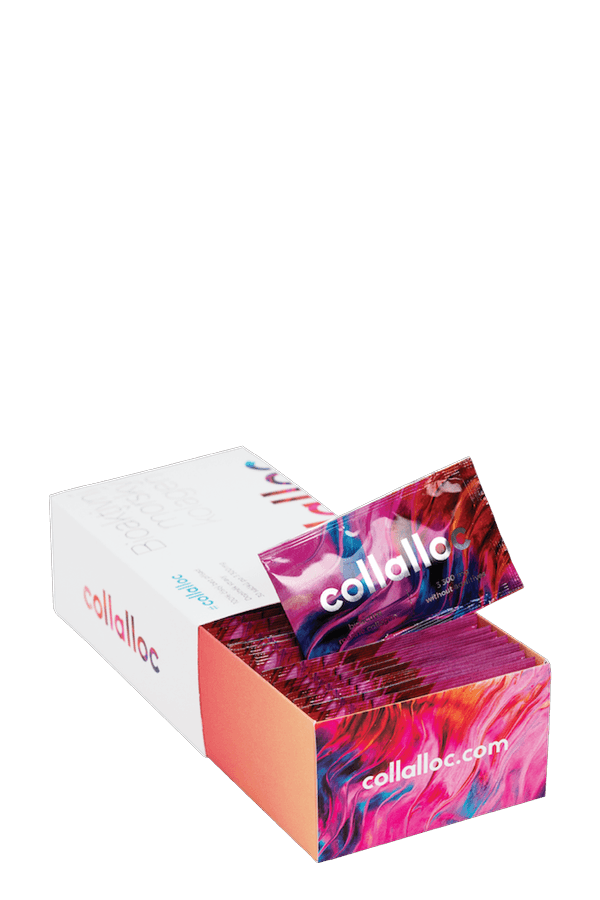
The sachets contain only marine collagen types I, II and III, with no fillers, colourings or sweeteners and no vitamin C. The contents of a sachet are stirred into 200 ml of a cold or lukewarm drink up to 60 °C. The liquid NANO 2.0 is not mixed; it is taken as 1 ml a day and contains vitamin C. Vitamin C contributes to normal collagen formation for the normal function of skin. The collalloc MIND capsules contain extracts of four functional mushrooms, Lion’s Mane, Cordyceps, Chaga and Maitake, in organic (BIO) quality and caffeine free. The daily dose is 4 capsules. MIND is a daily ritual, not a medicine or a nootropic.
What research says about marine collagen
After you drink it, collagen is broken down and short peptides reach the blood. In a Japanese study, healthy volunteers drank 9.4 to 23 g of gelatin hydrolysate, in other words broken-down collagen, and peptides containing hydroxyproline peaked in their blood after 1 to 2 hours. Most of them were the dipeptide Pro-Hyp (Iwai et al., 2005). In a smaller study with five men, there was more hydroxyproline in the blood overall after a hydrolysate from fish scales than after a hydrolysate from pig skin (Ohara et al., 2007). These are measurements in the blood, not an effect on the skin, and neither study tested collalloc.
For skin, the results are mixed. In a double-blind study with 69 women aged 35 to 55, measured skin elasticity improved compared with placebo after 8 weeks of taking 2.5 or 5 g of collagen hydrolysate a day (Proksch et al., 2014). A meta-analysis of 19 studies with 1,125 participants found favourable results for hydration, elasticity and wrinkles (de Miranda et al., 2021). However, a newer meta-analysis of 23 randomised studies with 1,474 participants found an improvement only in studies funded by manufacturers; independent, high-quality studies did not measure one (Myung and Park, 2025). You can find details in the article Marine collagen and skin: what science really says.
How collalloc is tested
Microbiology is tested in every production batch, heavy metals every month. What exactly is measured and against which limits, we show on the Laboratory page.
Frequently asked questions
Who is behind the collalloc brand?
Behind the brand is its founder, Záviš Lacina, who founded collalloc in 2016. In an interview for HROT magazine (issue 3, March 2026), he says he has worked in various fields and that his own experience led him to food supplements. The beginnings were modest; the boxes were packed in a garage.
Where does collalloc collagen come from?
collalloc collagen comes from North Sea fish, and the raw material is hydrolysed in Switzerland into peptides with a molecular weight of around 500 Da. According to the founder, it is obtained from fish scales and skin, in other words from parts of the fish that would otherwise be thrown away.
How is collalloc tested?
Microbiology is tested in every production batch and heavy metals every month. The results and the limits they are compared against are on the Laboratory page at collalloc.com.
Where can I buy collalloc?
You can buy the collagen in sachets, the liquid NANO 2.0, MIND and Vitamin C in the online shop at collalloc.com, where each product has its own page with ingredients and dosage. Customer service at collalloc@collalloc.com will help with any questions.
How is collalloc collagen different from others?
A sachet contains only marine collagen types I, II and III, 3,300 mg per dose, with no fillers, colourings or sweeteners. It is hydrolysed into short peptides of around 500 Da; peptides containing hydroxyproline, mainly Pro-Hyp, can be measured in the blood after drinking collagen hydrolysate (Iwai et al., 2005).
How do I start with collalloc collagen?
Stir one sachet a day into 200 ml of a cold or lukewarm drink, at most 60 °C. Studies focused on skin gave 2.5 to 10 g of collagen hydrolysate a day for 8 to 24 weeks (Choi et al., 2019), so it makes sense to take collagen regularly and not to judge it after a few days. Marine collagen comes from fish, so it is not suitable if you have a fish allergy.
Sources
- Identification of food-derived collagen peptides in human blood after oral ingestion of gelatin hydrolysates Iwai K., Hasegawa T., Taguchi Y., Morimatsu F., Sato K., Nakamura Y., Journal of Agricultural and Food Chemistry, 2005
- Comparison of quantity and structures of hydroxyproline-containing peptides in human blood after oral ingestion of gelatin hydrolysates from different sources Ohara H., Matsumoto H., Ito K., Iwai K., Sato K., Journal of Agricultural and Food Chemistry, 2007
- Oral supplementation of specific collagen peptides has beneficial effects on human skin physiology: a double-blind, placebo-controlled study Proksch E., Segger D., Degwert J., Schunck M., Zague V., Oesser S., Skin Pharmacology and Physiology, 2014
- Effects of hydrolyzed collagen supplementation on skin aging: a systematic review and meta-analysis de Miranda R. B., Weimer P., Rossi R. C., International Journal of Dermatology, 2021
- Effects of Collagen Supplements on Skin Aging: A Systematic Review and Meta-Analysis of Randomized Controlled Trials Myung S. K., Park Y., The American Journal of Medicine, 2025
- Oral Collagen Supplementation: A Systematic Review of Dermatological Applications Choi F. D., Sung C. T., Juhasz M. L., Mesinkovsk N. A., Journal of Drugs in Dermatology, 2019