MagazineCollagen and menopause: skin after fifty and what studies say
Collagen and menopause: skin after fifty and what studies say
Collagen after menopause and 50: why skin loses it, what studies in women 45 to 65 found, how much protein to eat, what to check on labels, when to see a doctor.

Short answer: after menopause, oestrogen falls and the skin loses collagen faster. Measurements show a decline of roughly 1 to 2% a year (Brincat et al., 1987). Collagen taken by mouth will not replace oestrogen. In a study of 114 women aged 45 to 65, however, the volume of wrinkles around the eyes decreased compared with placebo after 8 weeks of taking 2.5 g of collagen peptides a day (Proksch et al., 2014b). After fifty and after sixty, it is just as important to eat enough protein and to choose a product by its label, not by its promises.
What happens to collagen in the skin after menopause
Oestrogen influences collagen production in the skin as well as its thickness and hydration. After menopause, its level drops and the skin tends to be thinner, drier and less elastic, and wrinkles deepen (Thornton, 2013).
How much collagen is lost was measured mainly by smaller studies from the 1980s and 1990s. Brincat et al. (1987) found that skin collagen content and skin thickness fell after menopause by roughly 1 to 2% a year. A review gives an estimate that up to 30% of type I and III collagen may be lost in the first five years after menopause, and that the loss is linked more to how many years have passed since menopause than to age itself (Thornton, 2013). Treat the numbers as an order of magnitude, not as an exact forecast for your skin.
What studies in middle-aged and older women showed
The research asks whether collagen peptides from food can influence the properties of the skin, not whether they will replace hormones.
| Study | Who took what | Result | What to keep in mind |
|---|---|---|---|
| Proksch et al., 2014a | 69 women aged 35 to 55, 2.5 or 5 g of collagen hydrolysate a day for 8 weeks | Skin elasticity improved compared with placebo at both doses, and in older women it stayed higher even 4 weeks after stopping | Hydration improved only in a subgroup and without statistical significance |
| Proksch et al., 2014b | 114 women aged 45 to 65, 2.5 g of collagen peptides a day for 8 weeks | The volume of wrinkles around the eyes decreased by 20% compared with placebo, and the skin contained more type I procollagen | One specific raw material, so the result cannot be applied to every collagen |
| Pu et al., 2023 | Meta-analysis of 26 randomised studies with 1,721 participants | Skin hydration and elasticity improved compared with placebo | The authors point to bias in the studies and call for larger studies |
In short: the results are promising, but the studies were short and examined specific raw materials. In addition, some of the women aged 45 to 65 have not yet reached menopause, and women over 65 were not included in the Proksch et al. studies. No study has shown that collagen returns the skin to its state before menopause.
Collagen after fifty: protein is the foundation
With age, the body needs more protein. The PROT-AGE expert group recommends that people over 65 get at least 1.0 to 1.2 g of protein per kilogram of body weight a day, together with regular exercise including strength training. For a seventy-year-old woman weighing 65 kg, that comes to roughly 65 to 78 g a day (Bauer et al., 2013). The exception is people with serious kidney disease, who may instead need to limit protein. In that case, the doctor decides.
Collagen counts towards this amount only in part. It lacks the essential amino acid tryptophan and is therefore an incomplete protein (Paul et al., 2019). Fish, meat, eggs, dairy products and pulses remain the foundation. Collagen is a supplement, not a replacement for food.
What to check on the label
| On the label | Why it matters | collalloc kolagen |
|---|---|---|
| Hydrolysed collagen, collagen peptides | The studies above examined collagen hydrolysates and peptides | Hydrolysed marine collagen |
| Molecular weight | It tells you how small the peptides are. A reputable manufacturer will state it | Around 500 Da |
| Dose in grams per day | Compare it with the doses in the studies, that is 2.5 to 5 g (Proksch et al., 2014a) | 3.3 g in one sachet |
| Source | Marine collagen comes from fish and is not suitable if you are allergic to fish | Fish |
| Added substances | With combination products, check the vitamins and herbs, especially if you take medication | No sweeteners, colourings or flavourings |
| Lab tests | For marine collagen, ask about heavy metals and microbiology | Microbiology for every production batch, heavy metals every month in an external laboratory |
You will find the test results on the product page and on the Laboratory page.
How to take collagen
- One dose every day. For collalloc, one sachet (3.3 g).
- In a cold or lukewarm drink, no hotter than 60 °C. In water, juice, milk or a smoothie.
- For at least 8 weeks. That is how long the Proksch et al. studies lasted. Judge any change by photos taken in the same light.
- Together with a varied diet and sun protection. Collagen will not replace a cream with a UV filter.
Collagen in a cream moisturises the skin on the surface, but it does not reach the dermis.
When to talk to a doctor
Collagen is a food supplement, not a treatment for menopause. Talk to your gynaecologist or GP if:
- you suffer from hot flushes, poor sleep or mood swings and are considering hormone replacement therapy (HRT). Whether it is suitable for you will be judged by your doctor based on your overall health, not your skin.
- you are dealing with your bones and their density. That belongs with a doctor, and this article does not cover bones.
- you have kidney disease, a tendency to kidney stones, a fish allergy or you take medication regularly. You will find details in our article Side effects of collagen.
- bleeding reappears after menopause or you notice a mole on your skin that is changing.
How we do it at collalloc
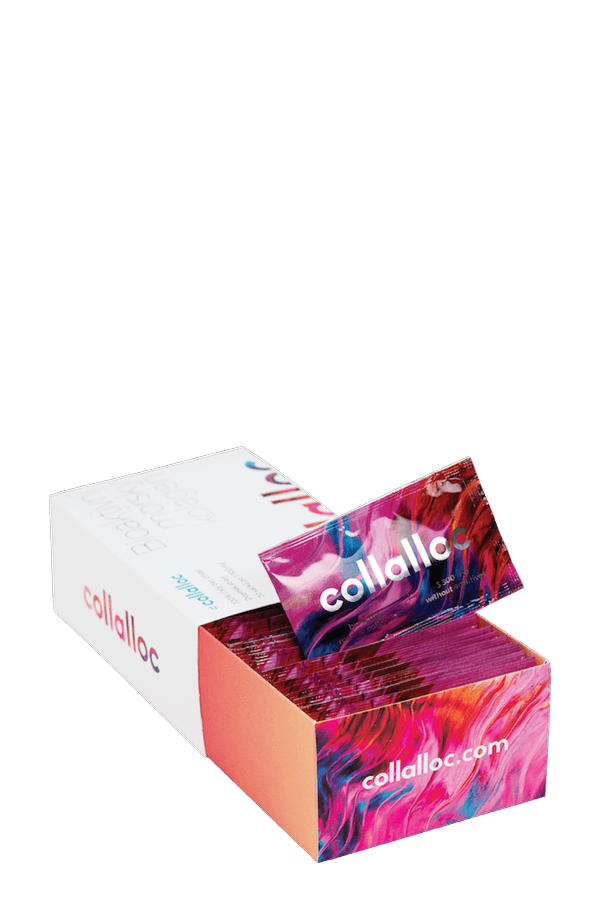
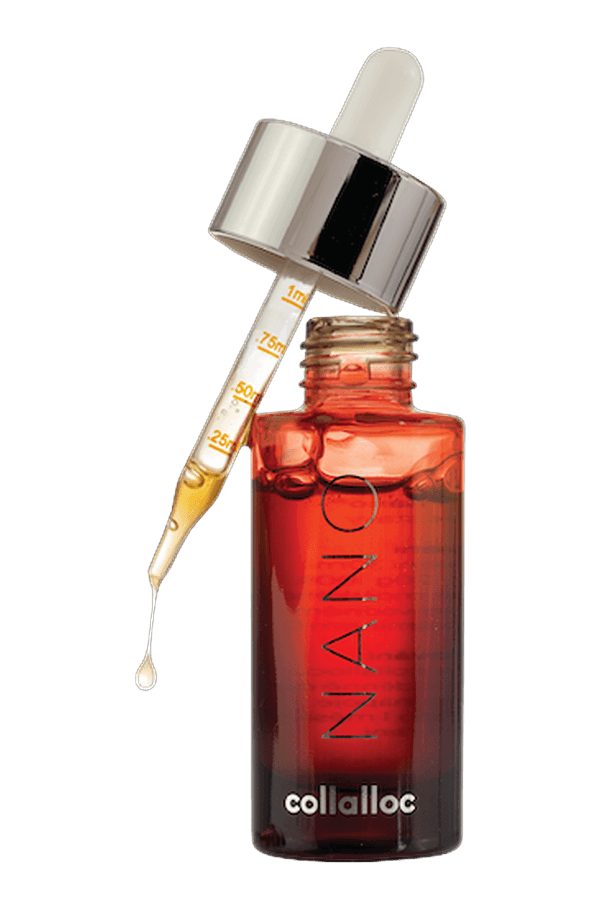
collalloc kolagen is hydrolysed marine collagen with a molecular weight of around 500 Da, with no sweeteners, colourings or flavourings. If you do not want to mix anything, you can reach for the liquid NANO 2.0 with vitamin C. Vitamin C contributes to normal collagen formation for the normal function of skin. You will find more about collagen and skin on the Collagen for skin page, how to choose by age in our article How to choose a collagen supplement by age and general advice in our article How to take collagen correctly.
Frequently asked questions
Does it make sense to take collagen after menopause?
It can be a sensible supplement, not a replacement for hormones or diet. In a study of 114 women aged 45 to 65, the volume of wrinkles around the eyes decreased compared with placebo after 8 weeks of taking collagen peptides (Proksch et al., 2014b). The studies, however, are short and examined specific raw materials.
Which collagen is best for women over fifty?
There is no single best one. Look for hydrolysed collagen with a stated molecular weight, a dose in grams comparable to the studies (2.5 to 5 g a day, Proksch et al., 2014a), a short ingredient list and published test results. The same rules apply after sixty.
After menopause, is bovine or marine collagen better?
Strong evidence for one source is lacking. In a meta-analysis of 26 studies, the effect on skin elasticity did not differ statistically significantly between collagen sources, while for hydration the results varied by source and length of use (Pu et al., 2023). If you are allergic to fish, do not take marine collagen.
Does collagen raise oestrogen levels?
Collagen is a protein, not a hormone, and we have no evidence that it raises oestrogen levels. It does not replace hormone therapy. Whether that is suitable for you is for your gynaecologist to judge.
How long before a change in the skin may show?
The Proksch et al. studies assessed the skin after 8 weeks of daily use. There is no point judging the result earlier, and it is best to do so using photos taken in the same light.
When should you talk to a doctor about taking collagen?
If you have kidney disease or a tendency to kidney stones, a fish allergy, take medication regularly, or are dealing with hormone therapy or your bones. Collagen is a food supplement, not a treatment for menopause.
Sources
- Estrogens and aging skin Thornton M. J., Dermato-Endocrinology, 2013
- A study of the decrease of skin collagen content, skin thickness, and bone mass in the postmenopausal woman Brincat M., Kabalan S., Studd J. W., Moniz C. F., de Trafford J., Montgomery J., Obstetrics & Gynecology, 1987
- Oral supplementation of specific collagen peptides has beneficial effects on human skin physiology: a double-blind, placebo-controlled study Proksch E., Segger D., Degwert J., Schunck M., Zague V., Oesser S., Skin Pharmacology and Physiology, 2014
- Oral intake of specific bioactive collagen peptides reduces skin wrinkles and increases dermal matrix synthesis Proksch E., Schunck M., Zague V., Segger D., Degwert J., Oesser S., Skin Pharmacology and Physiology, 2014
- Effects of Oral Collagen for Skin Anti-Aging: A Systematic Review and Meta-Analysis Pu S. Y., Huang Y. L., Pu C. M., Kang Y. N., Hoang K. D., Chen K. H., Chen C., Nutrients, 2023
- Evidence-based recommendations for optimal dietary protein intake in older people: a position paper from the PROT-AGE Study Group Bauer J., Biolo G., Cederholm T., Cesari M., Cruz-Jentoft A. J., Morley J. E. et al., Journal of the American Medical Directors Association, 2013
- Significant Amounts of Functional Collagen Peptides Can Be Incorporated in the Diet While Maintaining Indispensable Amino Acid Balance Paul C., Leser S., Oesser S., Nutrients, 2019
- Commission Regulation (EU) No 432/2012 establishing a list of permitted health claims made on foods European Commission, Official Journal of the European Union, 2012